

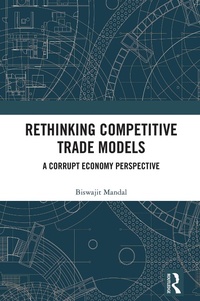
Rethinking Competitive Trade Models
A Corrupt Economy Perspective
Published on 17. February 2026
146 pages
978-1-040-85056-5 (ISBN)
Description

This book presents competitive trade models to recast them from the perspective of an economy which is beset with corruption and related intermediation that requires some sort of cost. It innovatively transforms traditional models (HOSV, SFM, HO nugget) by treating intermediation as a distinct economic sector that consumes factors of production.
Through rigorous general equilibrium analysis, it also discusses real life events such as trade liberalization, capital inflow, labor immobility, extortion, etc. It is unquestionably an exciting approach to paving the way for future research around trade and development in competitive trade models befitting developing economies where ramifications of corruption and related damages are pervasive.
This book will be of interest to researchers, faculty members, and policy makers working with international trade theory and policy, development economics and labour economics.
Through rigorous general equilibrium analysis, it also discusses real life events such as trade liberalization, capital inflow, labor immobility, extortion, etc. It is unquestionably an exciting approach to paving the way for future research around trade and development in competitive trade models befitting developing economies where ramifications of corruption and related damages are pervasive.
This book will be of interest to researchers, faculty members, and policy makers working with international trade theory and policy, development economics and labour economics.
Reviews / Votes
'In this masterpiece, Professor Biswajit Mandal, with his expertise in international trade and development economics, proves that the small-scale analytical general equilibrium (AGE) models can offer deeper insights into the real social phenomena, such as corruption, than the more fashionable large-scale computer-based quantitative general equilibrium (CGE) models. I highly recommend Professor Mandal's new book not only to scholars interested in the workings of corrupt economies but also to younger researchers eager to master the techniques for constructing and manipulating small-scale yet powerful AGE models.'- Noritsugu Nakanishi, Professor of International Economics, Graduate School of Economics, Kobe University, Japan, Advisor/Former President of the Japan Society of International Economics.
'This book provides a compelling study of competitive trade theory that incorporates corruption-related transaction costs, an overlooked aspect in conventional economic models. With a strong foundation in neoclassical trade theory, Professor Mandal skillfully integrates standard trade theory frameworks with institutional deficiencies that are rampant in developing countries. A must-read for scholars and policymakers interested in the evolving dynamics of trade and economic development in imperfect institutional settings.'
- Reza Oladi, Professor of Economics, Utah State University, USA
'Biswajit Mandal presents a groundbreaking recast of competitive trade models through the lens of corruption and intermediation, providing a new perspective on transaction costs in global trade. With rigorous theoretical frameworks, the book bridges classical models with the complexities of the real world, making it an essential resource for advanced students and researchers. Additionally, Mandal pays tribute to Professor Ronald W. Jones and his profound insights into informal economies, enhancing this work's significance as a critical contribution to international trade literature.'
- Akihiko Yanase, Professor of Economics, Nagoya University, Nagoya, Japan
More details
Language
English
Place of publication
London
United Kingdom
Publishing group
Taylor & Francis Ltd
Target group
College/higher education
Professional and scholarly
Product notice
Reflowable
Illustrations
1 Tables, black and white; 16 Line drawings, black and white; 16 Illustrations, black and white
File size
1,79 MB
ISBN-13
978-1-040-85056-5 (9781040850565)
Copyright in bibliographic data and cover images is held by Nielsen Book Services Limited or by the publishers or by their respective licensors: all rights reserved.
Schweitzer Classification
Other editions
Additional editions
Book
approx. 02/2026
1st Edition
Routledge
€210.70
Not yet published
Person
Biswajit Mandal, Professor of Economics at CSSSC, has taught at Visva-Bharati, Soka University (Japan), and several Indian institutions. A JSPS and C.V. Raman Fellow, his research spans International Trade, Development, and Health Economics. Widely published in reputed international journals, he serves as Associate Editor of South Asian Journal of Macroeconomics and Public Finance and contributes op-eds to leading dailies.
Content
List of Figures. List of Tables. Foreword. Preface. 1. Introduction 2. A Brief Backdrop 3. Transaction Costs of Corruption in Pure Theory of International Trade 4. Trade Reform and Intermediation 5. Traded Goods, Tax and Intermediation - the Role of Corrupt Non-traded Sector 6. Extortion and Informal Sector in a Competitive Trade Model 7. Migration, Informality, and Extortion in a Small Country Trade Model 8. Recessionary Shock and the Informal Sector - Implication for Intermediation 9. Conclusion. References. Index
