

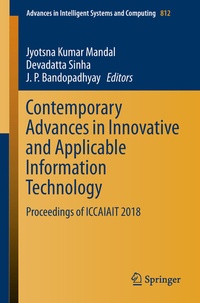
Contemporary Advances in Innovative and Applicable Information Technology
Description

More details
Other editions
Additional editions
Persons
Prof Dr. Devadatta Sinha graduated from Presidency College with Mathematics Honours and did his post graduation in Applied Mathematics and then in Computer Science. He did his Ph.D in the field of Computer Science from Jadavpur University in 1985. He started his teaching career at the Dept. of Computer Engineering at BIT Mesra Ranchi, then at Jadavpur University and at Calcutta University from where he retired as Professor at the Department of Computer Science and Engineering. He also served as Head of the Department of Computer Science and Engineering. He also served as Convener, Ph.D. Committee in Computer Science and Engineering and in Information Technology at University of Calcutta .He also served as Vice-Chairman, Research Committee in Computer Science and Engineering ,West Bengal University of Technology.During his career, he has written a number of research papers in National and International Journals, Conference Proceedings. He has also written a number of expository articles in periodicals, books, monographs. His research interests include Software Engineering, Parallel and Distributed Algorithms, Bioinformatics, Computational Intelligence, Computer Education, Mathematical Ecology, Networking. He has guided Research students for Ph.D. in Computer Science and Engineering and M. Tech., B. Tech. and M.Sc. students for their dissertation. He has a total teaching /research experience of more than 38 years. He was also in the editorial boards of different journals.conference proceedings. He also served in different capacities in the Program Committees and Organising Committees of different National and International Conferences. He was .Sectional President, Section of Computer Science, Indian Science Congress Association during the year 1993-94. He is an active member of different academic bodies in different institutions He is a Fellow and Senior Life Member of CSI and has been involved in different activities including organization of different computer/IT courses since a long time. He is also adjudged Distinguished Speaker by Computer Society of India
Prof. Jyoti Prasad Bandyopadhyay is a former Professor and UGC Emeritus Fellow in the Institute of Radio Physics and Electronics, University of Calcutta. He is also the former Director of the centre of Millimeter wave Semiconductor Devices and Systems (CMSDS), University of Calcutta. He has a long and successful teaching and research career of about four decades in the Institute of Radio Physics and Electronics, University of Calcutta. His research interest covers Semiconductor Microwave and Terahertz devices as well as Photonic and Quantum effect devices. He has published 184 research articles in peer reviewed journals, several of which are highly cited. He has authored 5 text books in the field of Electronics and Telecommunication Engineering for UG and PG students, some of which are recommended in the prescribed syllabus of various Indian Universities as text books. He was the Principal investigator of several R&D projects funded by DRDO, MIT, AICTE, CSIR, UGC, DST and DOE in the field of microwave and millimetre wave semiconductor devices in the University of Calcutta. He has supervised the PhD theses of large number of students of Calcutta University for their doctoral degrees. He was honoured several times to deliver invited talks in various research seminars, symposia and conferences held in India and abroad in the area of his teaching and research expertise. He also chaired the technical sessions of various International conferences. Dr. Bandyopadhyay has been serving the cause of higher education , both teaching and research by participating in PhD committees and Board of higher studies as an external expert member of different Premier Institutes in India.
Content
Part 1.Computational Intelligence.- Chapter 1.A Hierarchical Image Cryptosystem Based on Visual Cryptography and Vector Quantization.- Chapter 2.Intelligent Web Service Searching Using Inverted Index.- Chapter 3.Computational Intelligence based Neural Session Key Generation on E-Health System for Ischemic Heart Disease Information Sharing.- Part 2.Circuit System & Devices.- Chapter 4.Computation of Peak Tunneling Current Density in Resonant Tunneling Diode using Self-Consistency Technique.- Chapter 5.Computing Surface Potential and Drain Current in Nanometric Double-Gate MOSFET using Ortiz- Conde Model.- Chapter 6.Comparative Studies on the Performance Parameters of a P-channel Tunnel Field Effect Transistor using Graphene Nanoribbon as channel material with those using other channel materials for Low Power Digital application.- Chapter 7.Implementation of Toffoli Gate using LTEx Module of Quantum-Dot Cellular Automata.- Chapter 8.Study on localized surface plasmon to improvephotonic extinction in solar cell.- Chapter 9.Organic electricity from Zn/Cu-PKL electrochemical cell.- etc.
