

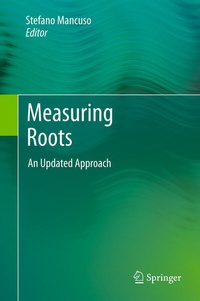
Measuring Roots
Description

Roots represent half of the plant body - and arguably the more interesting half. Despite its obvious importance for the whole plant, until recently our knowledge of the root apparatus was very limited, mostly due to the inadequacy of the techniques available. Recent advances in the visualization and measurement of roots have resulted in significant progress in our understanding of root architecture, growth and behaviour. In this book international experts highlight the most advanced techniques, both lab and field methods, and discuss them in detail. Measuring Roots combines academic and practical aspects of this topic, making it a universal handbook for all researchers and others interested in root-measuring methods.
Reviews / Votes
From the reviews:
"This book describes some remarkable methods, mostly of recent development, by which roots can be rendered more accessible, and measurable, than normally allowed by nature. Split into two sections covering lab and field applications, Measuring Roots: An Updated Approach describes a range of imaging and sensor techniques. . Examples of the kind of information that each technique can generate are presented in abundant images, many in colour. Anyone studying roots will find something interesting in this multi-author volume . ." (David Robinson, Experimental Agriculture, Vol. 48 (3), 2012)
More details
Other editions
Additional editions
Content
Higher Plants: Structural Diversity of Roots.- Electrical Impedance Spectroscopy and Roots.- Multi Electrode Arrays (MEAs) and the Electrical Network of the Roots.- The Vibrating Probe Technique in the Study of Root Physiology Under Stress.- The Use of Planar Optodes in Root Studies for Quantitative Imaging.- Applications of Confocal Microscopy in the Study of Root Apparatus.- High-Throughput Quantification of Root Growth.- Flat Optical Scanner Method and Root Dynamics.- 3D Reconstruction and Dynamic Modeling of Root Architecture in situ.- Geophysical Imaging Techniques.- Multi electrode Resistivity Imaging.- Using Ground-Penetrating Radar to Detect Tree Roots and Estimate Biomass.- Root Structure: in situ Studies Through Sap Flow Research.- Root Function: in situ Studies Through Sap Flow Research.- Fine Root Dynamics and Root Respiration.- Biases and Errors Associated with Different Root Production Methods and Their Effects on Field Estimates of Belowground Net Primary Production.- Minirhizotrons in Modern Root Studies.- Fine Root Turnover.
