

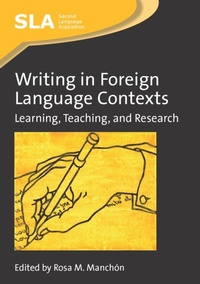
Writing in Foreign Language Contexts
Learning, Teaching, and Research
Published on 9. July 2009
280 pages
978-1-84769-902-2 (ISBN)
Description

This book represents the most comprehensive account to date of foreign language (FL) writing. Its basic aim is to reflect critically on where the field is now and where it needs need to go next in the exploration of FL writing at the levels of theory, research, and pedagogy, hence the two parts of the book: 'Looking back' and 'Looking ahead'. The chapters in Part I offer accounts of both the inquiry process followed and the main insights gained in various long-term research programs. The chapters in Part 2 contribute a retrospective analysis of the available empirical research and of professional experiences in an attempt to move forward. The book invites the reader to step back and rethink seemingly well established knowledge about L2 writing in light of what is known about writing in FL contexts.
Reviews / Votes
Looking back and highlighting the many ways in which SL and FL learning contexts differ, this collection of papers challenges readers to (re-)consider what the field knows about L2 writing development. Looking forward, the resulting contextualization and expansion of theoretical, empirical, and pedagogical insights is sure to facilitate a more robust understanding of all L2 writing, irrespective of the educational environment, while appropriately recognizing the situatedness and diversity of writing practices in FL settings. * Heidi Byrnes, Georgetown University. * Although the predominant focus of the field of L2 writing has long been English writing in English dominant contexts, the number of studies focusing on non-English dominant contexts has been growing steadily. This authoritative volume features some of the most accomplished researchers in those contexts, seizing the momentum to expand the scope of the field and to provide a much needed global perspective. Without doubt, the editor and the contributors to this collection are laying a foundation for further exploration of L2 writing theory, research and instruction--especially in contexts where English is not one of the dominant languages. * Paul Matsuda, Arizona State University. * This collection convincingly argues for the need for greater recognition of writing in diverse foreign language contexts. Especially welcome are the focus on programs of research and the consolidation of knowledge and the spirit of inclusiveness regarding perspectives (linguistic, cognitive, and social) and approaches (to research, theory, and teaching). * Tony Silva, Purdue University. * What sets the volume apart from other edited collections is the remarkable way in which it brings together studies from different theoretical and methodological orientations without creating a mixed bag of self-contained, disjointed studies. Each chapter stays true to the book's overall theme of looking back and moving forward as the authors take the reader through an almost narrativelike account of the past history of their academic endeavors and outline current and future developments in their research agendas...Without a doubt, this book will serve as an ideal overview for both established scholars and students who are interested in learning about current issues in the area of FL writing as well as the intersections of SLA and L2 writing. * Soo Hyon Kim, Michigan State University in SSLA Book Reviews, pp457-459, 2010 * Two elements guarantee the success of this long-overdue book. The first is the attention this book gives to contexts-from curricula and instruction methods to a recognition of English as the global language for written communication-to explain how EFL learners approach writing in English.The second notable element is the unusual and effective method of compilation, in which multiauthored chapters are intertwined as the authors refer to each others' chapters, bringing a sense of wholeness to the book...Researchers seeking to conduct studies on FL writing will benefit from studying this impressive overview of the field. Tertiary educators also might view this book as a key resource in developing writing courses specifically for their EFL classes...Manchon's compilation is a brief but rich and necessary handbook that places FL writing in the forefront of the writing research field-aplace that, as the contributors to this book have amply illustrated, is well earned. * Idoia Elola, Texas Tech University, The Modern Language Journal 95 (2011) * This volume is a timely contribution to the field and provides a much needed comprehensive review of this burgeoning area of research in L2 writing...What sets the volume apart from other edited collections is the remarkable way in which it brings together studies from different theoretical and methodological orientations without creating a mixed bag of self-contained, disjointed studies. Each chapter stays true to the book's overall theme of looking back and moving forward as the authors take the reader through an almost narrativelike account of the past history of their academic endeavors and outline current and future developments in their research agendas...Without a doubt, this book will serve as an ideal overview for both established scholars and students who are interested in learning about current issues in the area of FL writing as well as the intersections of SLA and L2 writing. The book gives readers the rare opportunity to partake in the ruminations of experienced researchers as they refl ect on their previous work in light of new research fi ndings and the growing knowledge base of FL and L2 writing. * Soo Hyon Kim, Michigan State University, SSLA issue 33:3 *More details
Series
Language
English
Place of publication
Bristol
United Kingdom
Publishing group
Channel View Publications Ltd
Target group
Professional and scholarly
ISBN-13
978-1-84769-902-2 (9781847699022)
Copyright in bibliographic data and cover images is held by Nielsen Book Services Limited or by the publishers or by their respective licensors: all rights reserved.
Schweitzer Classification
Other editions
Additional editions
Book
07/2009
Multilingual Matters
€48.30
Shipment within 10-20 days
Person
Rosa Manchon is Associate Professor of Applied Linguistics and Director of the postgraduate programme in English Language and Linguistics at the University of Murcia, Spain. Her research interests include second language writing and research methods. Her work has appeared in leading applied linguistics and second language writing journals such as the Journal of Second Language Writing, Language Learning, and the Modern Language Journal. She has also edited various journal issues on SLA and L2 writing as a guest editor for the International Journal of English Studies, International Review of Applied Linguistics, and the Journal of Second Language Writing. She is currently co-editor (with Ilona Leki) of the Journal of Second Writing.
Content
Preface (by Ilona Leki)
Introduction - Rosa M. Manchon
Part 1: Looking Back: Research Insights
Chapter 1: Situated Writing Practices in Foreign Language Settings - Carol Rinnert and Hiroe Kobayashi
Chapter 2: Changes in EFL Students' Writing over 3.5 Years - Miyuki Sasaki
Chapter 3: Towards a Blueprint of the Foreign Language Writer - Rob Schoonen, Patrick Snellings, Marie Stevenson and Amos van Gelderen
Chapter 4: The Problem-solving Nature of Foreign Language Composing - Rosa Manchon, Julio Roca, and Liz Murphy
Chapter 5: Age-related Differences and Associated Factors in Foreign Language Writing - M. Luz Celaya and Teresa Naves
Chapter 6: The Globalization of Scholarship - John Flowerdew and Yongyan Li
Chapter 7: A Critical Evaluation of Writing Teaching Programmes in Different Foreign Language Settings - Melinda Reichelt
Part 2: Looking Ahead: Issues in Theory, Research and Pedagogy
Chapter 8: The Contribution of Studies of Foreign Language Writing Research to Research, Theories and Policies - Alister Cumming
Chapter 9: Studying Writing Across EFL Contexts: Looking Back and Moving Forward - Lourdes Ortega
Chapter 10: Training for Writing or Training for Reality? Challenges Facing EFL Writing Teachers and Students in Language Teacher Education Programs - Christine Pearson Casanave
Part 3: Coda
Chapter 11: Bibliography of Sources on Foreign Language Writing - Melinda Reichelt
Introduction - Rosa M. Manchon
Part 1: Looking Back: Research Insights
Chapter 1: Situated Writing Practices in Foreign Language Settings - Carol Rinnert and Hiroe Kobayashi
Chapter 2: Changes in EFL Students' Writing over 3.5 Years - Miyuki Sasaki
Chapter 3: Towards a Blueprint of the Foreign Language Writer - Rob Schoonen, Patrick Snellings, Marie Stevenson and Amos van Gelderen
Chapter 4: The Problem-solving Nature of Foreign Language Composing - Rosa Manchon, Julio Roca, and Liz Murphy
Chapter 5: Age-related Differences and Associated Factors in Foreign Language Writing - M. Luz Celaya and Teresa Naves
Chapter 6: The Globalization of Scholarship - John Flowerdew and Yongyan Li
Chapter 7: A Critical Evaluation of Writing Teaching Programmes in Different Foreign Language Settings - Melinda Reichelt
Part 2: Looking Ahead: Issues in Theory, Research and Pedagogy
Chapter 8: The Contribution of Studies of Foreign Language Writing Research to Research, Theories and Policies - Alister Cumming
Chapter 9: Studying Writing Across EFL Contexts: Looking Back and Moving Forward - Lourdes Ortega
Chapter 10: Training for Writing or Training for Reality? Challenges Facing EFL Writing Teachers and Students in Language Teacher Education Programs - Christine Pearson Casanave
Part 3: Coda
Chapter 11: Bibliography of Sources on Foreign Language Writing - Melinda Reichelt
