

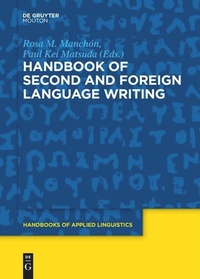
Handbook of Second and Foreign Language Writing
Description

The Handbook of Second and Foreign Language Writing is an authoritative reference compendium of the theory and research on second and foreign language writing that can be of value to researchers, professionals, and graduate students. It is intended both as a retrospective critical reflection that can situate research on L2 writing in its historical context and provide a state of the art view of past achievements, and as a prospective critical analysis of what lies ahead in terms of theory, research, and applications. Accordingly, the Handbook aims to provide (i) foundational information on the emergence and subsequent evolution of the field, (ii) state-of-the-art surveys of available theoretical and research (basic and applied) insights, (iii) overviews of research methods in L2 writing research, (iv) critical reflections on future developments, and (iv) explorations of existing and emerging disciplinary interfaces with other fields of inquiry.
Reviews / Votes
"The
Handbook of Second and Foreign Language Writing
is a 'must have' for researchers, teachers, and their graduate students globally who want to know more about the many facets of learning, teaching, and researching writing in L2 English. Throughout this text with its comprehensive references, readers will know more about what theoretical developments to pursue, what research/ applications to explore, what research methods to apply, and what disciplinary boundaries to cross in second and foreign language (L2) writing scholarship."
Donna Bain Butler in: www.linguistlist.com 09/2017
More details
Other editions
Additional editions
Persons
Content
- Intro
- Preface
- Introduction to the handbook series
- Contents
- Introduction: Past and future of L2 writing research
- I. Mapping the terrain
- 1. An overview of the development of the infrastructure of second language writing studies
- 2. Dimensions in L2 writing theory and research: Learning to write and writing to learn
- 3. Theoretical orientations to L2 writing
- II. Populations and contexts
- 4. ESL writing in schools
- 5. EFL writing in schools
- 6. L2 writers in higher education
- 7. L2 writers in study-abroad contexts
- 8. L2 writing in languages other than English
- 9. Academic writing for publication in a multilingual world
- 10. Workplace writing: From text to context
- III. Learning writing
- 11. Focus on texts and readers: Linguistic and rhetorical features
- 12. Focus on writers: Processes and strategies
- 13. Language development in second language writing
- 14. The development of digital literacies
- 15. Writing from sources, plagiarism and textual borrowing
- 16. Voice and identity
- 17. Multicompetence and multilingual writing
- 18. Collaborative writing
- 19. Making use of teacher written feedback
- IV. Teaching and assessing writing
- 20. Key issues of debate about feedback on writing
- 21. Writing centers and second and foreign language writers
- 22. Second language writing assessment
- V. Researching writing
- 23. Qualitative inquiry in L2 writing
- 24. Quantitive inquiry in L2 writing
- VI. Interdisciplinary relations
- 25. Second language writing and culture
- 26. L2 writing and SLA studies
- 27. Reading/writing and speaking/writing connections: The advantages of multimodal pedagogy
- Biographical notes
- Name index
- Subject index
