

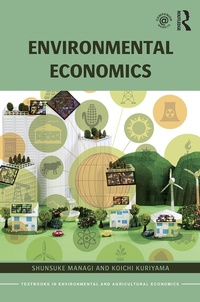
Environmental Economics
1st Edition
Published on 22. September 2016
246 pages
978-1-315-46732-0 (ISBN)
Description

This book aids those concerned about environmental issues to firmly grasp relevant analytical methods and to comprehend the thought process behind environmental economics. It does so by drawing from specific environmental issues and at the same time providing commentary that facilitates understanding. This text contains in-depth explanations necessary for a thorough understanding of the fundamental aspects and importance of environmental economics.
Environmental Economics seeks to elucidate the mechanisms that give rise to environmental problems by approaching environmental issues from an economic perspective. At the same time, it is a study aiming to indicate specific countermeasures that could resolve present environmental issues. This text has been put together in way that allows readers without specialized economics knowledge to easily understand the situation, issues and challenges of environmental economics.
Environmental Economics seeks to elucidate the mechanisms that give rise to environmental problems by approaching environmental issues from an economic perspective. At the same time, it is a study aiming to indicate specific countermeasures that could resolve present environmental issues. This text has been put together in way that allows readers without specialized economics knowledge to easily understand the situation, issues and challenges of environmental economics.
Reviews / Votes
'This is an introductory text to help readers understand environmental economics... It is simple and understandable making a valuable contribution to the existing literature. The text has been put together in a way that allows readers without specialization in economics to understand the issues and challenges of environmental economics. I consider this book a useful introductory textbook for readers interested in Environmental Economics.' - George Halkos, Professor in Economics of Natural Resources, University of Thessaly'The book shows a solid and comprehensive coverage of main relevant issues in current environmental policy debate, with an interesting focus on waste and resources. Microeconomic, meso and macroeconomic issues are presented and linked together, through theoretical and 'applications' chapters.
The chapters can be usefully read in isolation, or find a proper complementary value in the overall reading. It both covers the theory of environmental policy and its applications in the real world.' - Massimiliano Mazzanti, Associate Professor of Economics, University of Ferrara 'This is an introductory text to help readers understand environmental economics... It is simple and understandable making a valuable contribution to the existing literature. The text has been put together in a way that allows readers without specialization in economics to understand the issues and challenges of environmental economics. I consider this book a useful introductory textbook for readers interested in Environmental Economics.' - George Halkos, Professor in Economics of Natural Resources, University of Thessaly
'The book shows a solid and comprehensive coverage of main relevant issues in current environmental policy debate, with an interesting focus on waste and resources. Microeconomic, meso and macroeconomic issues are presented and linked together, through theoretical and 'applications' chapters.
The chapters can be usefully read in isolation, or find a proper complementary value in the overall reading. It both covers the theory of environmental policy and its applications in the real world.' - Massimiliano Mazzanti, Associate Professor of Economics, University of Ferrara' - Massimiliano Mazzanti, Associate Professor of Economics, University of Ferrara
More details
Series
Language
English
Place of publication
London
United Kingdom
Publishing group
Taylor & Francis Ltd
Target group
College/higher education
Illustrations
21 farbige Tabellen, 87 farbige Zeichnungen, 87 farbige Abbildungen
21 Tables, color; 87 Line drawings, color; 87 Illustrations, color
File size
6,72 MB
ISBN-13
978-1-315-46732-0 (9781315467320)
Copyright in bibliographic data and cover images is held by Nielsen Book Services Limited or by the publishers or by their respective licensors: all rights reserved.
Schweitzer Classification
Other editions
New editions
E-Book
11/2024
2nd Edition
Routledge
€49.99
Available for download
E-Book
08/2024
2nd Edition
Routledge
€115.99
Available for download
Additional editions
Shunsuke Managi | Koichi Kuriyama
Environmental Economics
Book
09/2016
1st Edition
Routledge
€259.98
Shipment within 10-20 days
Shunsuke Managi | Koichi Kuriyama
Environmental Economics
Book
09/2016
1st Edition
Routledge
€62.00
Shipment within 10-20 days
Persons
Shunsuke Managi is the Distinguished Professor of Technology and Policy in the Urban Institute & School of Engineering at Kyushu University, Japan, while also holding positions as an Adjunct Professor at QUT Business School, and the University of Tokyo. He is an editor of Environmental Economic and Policy Studies, a lead author for the Intergovernmental Panel on Climate Change, and is the author of Technology, Natural Resources and Economic Growth: Improving the Environment for a Greener Future and editor of The Economics of Green Growth.
Koichi Kuriyama is the Professor of Agricultural and Resource Economics at the Kyoto University, Japan. His research has focused on the evaluation of the environment including forest and ecosystem services. He is the author of 'A latent segmentation approach to a Kuhn-Tucker model: An application to recreation demand' (with W.M. Hanemann and J.R. Hilger), published in the Journal of Environmental Economics and Management.
Koichi Kuriyama is the Professor of Agricultural and Resource Economics at the Kyoto University, Japan. His research has focused on the evaluation of the environment including forest and ecosystem services. He is the author of 'A latent segmentation approach to a Kuhn-Tucker model: An application to recreation demand' (with W.M. Hanemann and J.R. Hilger), published in the Journal of Environmental Economics and Management.
Content
Chapter 1: Our Lifestyles and the Environment
Section 1. Economic Development and Environmental Issues
Section 2. Waste Problems and Sustainable Society
Section 3. Climate Change
Chapter 2: Mechanisms that Give Rise to Environmental Problems
Section 1. Externalities and Market Failures
Section 2. The Use and Management of Common-Pool Resources
Section 3. Public Goods and Free Riding
Chapter 3: Fundamental Theories of Environmental Policy
Section 1. Direct Regulations and Market Mechanisms
Section 2. Environmental Taxes and Subsidies
Section 3. Resolutions through Direct Negotiations
Section 4. Emission Cap and Trade
Chapter 4: Applications for Environmental PoliciesSection 1. Choice among Policy Measures
Section 2. Waste Policy
Section 3. The Kyoto Protocol and Climate Change Policy
Section 4. The Current State and Future Targets of Climate Change Policy
Chapter 5: Environmental Value AssessmentSection 1. Environmental Value
Section 2. Environmental Valuation Method 1: Revealed Preferences Method
Section 3. Environmental Valuation Method 2: Stated Preferences Method
Section 4. Cost-Benefit Analysis
Chapter 6: Business and Environmental Problems
Section 1. Business and Environmental Policies
Section 2. Social Responsibility Demanded from Business
Section 3. Business and Environmental Risks
Section 4. Biodiversity and the Ecosystem
Chapter 7: Global Environmental Problems and International Trade
Section 1. International Trade and the Environment
Section 2. Environmental Regulations and Technological Development
Section 3. Sustainable Development
Section 4. Energy Economics
Section 1. Economic Development and Environmental Issues
Section 2. Waste Problems and Sustainable Society
Section 3. Climate Change
Chapter 2: Mechanisms that Give Rise to Environmental Problems
Section 1. Externalities and Market Failures
Section 2. The Use and Management of Common-Pool Resources
Section 3. Public Goods and Free Riding
Chapter 3: Fundamental Theories of Environmental Policy
Section 1. Direct Regulations and Market Mechanisms
Section 2. Environmental Taxes and Subsidies
Section 3. Resolutions through Direct Negotiations
Section 4. Emission Cap and Trade
Chapter 4: Applications for Environmental PoliciesSection 1. Choice among Policy Measures
Section 2. Waste Policy
Section 3. The Kyoto Protocol and Climate Change Policy
Section 4. The Current State and Future Targets of Climate Change Policy
Chapter 5: Environmental Value AssessmentSection 1. Environmental Value
Section 2. Environmental Valuation Method 1: Revealed Preferences Method
Section 3. Environmental Valuation Method 2: Stated Preferences Method
Section 4. Cost-Benefit Analysis
Chapter 6: Business and Environmental Problems
Section 1. Business and Environmental Policies
Section 2. Social Responsibility Demanded from Business
Section 3. Business and Environmental Risks
Section 4. Biodiversity and the Ecosystem
Chapter 7: Global Environmental Problems and International Trade
Section 1. International Trade and the Environment
Section 2. Environmental Regulations and Technological Development
Section 3. Sustainable Development
Section 4. Energy Economics
