

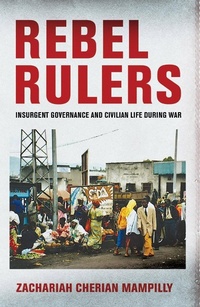
Rebel Rulers
Insurgent Governance and Civilian Life During War
Published on 7. October 2011
320 pages
978-0-8014-6298-6 (ISBN)
Description

"Rebel Rulers skillfully blends theoretical insights into the factors that explain effective governance with rich ethnographic research to produce a thought-provoking analysis of how rebels (attempt) to govern the populations under their control."
a* Journal of Politics
Rebel groups are often portrayed as predators, their leaders little more than warlords. In conflicts large and small, however, insurgents frequently take and hold territory, establishing sophisticated systems of governance that deliver extensive public services to civilians under their control. From police and courts, schools, hospitals, and taxation systems to more symbolic expressions such as official flags and anthems, some rebels are able to appropriate functions of the modern state, often to great effect in generating civilian compliance. Other insurgent organizations struggle to provide even the most basic services and suffer from the local unrest and international condemnation that result.
Rebel Rulers is informed by Zachariah Cherian Mampilly's extensive fieldwork in rebel-controlled areas. Focusing on three insurgent organizations-the Liberation Tigers of Tamil Eelam (LTTE) in Sri Lanka, the Rally for Congolese Democracy (RCD) in Congo, and the Sudan People's Liberation Movement/Army (SPLM/A) in Sudan-Mampilly's comparative analysis shows that rebel leaders design governance systems in response to pressures from three main sources. They must take into consideration the needs of local civilians, who can challenge rebel rule in various ways. They must deal with internal factions that threaten their control. And they must respond to the transnational actors that operate in most contemporary conflict zones. The development of insurgent governments can benefit civilians even as they enable rebels to assert control over their newly attained and sometimes chaotic territories.
a* Journal of Politics
Rebel groups are often portrayed as predators, their leaders little more than warlords. In conflicts large and small, however, insurgents frequently take and hold territory, establishing sophisticated systems of governance that deliver extensive public services to civilians under their control. From police and courts, schools, hospitals, and taxation systems to more symbolic expressions such as official flags and anthems, some rebels are able to appropriate functions of the modern state, often to great effect in generating civilian compliance. Other insurgent organizations struggle to provide even the most basic services and suffer from the local unrest and international condemnation that result.
Rebel Rulers is informed by Zachariah Cherian Mampilly's extensive fieldwork in rebel-controlled areas. Focusing on three insurgent organizations-the Liberation Tigers of Tamil Eelam (LTTE) in Sri Lanka, the Rally for Congolese Democracy (RCD) in Congo, and the Sudan People's Liberation Movement/Army (SPLM/A) in Sudan-Mampilly's comparative analysis shows that rebel leaders design governance systems in response to pressures from three main sources. They must take into consideration the needs of local civilians, who can challenge rebel rule in various ways. They must deal with internal factions that threaten their control. And they must respond to the transnational actors that operate in most contemporary conflict zones. The development of insurgent governments can benefit civilians even as they enable rebels to assert control over their newly attained and sometimes chaotic territories.
Reviews / Votes
Rebel Rulers skillfully blends theoretical insights into the factors that explain effective governance with rich ethnographic research to produce a thought-provoking analysis of how rebels (attempt) to govern the populations under their control.(Journal of Politics) The empirical basis for this innovative study consists of three case studies. The author looks at the governance systems set up by the Liberation Tigers of Tamil Eelam (LTTE) in Sri Lanka, the Rally for Congolese Democracy (RCD) in Congo, and the Sudan People's Liberation Movement/Army (SPLM/A)... this book is an important achievement. Mampilly has cleared a path towards further research into modes of governance beyond the state.
- Christoph Zuercher (African Affairs) This book is a must-read for anybody wishing to understand why some rebels assemble comprehensive administrations to rule civilians while others fail to do so or reject this task. In his analysis, Mampilly challenges claims of other scholars that economic incentives drive rebel organization and goals, arguing instead for a process-based approach... This is a great book that provides rich detail. The analysis rests on the key observation that violence shapes the environment, which in turn shapes choices.
- William Reno, Northwestern University (African Studies Review) Rebel Rulers is an important achievement. Mampilly has cleared a path toward further research into modes of governance beyond the state.
(African Affairs)
More details
Language
English
Place of publication
Ithaca
United States
Product notice
Reflowable
Illustrations
4 halftones, 2 line drawings, 6 maps, 1 table - 4 Halftones, black and white - 9 Tables, unspecified - 5 Charts
ISBN-13
978-0-8014-6298-6 (9780801462986)
Copyright in bibliographic data and cover images is held by Nielsen Book Services Limited or by the publishers or by their respective licensors: all rights reserved.
Schweitzer Classification
Other editions
Additional editions
Book
08/2015
Cornell University Press
€44.75
Shipment within 15-20 days
Book
10/2011
Cornell University Press
€60.66
Shipment within 10-20 days
Person
Zachariah Cherian Mampilly is the Director of Africana Studies and Associate Professor of Political Science and International Studies at Vassar College. He is coauthor of Africa Uprising: Popular Protest and Political Change.
Content
1. Introduction: Governing Rebels
2. Bandits, Warlords, Embryonic States, Black Spots, and
Ungoverned Territories: The Unwieldy Taxonomy
of Rebel-Governed Areas
3. Understanding Variation in Insurgent Governance Systems
4. The Two Faces of the Tiger: Sri Lanka's Liberation Tigers
of Tamil Eelam
5. Building a New Sudan: The Sudan People's Liberation
Movement/Army
6. Resurrecting Bula Matari: The Rassemblement Congolais
pour la Democratie-Goma
7. Comparative Insurgent Governance
8. Rules and Resistance: New Agendas for Studying Insurgency
and Governance
2. Bandits, Warlords, Embryonic States, Black Spots, and
Ungoverned Territories: The Unwieldy Taxonomy
of Rebel-Governed Areas
3. Understanding Variation in Insurgent Governance Systems
4. The Two Faces of the Tiger: Sri Lanka's Liberation Tigers
of Tamil Eelam
5. Building a New Sudan: The Sudan People's Liberation
Movement/Army
6. Resurrecting Bula Matari: The Rassemblement Congolais
pour la Democratie-Goma
7. Comparative Insurgent Governance
8. Rules and Resistance: New Agendas for Studying Insurgency
and Governance
