

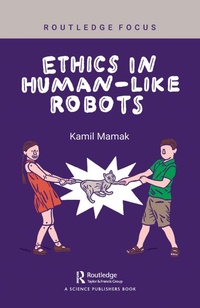
Ethics in Human-like Robots
1st Edition
Published on 25. November 2024
140 pages
978-1-040-27682-2 (ISBN)
Description

The idea of creating artificial humans can be found at the beginning of the human culture. Ancient myths contain the stories of artificial humans brought to life by gods. The word robot originates from a play that was about artificial humans made from artificial flesh that aims to serve real humans. With advancements in robotics, the materialization of this idea is more real than ever before. We are witnessing attempts to create humanoid robots that might be deployed in many spheres of our life - policing, healthcare, and even for love and sex.
The book focuses on the ethical issues of human likeness of robots and human tendency to anthropomorphize. It is built on the assumption that design choices are not neutral, and they need to be discussed to align robots with human values. With robots operating in the physical world, they bring ideas and risks that should be addressed before widespread deployment. The book reviews specific issues and provides suggestions and recommendations for improving robots to serve humans better. It draws on literature from Human-Robot Interactions, ethics of AI and robotics, and the philosophy of technology.
The book focuses on the ethical issues of human likeness of robots and human tendency to anthropomorphize. It is built on the assumption that design choices are not neutral, and they need to be discussed to align robots with human values. With robots operating in the physical world, they bring ideas and risks that should be addressed before widespread deployment. The book reviews specific issues and provides suggestions and recommendations for improving robots to serve humans better. It draws on literature from Human-Robot Interactions, ethics of AI and robotics, and the philosophy of technology.
Reviews / Votes
"Human-like robots are emerging from science fiction and entering real life. This is fascinating. But what ethical issues are raised by robots designed to look and behave like humans? This great new book by Kamil Mamak tackles this intriguing issue head on. A must-read for anyone interested in human-robot interaction!"- Sven Nyholm, Professor of the Ethics of Artificial Intelligence at LMU Munich and author of Humans and Robots: Ethics, Agency, and Anthropomorphism and This is Technology Ethics: An Introduction.
"If or even when we succeed in creating humanoid robots, what will be the moral and legal challenges of this technologically enabled imago hominis? In this forward-thinking and accessible book, Kamil Mamak provides us with the critical insights necessary to respond to and take responsibility for human-like robots.
The book focuses on the ethical issues of human likeness of robots and human tendency to anthropomorphize. It is built on the assumption that design choices are not neutral, and they need to be discussed to align robots with human values. With robots operating in the physical world, they bring ideas and risks that should be addressed before widespread deployment. The book reviews specific issues and provides suggestions and recommendations for improving robots to serve humans better. It draws on literature from Human-Robot Interactions, ethics of AI and robotics, and the philosophy of technology."
David J. Gunkel
Presidential Research, Scholarship and Artistry Professor
Northern Illinois University
More details
Edition
1. Auflage
Language
English
Place of publication
London
United Kingdom
Publishing group
Taylor & Francis Ltd
Target group
College/higher education
Professional and scholarly
Illustrations
6 Line drawings, black and white; 6 Illustrations, black and white
File size
3,69 MB
ISBN-13
978-1-040-27682-2 (9781040276822)
Copyright in bibliographic data and cover images is held by Nielsen Book Services Limited or by the publishers or by their respective licensors: all rights reserved.
Schweitzer Classification
Other editions
Additional editions
Kamil Mamak
Ethics in Human-like Robots
Book
05/2026
1st Edition
Routledge
€30.00
Shipment within 10-20 days
Kamil Mamak
Ethics in Human-like Robots
Book
11/2024
1st Edition
Routledge
€74.80
Shipment within 10-20 days
Person
Kamil Mamak is a philosopher and a lawyer. He is a postdoctoral researcher at Robophilosophy, AI ethics and Datafication Research group at University of Helsinki and an assistant professor at the Department of Criminal Law at the Jagiellonian University, Cracow, Poland. He is also a board member at the Cracow Institute of Criminal Law. He holds PhDs in law (2018) from Jagiellonian University and philosophy (2020) from the Pontifical University of John Paul II in Cracow. He has authored 4 monographs. He has published more than 40 peer-reviewed journal articles and contributed chapters. His works have been published in reputed journals, including the European Journal of Criminology; Ethics and Information Technology; International Journal of Social Robotics; AI & Society; Medicine, Healthcare, and Philosophy; Science and Engineering Ethics; European Journal of Crime, Criminal Law and Criminal Justice; Frontiers in Robotics and AI, and Criminal Justice Studies. He received a research grant from the National Science Center in Poland. He is a recipient of the Minister's scholarship for outstanding young scientists.
Content
Introduction. Risks of Living with Human-like Robots. Representational Issues of Human-like Robots. Human-like Ethics and Responsibility of Robots. Human Likeness of Robots and Moral Patiency. Conclusion: Towards Ethical Design of Human-like Robots
