

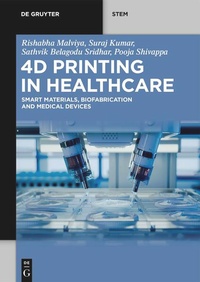
4D Printing in Healthcare
Description

4D Printing is revolutionizing healthcare by enabling adaptive, patient-specific medical devices and advanced treatment options. 4D Printing in Healthcare provides a comprehensive exploration of 4D printing in healthcare, detailing how this innovative technology enhances the diagnosis and treatment of various health issues. It covers the principles and algorithms behind 4D-based printing, highlighting its transformative impact on healthcare. By adding the dimension of time to traditional 3D printing, 4D printing enables the creation of dynamic, self-transforming medical devices and structures. The book discusses the customization of medical implants, prosthetics, and drug delivery systems, emphasizing how personalization can greatly improve patient outcomes and quality of life. Each chapter explores the potential of 4D printing in different healthcare sectors, such as orthopedics, dentistry, tissue engineering, and more. Additionally, it underscores the potential cost savings in healthcare by using smart materials that adapt to environmental conditions or patient needs, reducing the need for frequent replacements and minimizing waste. The book offers a multidisciplinary perspective, bringing together insights from engineering, biomedical science, materials science, and medicine to showcase the innovations and possibilities of 4D printing in healthcare.
More details
Other editions
Additional editions
Persons
Dr. Rishabha Malviya completed B. Pharmacy from Uttar Pradesh Technical University and M. Pharmacy (Pharmaceutics) from Gautam Buddha Technical University, Lucknow Uttar Pradesh. His PhD (Pharmacy) work was in the area of Novel formulation development techniques. He has 12 years of research experience and presently working as Associate Professor in the Department of Pharmacy, School of Medical and Allied Sciences, Galgotias University since past 8 years. His area of interest includes formulation optimization, nanoformulation, targeted drug delivery, localized drug delivery and characterization of natural polymers as pharmaceutical excipients. He has authored more than 150 research/review papers for national/international journals of repute. He has 58 patents (19 grants, 38 published, 1 filed) and publications in reputed National and International journals with total of 250 cumulative impact factor. He has also received an Outstanding Reviewer award from Elsevier. He has authored/edited/editing 58 books (Wily, CRC Press/Taylor and Francis, Springer, River Publisher, IOP publishing and OMICS publication) and authored 50 book chapters. His name has included in word's top 2% scientist list for the year 2020, 2021 and 2022 by Elsevier BV and Stanford University. He is Reviewer/Editor/Editorial board member of more than 50 national and international journals of repute. He has invited as author for "Atlas of Science" and pharma magazine dealing with industry (B2B) "Ingredient south Asia Magazines".
Mr. Suraj Kumar completed a B. Pharmacy from SRM University, Chengalpattu, Tamil Nadu, India, and an M. Pharmacy from Galgotias University, Greater Noida, India. He has attended more than 10 International/National conferences. He has published over 15 SCI publications with reputed international publishers like Elsevier, Wiley, and Bentham Science with 45 cumulative impact factors. He has published 7 chapters, and Two books are accepted for the publications.
Dr. Sathvik is currently working as an Associate Dean and Professor at RAK College of Pharmacy, RAK Medical and Health Sciences University located in Ras Al Khaimah, United Arab Emirates. Dr. Sathvik has completed his Ph.D. in Clinical Pharmacy from Rajiv Gandhi University of Health Sciences, Bangalore, India. He has received an FIP fellowship for higher training in renal clinical pharmacy at Royal Adelaide Hospital and Queen Elizabeth Hospital in Adelaide, South Australia. Dr. Sathvik has worked as an Assistant Professor and Clinical Pharmacist at JSS College of Pharmacy and JSS Medical College Hospital, Mysore, India, for eight years and later Joined International Medical University (IMU) Malaysia as a senior lecturer in the Department of Pharmacy Practice from 2008 to 2010. Dr. Sathvik joined as an assistant professor in the Department of Clinical Pharmacy at RAK College of Pharmacy, RAK Medical, and Health Sciences University in 2010 and worked as a professor and chairperson of the Department of Clinical Pharmacy and Pharmacology from 2018 to 2023. Dr. Sathvik has been honored with a prestigious teacher award by the Society of Pharmaceutical Education & Research [SPER]. He has also received training in Pharmacovigilance at the Uppsala Monitoring Centre in Uppsala, Sweden. Dr. Sathvik has 25 years of experience teaching and practicing clinical pharmacy in India, Malaysia, and the UAE. His research interests include Medication Safety, Pharmacovigilance, Pharmacoepidemiology, and Renal and Psychiatry Clinical Pharmacy. Dr. Sathvik has more than 75 research papers published in reputable national and international journals, along with book chapters. He has presented more than 75 research papers at numerous national and international conferences and has been honored with many awards. He also serves as a reviewer for various national and internal pharmacy practice-related journals.
Dr. Pooja Shivappa is a Project Scientist in Manipal School of Life Sciences, Manipal Academy of Higher Education, MAHE- Manipal-576104, Karnataka, India. Her past positions encompass serving as a post-doctoral fellow and Clinical Scientist specializing in COVID testing, overseeing the Central Research Laboratory, and working as a Research Associate/Assistant Professor at RAK Medical & Health Sciences University in the UAE. She has a Ph.D. in radiation and cancer biology from K.S. Hegde Medical Academy, Mangalore, where she worked on a research project funded by the Board of Research in Nuclear Sciences (BRNS), Department of Atomic Energy (DAE), Government of India. She has experience in cytogenetics and molecular genetics techniques at the Diagnostic Centre for Molecular and Cytogenetics. During the COVID pandemic, she worked as a Clinical Scientist for COVID Testing at RAK Hospital, UAE. With a decade of experience as a researcher and academic in both India and the UAE, her research interests span interdisciplinary fields such as Biotechnology, Biochemistry, Genetics, Molecular Biology, Radiation Biology, and Neuroscience. Dr. Pooja has authored 40 research papers in esteemed journals, contributed to book chapters, and has been honoured with numerous awards.
Content
- Intro
- Preface
- Contents
- About the Book
- Chapter 1 4D Printing in Biomedical Engineering: Introduction and Fundamental Concepts
- 1.1 Introduction
- 1.2 Objectives of the chapter
- 1.3 Technological Developments in 4D Printing for Medical Purposes
- 1.3.1 Four-Dimensional Printing Materials and Production Methodologies
- 1.3.1.1 The Utilization of Sophisticated Materials in the Context of 4D Printing
- 1.3.1.2 Methodologies for Fabrication Utilizing 4D Printing
- 1.3.1.2.1 Fused Deposition Modeling (FDM)
- 1.3.1.2.2 Stereolithography (SLA)
- 1.3.1.2.3 Digital Light Processing (DLP)
- 1.3.1.2.4 Selective Laser Sintering (SLS)
- 1.3.1.2.5 Multi-material Jetting
- 1.3.1.2.6 Direct Ink Writing (DIW)
- 1.4 Repurposing 4D Printing Technology for Medicinal Purposes
- 1.4.1 Advanced Artificial Limbs and Implants
- 1.4.2 Drug Delivery Systems
- 1.4.3 Tissue Engineering and Regenerative Medicine
- 1.4.4 Responsive Surgical Equipment
- 1.4.5 Instruments for Diagnosis
- 1.4.6 Medical Aids for Recuperation
- 1.5 Challenges and Future Directions of the Application of 4D Printing Within the Domain of Biological Engineering
- 1.5.1 Challenge
- 1.5.1.1 Material Development
- 1.5.1.2 Precision and Control
- 1.5.1.3 Biocompatibility and Safety
- 1.5.1.4 Regulatory Hurdles
- 1.5.1.4.1 Regulatory Compliance
- 1.5.1.4.2 Ethical Compliance
- 1.5.1.4.3 Cost-Efficiency
- 1.5.2 Future Direction
- 1.5.2.1 Current Developments and Fields of Study
- 1.5.2.2 Incorporation of Sensors and Electronics
- 1.5.2.3 Biohybrid Systems
- 1.5.2.4 Materials with Self-Healing Properties
- 1.5.2.5 The Concept of Personalized Medicine
- 1.5.2.6 Materials with Environmental and Biodegradable Properties
- 1.5.2.7 Materials Exhibiting Responsiveness to Multiple Stimuli
- 1.5.2.8 Biomimetic Materials
- 1.5.2.9 Field of Nanomedicine
- 1.6 Conclusion
- Funding
- Conflict of Interest
- References
- Chapter 2 4D Printing in Healthcare of Smart Materials
- 2.1 Introduction
- 2.2 Purpose of the Study of This Chapter
- 2.3 3D Printing
- 2.4 4D Printing
- 2.5 Smart Materials
- 2.6 Smart Materials in 4D Bioprinting
- 2.7 Aspects of 4D Printing that Contribute to the Improvement of the Industrial Sector
- 2.8 Innovation in Production Using 4D Printing
- 2.9 Common Uses for 4D Printing in a Variety of Industries
- 2.10 Procedure Conceptualization for the 4D Technique of Additive Manufacturing
- 2.11 Procedure Conceptualization for the 4D Technique of Additive Manufacturing in Healthcare
- 2.12 The Importance of 4D Printing in the Industry as well as the Healthcare Sector
- 2.13 Conclusion
- References
- Chapter 3 4D Printing in Healthcare of Biological Fabrications
- 3.1 Introduction
- 3.2 4D Fabrication
- 3.2.1 Fabrication in Three Dimensions Progressing to Four Dimensions
- 3.2.2 Polymer Materials with Shape-Memory Properties
- 3.2.3 Stimulants and Reactive Substances
- 3.3 The Utilization of 4D Manufacturing Techniques in the Field of Healthcare Applications
- 3.3.1 Biosensors
- 3.3.2 Healing and Mending of Wounds and Injuries
- 3.3.3 Drug-Delivery System
- 3.3.4 Ailments of the Larynx
- 3.3.5 Tissue Engineering
- 3.3.6 Vascular Constructs
- 3.3.7 Pancreas
- 3.4 Challenge
- 3.5 Future Prospects: An Analysis of Potential Outcomes
- 3.6 Conclusions
- Funding
- Conflict of Interest
- References
- Chapter 4 4D Printing in Orthopedic Medicine
- 4.1 Introduction
- 4.2 4D Printing
- 4.3 The Significance of 4D Printing in the Field of Orthopedics
- 4.3.1 Patient-Specific Implants
- 4.3.2 Adaptive Devices
- 4.3.3 Drug Delivery Systems
- 4.3.4 Minimally Invasive Surgery
- 4.3.5 Reduced Surgery Time
- 4.3.6 Improved Rehabilitation
- 4.3.7 Biocompatible Materials
- 4.4 The Advantages of 4D Printing
- 4.5 Various Types of Sophisticated Materials Have the Potential to be Utilized in the Field of 4D Printing
- 4.6 Significant Progress in the Field of Orthopedics Has Been Achieved via the Application of 4D Printing Technology
- 4.7 Major Contributions of the Study
- 4.8 Limitations
- 4.9 Future Directions
- 4.10 Conclusions
- Funding
- Declaration of Competing Interest
- References
- Chapter 5 4D Printing in Dentistry (Odontology)
- 5.1 Introduction
- 5.2 4D Printing
- 5.3 Need for the Study
- 5.4 The Goals of the Investigation
- 5.5 The Process of Fabricating Innovative Materials Using 4D Printing
- 5.6 Four-Dimensional Printing in Orthodontics: A Conceptual Operational Schematic
- 5.7 Dental Implants Using Bioinspired, 4D-Printable Smart Materials
- 5.8 The Substantial Potential of 4D Printing in the Field of Orthodontics
- 5.9 Other Significant Applications of 4D Printing
- 5.10 Discussion
- 5.11 Future Prospects
- 5.12 Conclusion
- Funding
- Conflict of Interest
- References
- Chapter 6 4D Printing in Tissue Engineering
- 6.1 Introduction
- 6.2 Applications of 4D Printing in Tissue Engineering
- 6.3 Sophisticated Polymer Compounds for Use in 4D Printing Applications Related to Reconstructing Tissue Engineering
- 6.3.1 Sensitivity Toward Physical Stimuli
- 6.3.1.1 Temperature-Sensitive Polymer
- 6.3.1.2 Polymer Compounds That Are Sensitive to Light
- 6.3.1.3 Magnetic Polymeric Materials
- 6.4 Sensitivity to the Effects Associated with Chemical Stimuli
- 6.4.1 pH-Sensitive Polymers
- 6.4.2 Moisture-Responsive Polymers
- 6.5 Factors That Affect the 4D Printing Process
- 6.6 The Specific 3D Spatial Orientation
- 6.7 4D Printing Applications
- 6.8 Prospects and Conclusions
- References
- Chapter 7 4D Printing in Stimuli-Responsive Materials
- 7.1 Introduction
- 7.2 Transition from 3D to 4D Involves Many Methodologies and Their Respective Biological Applications
- 7.3 Materials That Respond to Stimulation: The Search for Smart Materials with Potential Medicinal Applications
- 7.3.1 Physical Stimuli
- 7.3.1.1 Temperature
- 7.3.1.2 Liquid/Moisture
- 7.3.1.3 Light
- 7.3.1.4 Magnetic Field
- 7.3.2 Chemical Stimuli
- 7.3.2.1 pH
- 7.3.2.2 Ionic Concentration
- 7.3.3 Biological Stimuli
- 7.3.3.1 Glucose
- 7.3.3.2 Enzymes
- 7.4 Challenges in the Implementation of 4D Printing for Biomedical Applications
- 7.5 Conclusion
- References
- Chapter 8 Hydrogel-Based 4D Printing
- 8.1 Introduction
- 8.2 Methods of Technological Implementation for the 4D Printing of Hydrogels
- 8.2.1 Printing Methods Suitable for Sophisticated Hydrogels
- 8.2.2 Approaches of Cross-Linking in Processed 4D-Printed Hydrogels
- 8.2.3 Concerns Regarding the Design Approach for 4D Printing
- 8.2.3.1 Materials
- 8.2.3.2 Shape
- 8.2.3.3 Printing Technology
- 8.2.3.4 Interlaying Patterns
- 8.2.3.5 After Therapy
- 8.2.4 Multimaterial Extrusion 4D Printing
- 8.2.5 Hydrogels for Drug Delivery: A New Frontier in 4D Printing
- 8.2.6 Applications
- 8.2.6.1 Systematic Approaches to Tissue Engineering and Drug Delivery
- 8.2.6.2 Actuators
- 8.2.6.3 Sensors as Smart Valves
- 8.2.7 Conclusion
- Funding
- Conflict of Interest
- References
- Chapter 9 4D Printing in Cardiac Health
- 9.1 Introduction
- 9.2 Application of Cardiovascular Interventions in Medical Practice
- 9.2.1 Instruments for Embolization of Aneurysms and Interventional Thrombectomy
- 9.2.2 Stents Placed Within Blood Vessels
- 9.2.3 Prosthetic Vascular Grafts
- 9.2.4 Cardiovascular Valves
- 9.2.5 Implantable Cardioverter Defibrillators
- 9.2.6 Cardiac Patches
- 9.2.7 Proliferative and Specialized Development of Stem Cells
- 9.3 Current Challenges and Prospects
- 9.4 Conclusions
- References
- Index
