

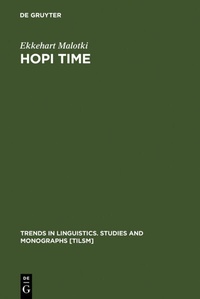
Hopi Time
A Linguistic Analysis of the Temporal Concepts in the Hopi Language
1st Edition
Published on 22. July 2011
XXII, 677 pages
978-3-11-082281-6 (ISBN)
Description

No detailed description available for "Hopi Time".
More details
Other editions
Additional editions
Book
06/1983
1st Edition
De Gruyter Mouton
€230.00
Shipment within 10-20 days
Book
01/1983
1st Edition
De Gruyter Mouton
€329.00
Article exhausted; check different version
Content
- Intro
- 0 Introduction
- 1 The device of the spatio-temporal metaphor
- 1.0 Introduction
- 1.1 Fundamentals of Hopi spatial orientation
- 1.2 Spatio-temporal metaphors in conjunction with the primary locators
- 1.3 Spatio-temporal metaphors in conjunction with the interrogative-indefinite bases ha- and haqa-
- 1.4 Spatio-temporal metaphors in conjunction with the regular local case suffixes (nonmodulated and modulated)
- 1.5 Spatio-temporal metaphors in conjunction with postpositional suffixes
- 1.6 Spatio-temporal metaphors in conjunction with nonprimary locators
- 1.7 Spatio-temporal metaphors in conjunction with the quantifier morpheme sa
- 1.8 Spatio-temporal metaphors in conjunction with the quantifier morphemes tsaa- 'small' and wuu- 'big'
- 1.9 Spatio-temporal metaphors in conjunction with nouns
- 1.10 Spatio-temporal metaphors in conjunction with verbs
- 1.11 Miscellaneous metaphorical time locutions
- 2 Units of time
- 2.0 Introduction
- 2.1 The day
- 2.2 The night
- 2.3 The week
- 2.4 The month
- 2.5 The seasons
- 2.6 yàasangw 'year'
- 3 Horizon-based sun time
- 4 Stellar orientation
- 5 The ceremonial calendar
- 5.0 Introduction
- 5.1 Primary ceremonial orientation points
- 5.2 Secondary ceremonial orientation features
- 6 Timekeeping devices
- 6.0 Introduction
- 6.1 Knotted calendar string
- 6.2 Notched calendar stick
- 6.3 Sun holes alignment
- 6.4 Shadow observation
- 7 Pluralization and quantification of time expressions
- 7.1 The concept 'number of times'
- 7.2 The counting of time units
- 8 Temporal particles
- 8.0 Introduction
- 8.1 aapiy 'prematurely'
- 8.2 angwu 'beforehand/aforetime'
- 8.3 ason 'later/subsequently'
- 8.4 haak 'temporarily'
- 8.5 iits 'early'
- 8.6 mòoti 'at first'
- 8.7 naaf 'still'
- 8.8 nawis' ew 'finally'
- 8.9 nen 'and then'
- 8.10 nit 'and after that'
- 8.11 nungwu 'meanwhile'
- 8.12 paapu 'progressively'
- 8.13 panis 'constantly'
- 8.14 pay 'right now/already'
- 8.15 pi'ep 'repetitively'
- 8.16 piw 'again'
- 8.17 puy 'now/then'
- 8.18 qa sùusa 'not (even) once'
- 8.19 se'elhaq 'a while ago/for a while'
- 8.20 sutsep 'always'
- 8.21 sùutsepngwat 'gradually'
- 9 Miscellaneous
- 9.1 Miscellaneous time words
- 9.2 The lexical field of 'ending'
- 9.3 Temporal anglicisms and morpheme borrowing from English into Hopi
- 9.4 The Hopi tense system
- 10 Concluding remarks
- Notes
- Appendices
- A. Graphic symbols
- B. List of abbreviations
- C. Orthography of Hopi village names
- Bibliography
