

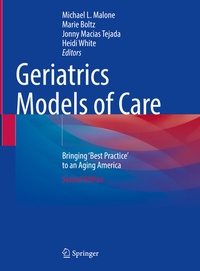
Geriatrics Models of Care
Description

Following the success of the previous edition, the second edition of Geriatrics Models of Care is the definitive resource for systems-based practice improvement for the care of older adults. Several new models of care have been published in the last eight years, new outcomes have emerged to better understand the impact of existing models, and with the rise of the Age-Friendly Health Systems movement, promoting organized efforts to prepare our health care settings for older individuals is of more importance than ever.
The second edition is organized based on the practice setting along a continuum of care: hospital, transitions from hospital to home, outpatient settings, and the emergency department. This book also highlights long-term care models, which is an important part of the continuum of care for older Americans. Further, this edition features models that address the needs of vulnerable populations. This new section will describe a spectrum of programs for older adults who have Alzheimer's disease or Parkinson's disease. Other models describe best practices for older adults undergoing surgery or those who want to remain functioning independently in their home.
A defining feature of this book is that each chapter follows a standard template: 1) the challenge which led to the model; 2) the patient population served; 3) core components of the intervention; 4) the role of interdisciplinary health professionals; 5) evidence to support the intervention; 6) lessons learned in the implementation and dissemination of the model; 7) implications for family caregivers, and communities (particularly underserved and diverse communities); and 8) how each model will provide care across the continuum during an entire episode of care. In addition, each chapter features a "call out" box with practical tips for implementing the model.
More details
Other editions
Additional editions
Previous edition
Persons
Michael L. Malone, MD is the Medical Director of Aurora Health Care's Senior Services program and Aurora at Home. He is a Clinical Adjunct Professor of Medicine at the University of Wisconsin School of Medicine and Public Health. He serves as the Section Head of Geriatrics at Aurora Sinai Medical Center in Milwaukee, WI as well as Aurora's Geriatrics Fellowship Director. Dr. Malone is the Section Editor for Models of Geriatric Care, Quality Improvement, and Program Dissemination for the Journal of the American Geriatrics Society. He serves as the Chairman of the Public Policy committee at the American Geriatrics Society.
Marie Boltz, PhD, GNP-BC, FGSA, FAAN is the Elouise Ross Eberly and Robert Eberly Endowed Professor at the Ross and Carol Nese College of Nursing, Penn State.
Jonny Macias Tejada, MD, AGSF is the Medical Director of Acute Care for Elders at Aurora St. Lukes Medical Center, Medical Director Hospital Elder Life Program Aurora Health Care, and Clinical Adjunct Associate Professor of Medicine at the University of Wisconsin School of Medicine and Public Health.
Heidi White, MD, MHS, MEd is a Professor of Medicine Geriatrics Division at Duke University Department of Medicine.
