

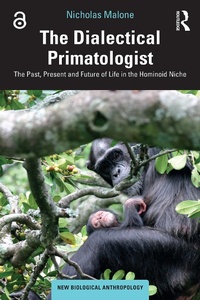
The Dialectical Primatologist
The Past, Present and Future of Life in the Hominoid Niche
1st Edition
Published on 24. October 2021
210 pages
978-0-429-55691-3 (ISBN)
Description

The Dialectical Primatologist identifies the essential parameters vital for the continued coexistence of hominoids (apes and humans), synthesising primate research and conservation in order to develop culturally compelling conservation strategies required for the facilitation of hominoid coexistence.
As unsustainable human activities threaten many primate species with extinction, effective conservation strategies for endangered primates will depend upon our understanding of behavioural response to human-modified habitats. This is especially true for the apes, who are arguably our most powerful connection to the natural world. Recognising the inseparability of the natural and the social, the dialectical approach in this book highlights the heterogeneity and complexity of ecological relationships. Malone stresses that ape conservation requires a synthesis of nature and culture that recognises their inseparability in ecological relationships that are both biophysically and socially formed, and seeks to identify the pathways that lead to either hominoid coexistence or, alternatively, extinction.
This book will be of keen interest to academics in biological anthropology, primatology, environmental anthropology, conservation and human-animal studies.
The Open Access version of this book, available at http://www.taylorfrancis.com, has been made available under a Creative Commons Attribution-Non Commercial-No Derivatives (CC-BY-NC-ND) 4.0 license.
As unsustainable human activities threaten many primate species with extinction, effective conservation strategies for endangered primates will depend upon our understanding of behavioural response to human-modified habitats. This is especially true for the apes, who are arguably our most powerful connection to the natural world. Recognising the inseparability of the natural and the social, the dialectical approach in this book highlights the heterogeneity and complexity of ecological relationships. Malone stresses that ape conservation requires a synthesis of nature and culture that recognises their inseparability in ecological relationships that are both biophysically and socially formed, and seeks to identify the pathways that lead to either hominoid coexistence or, alternatively, extinction.
This book will be of keen interest to academics in biological anthropology, primatology, environmental anthropology, conservation and human-animal studies.
The Open Access version of this book, available at http://www.taylorfrancis.com, has been made available under a Creative Commons Attribution-Non Commercial-No Derivatives (CC-BY-NC-ND) 4.0 license.
Reviews / Votes
Drawing from his primate socioecological and ethnographic field research in Java, Indonesia, Nicholas Malone advocates for a dialectical approach to the study of ape sociality. This approach recognizes contingency, the inseparability of the natural and the social, and the important role that context plays in the questions we ask about our closest living relatives, the data we collect, and the interpretations we make. Importantly, the Dialectical Primatologist is not merely a theoretical endeavor; Malone acknowledges that "the living apes are in serious trouble" and smartly illustrates how knowledge gained using a dialectical approach can inform ape conservation and management efforts. For example, documenting the social variability and ecological flexibility of the gibbons and other apes, particularly in the face of expanding anthropogenic pressures, has important implications for the design of reintroduction and rehabilitation protocols and efforts to facilitate human-ape coexistence moving forward. Scholars and advanced students from an array of fields including anthropology, philosophy, science studies, bioethics, and human-animal studies will find great interest in this thought-provoking book. - Dr. Erin P. Riley, San Diego State UniversityMore details
Series
Edition
1. Auflage
Language
English
Place of publication
London
United Kingdom
Publishing group
Taylor & Francis Ltd
Target group
College/higher education
Product notice
Reflowable
Illustrations
5 Tables, black and white; 2 Line drawings, black and white; 27 Halftones, black and white; 29 Illustrations, black and white
File size
6,53 MB
ISBN-13
978-0-429-55691-3 (9780429556913)
Copyright in bibliographic data and cover images is held by Nielsen Book Services Limited or by the publishers or by their respective licensors: all rights reserved.
Schweitzer Classification
Other editions
Additional editions
Nicholas Malone
The Dialectical Primatologist
The Past, Present and Future of Life in the Hominoid Niche
Book
10/2021
1st Edition
Routledge
€61.40
Shipment within 15-20 days

Nicholas Malone
The Dialectical Primatologist
The Past, Present and Future of Life in the Hominoid Niche
Book
10/2021
1st Edition
Routledge
€206.20
Shipment within 15-20 days
Persons
Nicholas Malone is a senior lecturer in Anthropology at the University of Auckland, New Zealand. Dr Malone is an anthropologist with a broad interest in the social and ecological lives of primates, especially those of apes and humans. Specifically, he seeks to understand how the observed patterns of variability within and between taxa are simultaneously shaped by, and act as shaping factors of, evolutionary processes. Additionally, he strives to contribute to primate conservation through a commitment to engaging with local and extra-local efforts. Finally, he wishes to situate the study of primates within the broader contexts of anthropology, history and research ethics. His writing is informed by research experiences in Indonesia and the Democratic Republic of the Congo.
Content
1. Introduction: The Dialectical Primatologist; 2. From the Miocene to the Margins: Overview of the Superfamily Hominoidea; 3. Emergence: Theorising Ape Sociality; 4. Waves of Change: Insights from Java, Indonesia; 5. Betwixt and Between: Apes in (and on) the Verge; 6. Conclusion: The Future of Life in the Hominoid Niche; 7. Epilogue
