

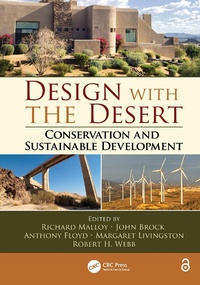
Design with the Desert
Conservation and Sustainable Development
Published on 19. April 2016
620 pages
978-1-000-21884-8 (ISBN)
Description

Typical development in the American Southwest often resulted in scraping the desert lands of the ancient living landscape, to be replaced with one that is human-made and dependent on a large consumption of energy and natural resources. This transdisciplinary book explores the natural and built environment of this desert region and introduces development tools for shaping its future in a more sustainable way. It offers valuable insights to help promote ecological balance between nature and the built environment in the American Southwest-and in other ecologically fragile regions around the world.
More details
Language
English
Place of publication
London
United Kingdom
Publishing group
Taylor & Francis Ltd
Target group
College/higher education
File size
48,35 MB
ISBN-13
978-1-000-21884-8 (9781000218848)
Copyright in bibliographic data and cover images is held by Nielsen Book Services Limited or by the publishers or by their respective licensors: all rights reserved.
Schweitzer Classification
Other editions
Additional editions
Richard Malloy | John Brock | Anthony Floyd
Design with the Desert
Conservation and Sustainable Development
Book
03/2017
1st Edition
CRC Press
€126.40
Shipment within 10-20 days
Richard Malloy | John Brock | Anthony Floyd
Design with the Desert
Conservation and Sustainable Development
Book
01/2013
1st Edition
CRC Press
€295.50
Shipment within 15-20 days
Persons
Richard A. Malloy is a manager for environmental projects for Arizona State University for the School of Applied Sciences and Mathematics and the Biodesign Institute. He currently oversees projects and facilities dedicated to advancing biotechnology and sustainable solutions to environmental challenges for Arizona State University.
John H. Brock is professor emeritus at the School of Applied Sciences and Mathematics department at Arizona State University (ASU) and founder of the firm Brock Habitat Restoration & Invasive Plant Management LLC. He operates a consulting firm in the area of invasive plant management and landscape restoration.
Anthony C. Floyd, AIA, is a registered architect and green building program manager for the City of Scottsdale. He maintains the city's green building rating standards for residential and commercial development and helps to facilitate Scottsdale's LEED gold mandate for newly constructed and renovated public facilities.
Margaret Livingston is a professor in the School of Landscape Architecture and Planning at the University of Arizona. She teaches a range of courses related to ecological and environmental issues in arid environments and has locally and internationally conducted lectures and workshops that focus on water conservation, wildlife habitat, and use of native plants in urban areas.
Robert H. Webb has worked on long-term changes in natural ecosystems of the southwestern United States since 1976. Since 1985, he has been a research hydrologist with the U.S. Geological Survey in Tucson and an adjunct faculty member of the Departments of Geosciences and Hydrology and Water Resources at the University of Arizona. He has authored, coauthored, or edited 12 books.
John H. Brock is professor emeritus at the School of Applied Sciences and Mathematics department at Arizona State University (ASU) and founder of the firm Brock Habitat Restoration & Invasive Plant Management LLC. He operates a consulting firm in the area of invasive plant management and landscape restoration.
Anthony C. Floyd, AIA, is a registered architect and green building program manager for the City of Scottsdale. He maintains the city's green building rating standards for residential and commercial development and helps to facilitate Scottsdale's LEED gold mandate for newly constructed and renovated public facilities.
Margaret Livingston is a professor in the School of Landscape Architecture and Planning at the University of Arizona. She teaches a range of courses related to ecological and environmental issues in arid environments and has locally and internationally conducted lectures and workshops that focus on water conservation, wildlife habitat, and use of native plants in urban areas.
Robert H. Webb has worked on long-term changes in natural ecosystems of the southwestern United States since 1976. Since 1985, he has been a research hydrologist with the U.S. Geological Survey in Tucson and an adjunct faculty member of the Departments of Geosciences and Hydrology and Water Resources at the University of Arizona. He has authored, coauthored, or edited 12 books.
Content
Introduction. Physical Aspects of the Desert Environment: Deserts of the World. Geology and Soils in Deserts of the Southwestern United States. Scales of Climate in Designing with the Desert. Water Resources in the Desert Southwest. Geologic, Hydrologic, and Urban Hazards for Design in Desert Environments. The Living Desert: Deep History and Biogeography of La Frontera. Vegetation Zones of the Southwest. Plant Ecology of the Sonoran Desert Region. Wildlife and Anthropogenic Changes in the Arid Southwest. Healing the Wounds: An Example from the Sky Islands. Built toBurn. Restoring Ecosystem Health in Frequent-Fire Forests of the American West. Desert Planning: Ecological Planning Method. Phoenix as Every City: A Closer Look at Sprawl in the Desert. Water Planning for Growing Southwestern Communities. Removable and Placed-Based Economies: Alternative Futures for America's Deserts. Environmental Injustice in the Urban Southwest: A Case Study of Phoenix, Arizona. Dwelling in Expanded Biotic Communities: Steps Toward Reconstructive Postmodern Communities. Dialogue on Development. Ecology in Design of Urban Systems: Ecological Design. Rainwater Harvesting and Stormwater Reuse for Arid Environments. Designing Habitats in Urban Environments. Native Plant Salvaging and Reuse in Southwestern Deserts. Sustainable Urban Living: Green Solar Energy for Food and Biofuels Production. Integral Urbanism in Desert Cities: Recapturing Links in Metro Phoenix. Urban Sustainability: Settlement, Growth, and Water Security for Southwest Cities. Creating Tomorrow. Desert Vernacular: Green Building and Ecological Design in Scottsdale, Arizona. Sustainable Energy Alternatives for the Southwest. Search for a Lean Alternative. Creating Sustainable Futures for Southwestern Cities: The ProtoCity Approach in the Ciudad Juarez Mexico/El Paso, Texas Metroplex. Index.
