

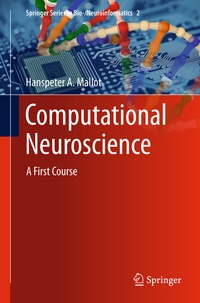
Computational Neuroscience
Description

Computational Neuroscience - A First Course provides an essential introduction to computational neuroscience and equips readers with a fundamental understanding of modeling the nervous system at the membrane, cellular, and network level. The book, which grew out of a lecture series held regularly for more than ten years to graduate students in neuroscience with backgrounds in biology, psychology and medicine, takes its readers on a journey through three fundamental domains of computational neuroscience: membrane biophysics, systems theory and artificial neural networks. The required mathematical concepts are kept as intuitive and simple as possible throughout the book, making it fully accessible to readers who are less familiar with mathematics. Overall, Computational Neuroscience - A First Course represents an essential reference guide for all neuroscientists who use computational methods in their daily work, as well as for any theoretical scientist approaching the field of computational neuroscience.
Reviews / Votes
"A useful guide for any neuroscientist desiring to incorporate computational methods into their research. The book covers three fundamental areas of computational neuroscience: membrane physics, systems theory, and artificial neural networks. . At the end each chapter, suggested reading materials are listed to help guide the reader to supporting resources which will fill in background material and\or extend the topic presented." (Stanley R. Huddy, Mathematical Reviews, May, 2015)
"This book focuses on basic mathematical modeling approaches and computational methods in neuroscience, and it is a significant presentation of some basic aspects of computational neuroscience. . I recommend it for students and researchers in neuroscience who are interested in mathematical modeling and computational methods." (Jin Liang, zbMATH 1317.92001, 2015)
"This is a good text discussing the mathematic neuromodeling introducing differential calculus inc. differential and partial differentional equations as they apply to temporal- spatial dynamics of the neural code. I recommend this book for all audiences with an interest in neuroscience." (Joseph J. Grenier, Amazon.com, August, 2014)
More details
Other editions
Additional editions
Person
Hanspeter Mallot received his PhD from the Faculty of Biology, University of Mainz, Germany, in 1986. In the following years, he held postdoctoral and research positions at the Massachusetts Institute of Technology, the Ruhr-University Bochum, the Max-Planck-Institute for Biological Cybernetics in Tübingen and the Institute for Advanced Study, Berlin. In 2000, he was appointed Professor of Cognitive Neuroscience at the Eberhard-Karls-University, Tübingen. Research focusses on spatial cognition in rats, humans and robots, using behavioral experiments in virtual reality, eye-movement recordings, and simulated agents in hard- and software.
Hanspeter Mallot is currently Professor of Cognitive Neuroscience . He is a member of the editorial board of the journal "Spatial Cognition and Computation". In the past, he served as a president of the European Neural Network Society (ENNS), as president of the German Society for Cognitive Science (GK) and as a member of the Neuroscience review pannel of the Deutsche Forschungsgemeinschaft.
