

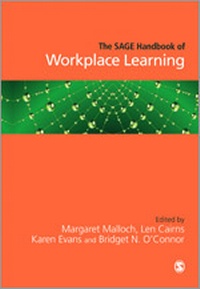
The SAGE Handbook of Workplace Learning
1st Edition
Published on 21. September 2010
504 pages
978-1-4462-4841-6 (ISBN)
Description

This Handbook provides a state-of-the art overview of the field of workplace learning from a global perspective. The authors are all well-placed theoreticians, researchers, and practitioners in this burgeoning field, which cuts across higher education, vocational education and training, post-compulsory secondary schooling, and lifelong education. The volume provides a broad-based, yet incisive analysis of the range of theory, research, and practical developments in workplace learning.
The editors draw together the three essential areas of Theory; Research and Practice; and Issues and Futures in the field of Workplace Learning. In addition, final chapters include recommendations for further development.
Key researchers and writers in the field have approached workplaces as the base of learning about work, that is, work-based learning. There has also been emerging interest in variations of this idea such as learning about, through, and at work. Many of the theoretical discussions have centred on adult learning and some on learners managing their own learning, with emphasis on aspects such as communities of practice and self directed learning.
In Europe and Australia, early work in the field was often linked to the Vocational Education and Training (VET) traditions with concerns around skills, competencies and 'on the job' learning. The idea that learning and workplaces had more to do with real lifelong and lifewide aspects than traditional "training" regimens has emerged in the last decade. Since the mid 1990s, the field has grown world-wide as an area of theory, research, and practical work that has not only expanded the interest but has also legitimized the area as a field of study, reflection, and progress.
The SAGE Handbook of Workplace Learning draws together a wide range of views, theoretical dispositions, and assertions and provides a leading-edge presentation by key writers and researchers with insight into the field and its current state. It is a resource for researchers and academics interested in the scope and breadth of Workplace Learning..
The editors draw together the three essential areas of Theory; Research and Practice; and Issues and Futures in the field of Workplace Learning. In addition, final chapters include recommendations for further development.
Key researchers and writers in the field have approached workplaces as the base of learning about work, that is, work-based learning. There has also been emerging interest in variations of this idea such as learning about, through, and at work. Many of the theoretical discussions have centred on adult learning and some on learners managing their own learning, with emphasis on aspects such as communities of practice and self directed learning.
In Europe and Australia, early work in the field was often linked to the Vocational Education and Training (VET) traditions with concerns around skills, competencies and 'on the job' learning. The idea that learning and workplaces had more to do with real lifelong and lifewide aspects than traditional "training" regimens has emerged in the last decade. Since the mid 1990s, the field has grown world-wide as an area of theory, research, and practical work that has not only expanded the interest but has also legitimized the area as a field of study, reflection, and progress.
The SAGE Handbook of Workplace Learning draws together a wide range of views, theoretical dispositions, and assertions and provides a leading-edge presentation by key writers and researchers with insight into the field and its current state. It is a resource for researchers and academics interested in the scope and breadth of Workplace Learning..
Reviews / Votes
'Over the past decade, workplace learning has become one of the major areas of development for business, management and education. Yet ideas about it are diverse and complex and its practice is affected by competing influences and differing perspectives. This essential guide brings together many of the world's leading scholars to clarify and explore the various concepts and approaches in ways that will benefit practitioners, researchers, educators and policymakers alike'Tom Nesbit
Simon Fraser University "I would recommend it to both serious academics and those who frivolously wish to sample the topic." -- Fiona Reeve * London Review of Education * As a nurse, manager and now researcher concerned with healthcare education I found this volume interesting and thought provoking... this volume provides a starting point to explore the evidence underpinning workplace learning, and encourages a wider appreciation of different perspectives and different work places. -- Nigel Davies
All prices
More details
Language
English
Place of publication
London
United Kingdom
Target group
Professional and scholarly
ISBN-13
978-1-4462-4841-6 (9781446248416)
Copyright in bibliographic data and cover images is held by Nielsen Book Services Limited or by the publishers or by their respective licensors: all rights reserved.
Schweitzer Classification
Other editions
Additional editions
Margaret Malloch | Len Cairns | Karen Evans
The SAGE Handbook of Workplace Learning
Book
03/2013
1st Edition
SAGE Publications Ltd
€64.10
Shipment within 15-20 days
Margaret Malloch | Len Cairns | Karen Evans
The SAGE Handbook of Workplace Learning
Book
09/2010
1st Edition
SAGE Publications Ltd
€200.40
Shipment within 15-20 days
Persons
Leonard Cairns, PhD, FRSA, is an Adjunct Associate professor at Monash University, Australia, and was previously Associate dean in the Faculty of Education, at Monash University. Len is a past Chair of the Workplace Learning Special Interest Group of the American Educational Research Association and has been a long-time member of the EERA, VETNET group. Len is an associate editor of a number of international journals and reviews for journals in the areas of VET, Management and Learning and Teacher Education. His research on work, learning and VET, and Capability Theory and application, has led to many publications. Past SAGE edited books have included The SAGE Handbook of Workplace Learning (Malloch, Cairns, Evans and O'Connor, Eds, 2011) and the four volume "major work", Learning and Teaching in Higher Education, (Malloch, Cairns and O'Connor Eds, 2016).
Karen Evans, PhD, FAcSS is Emeritus Professor of Education at UCL Institute of Education. She held the Chair in Education in the Department of Education, Practice and Society at UCL and served as Head of Lifelong Education and International Development in the Institute of Education, University of London. Karen's research and publications focus on learning in the life and work transitions of youth and adulthood. Honorary Professorships currently include the UK Economic and Social Research Council Centre for Learning and Life Chances (LLAKES, UCL) and RMIT University, Australia. She also plays leading roles in the Asia-Europe Education and Research Hub for Lifelong Learning and in VETNET (European Educational Research Association). She was honoured to be awarded the European Commission's Vocational Education and Training Research Award in 2017. Bridget N. O'Connor, Ph.D., is Professor Emerita, Higher Education and Business Education, New York University where she taught graduate level courses including curriculum development and workplace learning. In addition to her work with SAGE Publishing, her work includes six college-level textbooks related to either end-user computing or learning in the workplace. Bridget chaired AERA's Special Interest Group Workplace Learning and was president of the Organizational Systems Research Association, and editor of its journal. Bridget was a Peace Corps Volunteer in Kabul, Afghanistan, and a Fulbright Senior Specialist at Victoria University in Melbourne, Australia. She either chaired or served as a member of 60 NYU doctoral committees; several of her students have won national research awards.
Karen Evans, PhD, FAcSS is Emeritus Professor of Education at UCL Institute of Education. She held the Chair in Education in the Department of Education, Practice and Society at UCL and served as Head of Lifelong Education and International Development in the Institute of Education, University of London. Karen's research and publications focus on learning in the life and work transitions of youth and adulthood. Honorary Professorships currently include the UK Economic and Social Research Council Centre for Learning and Life Chances (LLAKES, UCL) and RMIT University, Australia. She also plays leading roles in the Asia-Europe Education and Research Hub for Lifelong Learning and in VETNET (European Educational Research Association). She was honoured to be awarded the European Commission's Vocational Education and Training Research Award in 2017. Bridget N. O'Connor, Ph.D., is Professor Emerita, Higher Education and Business Education, New York University where she taught graduate level courses including curriculum development and workplace learning. In addition to her work with SAGE Publishing, her work includes six college-level textbooks related to either end-user computing or learning in the workplace. Bridget chaired AERA's Special Interest Group Workplace Learning and was president of the Organizational Systems Research Association, and editor of its journal. Bridget was a Peace Corps Volunteer in Kabul, Afghanistan, and a Fulbright Senior Specialist at Victoria University in Melbourne, Australia. She either chaired or served as a member of 60 NYU doctoral committees; several of her students have won national research awards.
Content
PART ONE: THEORY
Theories of Work, Place and Learning: New Directions - Len Cairns and Margaret Malloch
Theories of Workplace Learning - Paul Hager
Workplaces and Learning - Knud Illeris
Workplace Learning and the Organization - Alison Fuller and Lorna Unwin
Subjectivity, Self and Personal Agency in Learning Through and for Work - Stephen Billet
Learning in the Workplace: Communities of Practice and Beyond - Len Cairns
Activity Theory and Learning at Work - Yrjo Engestrom
Informal Learning at Work: Conditions, Processes and Logics - Per Erik Ellstrom
Towards a Meta-Theory of Learning and Performance - Darlene Russ-Eft
Knowledge and Workplace Learning - Nicholas M Allix
Rethinking Work-Based Learning: For Education Professionals and Professionals Who Educate - Karen Evans, David Guile and Judy Harris
PART TWO: RESEARCH AND PRACTICE
Researching Workplace Learning: An Overview and Critique - Peter H Sawchuck
How Researching Learning at Work can Lead to Tools for Enhancing Learning - Michael Eraut
Researching Workplace Learning in the United States - Victoria Marsick, Karen Watkins and Bridget N O'Connor
Researching Workplace Learning in Australia - Nicky Solomon and David Boud
Researching Workplace Learning in Europe - Hans Gruber and Christian Harteis
Initiatives in VET and Workplace Learning: A Korean Perspective - Sang-Duk Choi
Age Management in Organisations in the European Union - Gerhard Naegele and Alan Walker
Work and Learning: From Schools to Workplaces - Richard D Lakes
Competency-based Training and its Impact on Workplace Learning in Australia - Allie Clemans and Peter Rushbrook
Work-related Learning in the United States: Past Practices, Paradigm Shifts, and Policies of Partnerships - John M Dirkx
Workplace Learning in East Africa: A Case Study - Martin Mulder and Judith Gulikers
Policies for the Knowledge Economy: Knowledge Discourses at Play - Tara Fenwick
Virtual Workplace Learning: Promises Met? - Robert G Brookshire, Kara M Lybarger and Lynn B Keane
Seeing Workplace Learning through an Emotional Lens - Brenda R Beatty
Towards a Social Ecology of Adult Learning in and through the Workplace - Karen Evans, Edmund Waite, and Natasha Kersh
PART THREE: ISSUES AND FUTURES
Beyond the Workplace: Learning in the Lifeplace - Margaret Harris and Colin Chisholm
Workplace Learning in the Knowledge Economy: The Development of Vocational Practice and Social Capital - David Guile
Workplace Learning and Higher Education - Carol Costley
Identifying and Classifying Corporate Universities in the United States - Amy Lui-Abel
Partnerships Between and Among Education and the Public and Private Sectors - Bridget N O'Connor and Doug Lynch
Brave New Workplace: The Impact of Technology on Location and Job Structures - Elizabeth Regan and Chester Delaney
Technology and Knowledge Management - Jingli Cheng, Su Jin Son and Curtis J Bonk
Workplace Learning: Organizations, Ethics and Issues - Craig E Johnson
Theories of Work, Place and Learning: New Directions - Len Cairns and Margaret Malloch
Theories of Workplace Learning - Paul Hager
Workplaces and Learning - Knud Illeris
Workplace Learning and the Organization - Alison Fuller and Lorna Unwin
Subjectivity, Self and Personal Agency in Learning Through and for Work - Stephen Billet
Learning in the Workplace: Communities of Practice and Beyond - Len Cairns
Activity Theory and Learning at Work - Yrjo Engestrom
Informal Learning at Work: Conditions, Processes and Logics - Per Erik Ellstrom
Towards a Meta-Theory of Learning and Performance - Darlene Russ-Eft
Knowledge and Workplace Learning - Nicholas M Allix
Rethinking Work-Based Learning: For Education Professionals and Professionals Who Educate - Karen Evans, David Guile and Judy Harris
PART TWO: RESEARCH AND PRACTICE
Researching Workplace Learning: An Overview and Critique - Peter H Sawchuck
How Researching Learning at Work can Lead to Tools for Enhancing Learning - Michael Eraut
Researching Workplace Learning in the United States - Victoria Marsick, Karen Watkins and Bridget N O'Connor
Researching Workplace Learning in Australia - Nicky Solomon and David Boud
Researching Workplace Learning in Europe - Hans Gruber and Christian Harteis
Initiatives in VET and Workplace Learning: A Korean Perspective - Sang-Duk Choi
Age Management in Organisations in the European Union - Gerhard Naegele and Alan Walker
Work and Learning: From Schools to Workplaces - Richard D Lakes
Competency-based Training and its Impact on Workplace Learning in Australia - Allie Clemans and Peter Rushbrook
Work-related Learning in the United States: Past Practices, Paradigm Shifts, and Policies of Partnerships - John M Dirkx
Workplace Learning in East Africa: A Case Study - Martin Mulder and Judith Gulikers
Policies for the Knowledge Economy: Knowledge Discourses at Play - Tara Fenwick
Virtual Workplace Learning: Promises Met? - Robert G Brookshire, Kara M Lybarger and Lynn B Keane
Seeing Workplace Learning through an Emotional Lens - Brenda R Beatty
Towards a Social Ecology of Adult Learning in and through the Workplace - Karen Evans, Edmund Waite, and Natasha Kersh
PART THREE: ISSUES AND FUTURES
Beyond the Workplace: Learning in the Lifeplace - Margaret Harris and Colin Chisholm
Workplace Learning in the Knowledge Economy: The Development of Vocational Practice and Social Capital - David Guile
Workplace Learning and Higher Education - Carol Costley
Identifying and Classifying Corporate Universities in the United States - Amy Lui-Abel
Partnerships Between and Among Education and the Public and Private Sectors - Bridget N O'Connor and Doug Lynch
Brave New Workplace: The Impact of Technology on Location and Job Structures - Elizabeth Regan and Chester Delaney
Technology and Knowledge Management - Jingli Cheng, Su Jin Son and Curtis J Bonk
Workplace Learning: Organizations, Ethics and Issues - Craig E Johnson
