

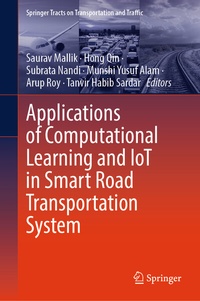
Applications of Computational Learning and IoT in Smart Road Transportation System
Description

This book discusses machine learning and AI in real-time image processing for road transportation and traffic management. There is a growing need for affordable solutions that make use of cutting-edge technology like artificial intelligence (AI), machine learning (ML), and the Internet of Things (IoT). The efficiency, sustainability, and safety of transport networks can be greatly increased by implementing an Internet of Things (IoT) and machine learning (ML)-based smart road transport system. Install sensors on roadways and intersections to gather data on traffic conditions in real time, such as vehicle density, speed, and flow. Predicting traffic patterns is done by analyzing the gathered data using machine learning algorithms. This can lessen traffic, enhance overall traffic management, and optimize traffic signal timings. Vehicles equipped with Internet of Things devices can have their health monitored in real time. Parameters including lane changes, brake condition, tire pressure, and engine performance can all be monitored by sensors. Based on the gathered data, ML models are used to forecast probable maintenance problems. By scheduling preventive maintenance, failures can be avoided and overall road safety can be increased. Create a smartphone app that would enable drivers to locate parking spots in their area. To forecast parking availability based on past data, the time of day, and special events, apply machine learning algorithms. Integrate Internet of Things (IoT) sensors into fleet vehicles to monitor their performance, location, and fuel consumption. To maximize fleet efficiency, reduce fuel consumption, and plan routes more effectively, apply machine learning algorithms. Train ML models to forecast the quickest and most efficient routes with the help of historical data analysis. Route recommendations for drivers or fleet management systems can be constantly adjusted with real-time updates, which contain real-time data on road conditions, accidents, and construction. To guarantee smooth integration and efficient implementation, government organizations, transportation providers, and technology firms must work together.
More details
Other editions
Additional editions
Persons
Content
Future Intelligent Vehicles: Research Roadmaps, Open Issues, and Key Challenges.- Speed Breaker and Vehicle Accident Detection with Alert Sensors.- Integrating Machine Learning and IoT: Pioneering Solutions for Sustainable Smart Cities.- Enhancing Emergency Response and Traffic Management with a Smart Ambulance Detection System Using Image Processing.- IoT-Driven Machine Learning Solutions for Smarter Urban Living.- Revolutionizing Road Transportation: The Role of Artificial Intelligence in Smart and Efficient Systems.- Recent Advancements and Future Perspectives of Dynamic Fuzzy Controllers for Smart Traffic Signaling.- Road Transport in the New Era Using Artificial Intelligence.- A Survey on Driver's Unusual Behaviour Detection.- Optimization Strategies for Next-Generation AI, ML, and IoT Applications.- Smart Traffic Systems: Revolutionizing Road Transport with AI and Image Processing.- Harnessing IoT and Machine Learning for Sustainable, Smart Urban Environments.- Smart Traffic Management: Automated Rerouting and Congestion Detection with Sensor Technology.
