

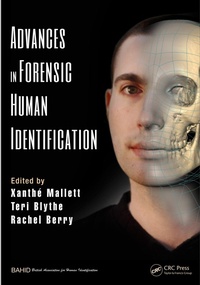
Advances in Forensic Human Identification
1st Edition
Published on 24. January 2014
474 pages
978-1-040-08106-8 (ISBN)
Description

As forensic human identification receives increased global attention, practitioners, policy makers, and students need an appropriate resource that describes current methods and modalities that have shaped today's policies and protocols. A supplemental follow-up to Forensic Human Identification: An Introduction, Advances in Forensic Human Identification covers advances in the most well-known scientific techniques and discusses new and developing subjects and modalities of human identification.
A collection of contributions from worldwide experts, the book embraces a broad context and looks at several issues beyond physical identification of human remains or offenders. The book examines online, sexual, and biometric identities and discusses problems associated with investigative practice, such as the developing use of the Internet as a distribution and communication medium for criminal activities. It also explores miscarriages of justice that can result from flawed applications or interpretations of forensic evidence. Finally, it looks at the future of forensic science in the United Kingdom in light of financial challenges and the closure of the Forensic Science Service. Where appropriate, case studies illustrate the use of techniques and the associated problems described in the text. The downloadable resources include images in full color.
This volume provides an important contribution to the ongoing practitioner and academic debates surrounding the application of forensic technologies. The insight presented is destined to springboard further inquiry into enhanced techniques and underlies the need for more research into the appropriate use of identification techniques to solve the mysteries of the unknown.
A collection of contributions from worldwide experts, the book embraces a broad context and looks at several issues beyond physical identification of human remains or offenders. The book examines online, sexual, and biometric identities and discusses problems associated with investigative practice, such as the developing use of the Internet as a distribution and communication medium for criminal activities. It also explores miscarriages of justice that can result from flawed applications or interpretations of forensic evidence. Finally, it looks at the future of forensic science in the United Kingdom in light of financial challenges and the closure of the Forensic Science Service. Where appropriate, case studies illustrate the use of techniques and the associated problems described in the text. The downloadable resources include images in full color.
This volume provides an important contribution to the ongoing practitioner and academic debates surrounding the application of forensic technologies. The insight presented is destined to springboard further inquiry into enhanced techniques and underlies the need for more research into the appropriate use of identification techniques to solve the mysteries of the unknown.
More details
Edition
1. Auflage
Language
English
Place of publication
London
United Kingdom
Publishing group
Taylor & Francis Ltd
Target group
Professional and scholarly
ISBN-13
978-1-040-08106-8 (9781040081068)
Copyright in bibliographic data and cover images is held by Nielsen Book Services Limited or by the publishers or by their respective licensors: all rights reserved.
Schweitzer Classification
Other editions
Additional editions
Xanthe Mallett | Teri Blythe | Rachel Berry
Advances in Forensic Human Identification
Book
10/2024
1st Edition
CRC Press
€82.00
Shipment within 10-20 days
Xanthe Mallett | Teri Blythe | Rachel Berry
Advances in Forensic Human Identification
Book
01/2014
1st Edition
CRC Press
€179.81
Shipment within 15-20 days
Persons
Xanth?allett is a lecturer in criminological sociology and forensic science based in Australia. She has worked on a collaborative facial recognition project with the FBI, undertaken casework in the area of child sex abuse, and has coauthored expert witness reports. Her research relates to behavior patterns of sex offenders, and societal, legal, and political responses to cases of child sexual abuse on an international scale. Xanth?as been involved with BAHID (British Association for Human Identification) for many years, fulfilling several roles including serving as student representative, conference convener, and membership secretary. She has also presented and contributed to a number of television series, including History Cold Case, The Decrypters, National Treasures Live, Coast Australia, and Wanted.
Teri Blythe is a specialist in forensic art and human identification with a background in human anatomy and forensic anthropology. She has spent many years working in the field of missing persons, including as head of identification while with the Missing People charity. Her expertise includes forensic artwork such as postmortem facial reconstructions and both child and adult age progressions. Teri has been a council member of BAHID for a number of years.
Rachel Berry is currently undertaking a PhD in biomedical engineering at the University of Auckland, New Zealand. She holds a BSc (hons) in forensic anthropology, an MSc in human identification and has more than five years experience demonstrating gross human anatomy. Her previous research projects include the impact of scavenging on the recovery of human remains, evaluation of the potential of geometric morphometric techniques to identify offenders by the shape of their hand, and human provenancing using stable isotope analysis of hair and bone. Rachel was previously a member of the Council for the British Association for Human Identification.
Teri Blythe is a specialist in forensic art and human identification with a background in human anatomy and forensic anthropology. She has spent many years working in the field of missing persons, including as head of identification while with the Missing People charity. Her expertise includes forensic artwork such as postmortem facial reconstructions and both child and adult age progressions. Teri has been a council member of BAHID for a number of years.
Rachel Berry is currently undertaking a PhD in biomedical engineering at the University of Auckland, New Zealand. She holds a BSc (hons) in forensic anthropology, an MSc in human identification and has more than five years experience demonstrating gross human anatomy. Her previous research projects include the impact of scavenging on the recovery of human remains, evaluation of the potential of geometric morphometric techniques to identify offenders by the shape of their hand, and human provenancing using stable isotope analysis of hair and bone. Rachel was previously a member of the Council for the British Association for Human Identification.
Content
Identifying the Unknown. Two Sides of the Same Coin: Missing and Unidentified People. Identification: The Coroner's Perspective. Identification of Missing Persons and Unidentified Remains in Disaster Victim Identification: Recommendations and Best Practice. Child Sex Offender Demographics: Toward an Improved Understanding. Identification from Soft and Hard Tissues. Distinguishing Human from Nonhuman Bone.Burnt Human Remains Part I: Fire Dynamics and Body Recovery. Burnt Human Remains Part II: Identification and Laboratory Analysis. Stable Isotopes and Human Provenancing. Multidisciplinary Approach toward the Identification of a Human Skull Found 55 km off the Southeast Coast of Ireland. Digital and Biometric Evidence. Image Analysis: Forensic Facial Comparison: Issues and Misconceptions. Developments in Forensic Facial Composites. Virtual Anthropology and Virtopsy in Human Identification. RNA Profiling: A New Tool in Forensic Science. Advances in Fingerprint Techniques. Legal Issues: An International Perspective. Admissibility of Expert Evidence. Expert Scientific Evidence in the Investigation and Prosecution of Child Sexual Abuse in Adversarial Jurisdictions. Child Sex Tourism at the US Mexico Border. Forensic Identification and Miscarriages of Justice in England and Wales. Forensic Science Evidence and Miscarriages of Justice. Future Considerations and Conclusions. Future of Forensic Science in the United Kingdom. Index.
