
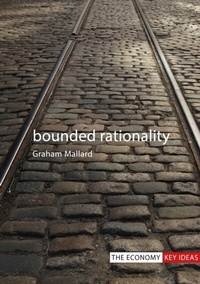
Bounded Rationality
Description
Alles über E-Books | Antworten auf Fragen rund um E-Books, Kopierschutz und Dateiformate finden Sie in unserem Info- & Hilfebereich.
Understanding how we take economic decisions and how we depart from rational choice theory has become increasingly important to understanding the workings of the economy at all levels. The concept of bounded rationality has been central to that endeavour and is used in economic models to shed light on real-life behaviour, which has led to specific policy implications that would otherwise have gone unappreciated.
This introduction presents the key concepts and approaches adopted in the field of bounded rationality. The exposition is non-technical and free from any mathematical expressions and workings. The focus throughout is primarily on the behaviour of individuals or organizations within given situations rather than on macroeconomic concerns. The book examines how the field has evolved since its beginnings and assesses the strengths and weaknesses of its current research programme, including its relationship with behavioural economics.
The book is excellent preparatory reading for degree-level courses in economics as well as specific courses in behavioural economics and philosophy of economics.
All prices
More details
Other editions
Additional editions
Person
Graham Mallard is Head of Economics at Clifton College. He gained his PhD in economics from the University of Bath in 2011, where he remains a Visiting Research Fellow. He is the author of two successful textbooks: The Economics Companion (2011) and Transport Economics (co-authored with Stephen Glaister) (2008).
Content
1. Different conceptions of decision-making2. A brief history3. Good enough4. Optimization with additional constraints5. Reflections on the story
Glossary

System requirements
File format: ePUB
Copy protection: Adobe-DRM (Digital Rights Management)
System requirements:
- Computer (Windows; MacOS X; Linux): Install the free reader Adobe Digital Editions prior to download (see eBook Help).
- Tablet/smartphone (Android; iOS): Install the free app Adobe Digital Editions or the app PocketBook before downloading (see eBook Help).
- E-reader: Bookeen, Kobo, Pocketbook, Sony, Tolino and many more (not Kindle).
The file format ePub works well for novels and non-fiction books – i.e., „flowing” text without complex layout. On an e-reader or smartphone, line and page breaks automatically adjust to fit the small displays.
This eBook uses Adobe-DRM, a „hard” copy protection. If the necessary requirements are not met, unfortunately you will not be able to open the eBook. You will therefore need to prepare your reading hardware before downloading.
Please note: We strongly recommend that you authorise using your personal Adobe ID after installation of any reading software.
For more information, see our ebook Help page.
File format: ePUB
Copy protection: Watermark-DRM (Digital Rights Management)
System requirements:
- Computer (Windows; MacOS X; Linux): Use a reading software that can process the file format ePUB: e.g., Adobe Digital Editions or FBReader – both free (see eBook Help).
- Tablet/Smartphone (Android; iOS): Before downloading, install the free app Adobe Digital Editions (see eBook Help).
- E-reader: Bookeen, Kobo, Pocketbook, Sony, Tolino and many more (not Kindle).
The file format ePUB works well for novels and non-fiction books – i.e., „flowing” text without complex layout. On an e-reader or smartphone, line and page breaks automatically adjust to fit the small displays.
This eBook uses Watermark-DRM, a „soft” copy protection. This means that there are no technical restrictions to prevent illegal distribution. However, there is a personalised watermark embedded in the eBook that can be used to identify the purchaser of the eBook in the event of misuse and to provide evidence for legal purposes.
For more information, see our eBook Help page.