
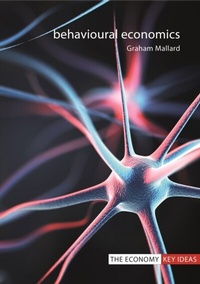
Behavioural Economics
Description
Alles über E-Books | Antworten auf Fragen rund um E-Books, Kopierschutz und Dateiformate finden Sie in unserem Info- & Hilfebereich.
The rise of behavioural approaches in economics has been one of most significant developments in the study of economic decision-making in recent years. The increasingly acknowledged failings of standard models of choice to explain economic decisions has prompted economists to incorporate into their analysis psychological insights into individual behaviour, such as social cognitive and emotional biases. This book introduces the topic of behavioural economics to a beginning readership, explaining its approach and methodology and assessing its successes and weaknesses.
The book begins by tracing the evolution of the field from its origins in Adam Smith's moral sentiments through the work of Herbert Simon to Daniel Kahneman and Richard Thaler today. The book explores how behavioural economics has advanced our understanding of human preferences including notions of fairness, reciprocity and inequality aversion, and the mental processes involved in decision making, which vary with the complexity of the decision and the ability of the decision-maker to process the information. The decision-making of individuals within social and economic groups is explored, including financial practitioners and what this can mean for financial markets. Finally the book looks at the ways in which findings from behavioural economics have been used to alter the decisions people make, such as the nudge approach, and the ethics of such persuasion.
All prices
More details
Other editions
Additional editions
Person
Graham Mallard is Head of Economics at Clifton College. He gained his PhD in economics from the University of Bath in 2011, where he remains a Visiting Research Fellow. He is the author of two successful textbooks: The Economics Companion (2011) and Transport Economics (co-authored with Stephen Glaister) (2008).
Content
1. Empiricism Returns
2. Evolution and Revolution
3. Preferences
4. Processes
5. Participation
6. Persuasion
7. Reflections

System requirements
File format: ePUB
Copy protection: Adobe-DRM (Digital Rights Management)
System requirements:
- Computer (Windows; MacOS X; Linux): Install the free reader Adobe Digital Editions prior to download (see eBook Help).
- Tablet/smartphone (Android; iOS): Install the free app Adobe Digital Editions or the app PocketBook before downloading (see eBook Help).
- E-reader: Bookeen, Kobo, Pocketbook, Sony, Tolino and many more (not Kindle).
The file format ePub works well for novels and non-fiction books – i.e., „flowing” text without complex layout. On an e-reader or smartphone, line and page breaks automatically adjust to fit the small displays.
This eBook uses Adobe-DRM, a „hard” copy protection. If the necessary requirements are not met, unfortunately you will not be able to open the eBook. You will therefore need to prepare your reading hardware before downloading.
Please note: We strongly recommend that you authorise using your personal Adobe ID after installation of any reading software.
For more information, see our ebook Help page.
File format: ePUB
Copy protection: Watermark-DRM (Digital Rights Management)
System requirements:
- Computer (Windows; MacOS X; Linux): Use a reading software that can process the file format ePUB: e.g., Adobe Digital Editions or FBReader – both free (see eBook Help).
- Tablet/Smartphone (Android; iOS): Before downloading, install the free app Adobe Digital Editions (see eBook Help).
- E-reader: Bookeen, Kobo, Pocketbook, Sony, Tolino and many more (not Kindle).
The file format ePUB works well for novels and non-fiction books – i.e., „flowing” text without complex layout. On an e-reader or smartphone, line and page breaks automatically adjust to fit the small displays.
This eBook uses Watermark-DRM, a „soft” copy protection. This means that there are no technical restrictions to prevent illegal distribution. However, there is a personalised watermark embedded in the eBook that can be used to identify the purchaser of the eBook in the event of misuse and to provide evidence for legal purposes.
For more information, see our eBook Help page.