

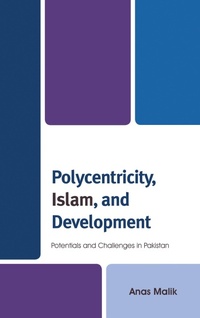
Polycentricity, Islam, and Development
Potentials and Challenges in Pakistan
1st Edition
Published on 26. December 2017
342 pages
978-1-4985-3976-0 (ISBN)
Description

Development analysts often focus on the role of "the state" in making the right rules by which to govern society, assuming that governance is exclusively or mainly the work of the central government authority. The reality in many developing countries, particularly those with weak central government authorities, is that governance happens through diverse rules and in many centers of decision-making, in ways that are formal and informal, official and unofficial. This real-world polycentricity can be dysfunctional or productive, depending in part on shared understandings between decision-making entities about how to relate to each other. Those shared understandings come from cultural backgrounds, historical interactions, and other sources.
Political economist Anas Malik argues that well-functioning polycentricity in developing countries depends in part on the shared understandings between official government entities and unofficial units that provide collective choice in particular arenas. In Muslim-majority contexts, the Islamic tradition - contrary to the image of a top-down, single-voiced religious law- provides ample resources supporting shared understandings that accommodate diverse rules and collective choice units. Pakistan, the largest Muslim-majority country at its founding, provides an important case. After building on the development literature to suggest a typology of collective choice units in developing countries, Malik explores resources in the Islamic tradition that support polycentric governance. The book then examines major deliberations in Pakistan's history, particularly through documented inquiries into serious political crises such as sectarian religious agitation and civil war, and through a selective survey of types of jurisdictions and collective choice units. Malik argues that there are significant polycentric understandings in Pakistan's historical lineage, but that these are heavily contested. While there is potential for polycentric development in Pakistan, the viability of polycentric order is constrained by countering forces and contextual factors.
Political economist Anas Malik argues that well-functioning polycentricity in developing countries depends in part on the shared understandings between official government entities and unofficial units that provide collective choice in particular arenas. In Muslim-majority contexts, the Islamic tradition - contrary to the image of a top-down, single-voiced religious law- provides ample resources supporting shared understandings that accommodate diverse rules and collective choice units. Pakistan, the largest Muslim-majority country at its founding, provides an important case. After building on the development literature to suggest a typology of collective choice units in developing countries, Malik explores resources in the Islamic tradition that support polycentric governance. The book then examines major deliberations in Pakistan's history, particularly through documented inquiries into serious political crises such as sectarian religious agitation and civil war, and through a selective survey of types of jurisdictions and collective choice units. Malik argues that there are significant polycentric understandings in Pakistan's historical lineage, but that these are heavily contested. While there is potential for polycentric development in Pakistan, the viability of polycentric order is constrained by countering forces and contextual factors.
More details
Edition
1. Auflage
Language
English
Place of publication
New York
United States
Publishing group
Bloomsbury Publishing Plc
Target group
Professional and scholarly
Illustrations
4 b/w illustrations; 2 tables
ISBN-13
978-1-4985-3976-0 (9781498539760)
Copyright in bibliographic data and cover images is held by Nielsen Book Services Limited or by the publishers or by their respective licensors: all rights reserved.
Schweitzer Classification
Other editions
Additional editions
Book
12/2017
Lexington Books
€147.40
Shipment within 15-20 days
Person
Anas Malik is associate professor of political science at Xavier University.
Content
- Cover
- Polycentricity, Islam, and Development
- Polycentricity, Islam, and Development
- Contents
- Preface and Acknowledgments
- Chapter 1
- Introduction
- Overview And Method
- Notes
- Chapter 2
- Polycentric Governance in a Weak State
- Polycentric Design
- Polycentric Design In A Weak State, Heterogeneous Society Context
- Type Iii Collective Choice Units
- Informal Institutions
- Metanorms For Polycentric Design
- Notes
- Chapter 3
- Polycentricity in Islamic Tradition
- Jurisprudential Tradition
- Political Islam, Modernity, And Polycentricity
- Concluding Note On Challenges And Bounds
- Notes
- Chapter 4
- Polycentric Metanorms and Islam in Pakistan
- The Pakistani Context
- National Self-conception
- Constitutional Crisis Over Polity Membership And Authorization
- Islam And The 1956 Constitution
- Conclusion
- Notes
- Chapter 5
- Jurisdictions and Collective Choice Units in Pakistan
- Type I Jurisdictions In Pakistan
- Type Ii Jurisdictions In Pakistan
- Type Iii Arrangements In Pakistan
- Conclusion
- Notes
- Chapter 6
- Viability
- Symbolic Contestation And Islamic Identity
- Supporting Self-governing Collective Choice Units
- Concluding Note
- Notes
- Bibliography
- Index
- About the Author
