

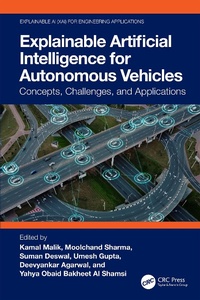
Explainable Artificial Intelligence for Autonomous Vehicles
Concepts, Challenges, and Applications
1st Edition
Published on 14. August 2024
204 pages
978-1-040-09929-2 (ISBN)
Description

Explainable AI for Autonomous Vehicles: Concepts, Challenges, and Applications is a comprehensive guide to developing and applying explainable artificial intelligence (XAI) in the context of autonomous vehicles. It begins with an introduction to XAI and its importance in developing autonomous vehicles. It also provides an overview of the challenges and limitations of traditional black-box AI models and how XAI can help address these challenges by providing transparency and interpretability in the decision-making process of autonomous vehicles. The book then covers the state-of-the-art techniques and methods for XAI in autonomous vehicles, including model-agnostic approaches, post-hoc explanations, and local and global interpretability techniques. It also discusses the challenges and applications of XAI in autonomous vehicles, such as enhancing safety and reliability, improving user trust and acceptance, and enhancing overall system performance. Ethical and social considerations are also addressed in the book, such as the impact of XAI on user privacy and autonomy and the potential for bias and discrimination in XAI-based systems. Furthermore, the book provides insights into future directions and emerging trends in XAI for autonomous vehicles, such as integrating XAI with other advanced technologies like machine learning and blockchain and the potential for XAI to enable new applications and services in the autonomous vehicle industry. Overall, the book aims to provide a comprehensive understanding of XAI and its applications in autonomous vehicles to help readers develop effective XAI solutions that can enhance autonomous vehicle systems' safety, reliability, and performance while improving user trust and acceptance.
This book:
Discusses authentication mechanisms for camera access, encryption protocols for data protection, and access control measures for camera systems.
Showcases challenges such as integration with existing systems, privacy, and security concerns while implementing explainable artificial intelligence in autonomous vehicles.
Covers explainable artificial intelligence for resource management, optimization, adaptive control, and decision-making.
Explains important topics such as vehicle-to-vehicle (V2V) communication, vehicle-to-infrastructure (V2I) communication, remote monitoring, and control.
Emphasizes enhancing safety, reliability, overall system performance, and improving user trust in autonomous vehicles.
The book is intended to provide researchers, engineers, and practitioners with a comprehensive understanding of XAI's key concepts, challenges, and applications in the context of autonomous vehicles. It is primarily written for senior undergraduate, graduate students, and academic researchers in the fields of electrical engineering, electronics and communication engineering, computer science and engineering, information technology, and automotive engineering.
This book:
Discusses authentication mechanisms for camera access, encryption protocols for data protection, and access control measures for camera systems.
Showcases challenges such as integration with existing systems, privacy, and security concerns while implementing explainable artificial intelligence in autonomous vehicles.
Covers explainable artificial intelligence for resource management, optimization, adaptive control, and decision-making.
Explains important topics such as vehicle-to-vehicle (V2V) communication, vehicle-to-infrastructure (V2I) communication, remote monitoring, and control.
Emphasizes enhancing safety, reliability, overall system performance, and improving user trust in autonomous vehicles.
The book is intended to provide researchers, engineers, and practitioners with a comprehensive understanding of XAI's key concepts, challenges, and applications in the context of autonomous vehicles. It is primarily written for senior undergraduate, graduate students, and academic researchers in the fields of electrical engineering, electronics and communication engineering, computer science and engineering, information technology, and automotive engineering.
More details
Series
Edition
1. Auflage
Language
English
Place of publication
London
United Kingdom
Publishing group
Taylor & Francis Ltd
Target group
College/higher education
Professional and scholarly
Illustrations
4 Tables, black and white; 18 Line drawings, black and white; 15 Halftones, black and white; 33 Illustrations, black and white
ISBN-13
978-1-040-09929-2 (9781040099292)
Copyright in bibliographic data and cover images is held by Nielsen Book Services Limited or by the publishers or by their respective licensors: all rights reserved.
Schweitzer Classification
Other editions
Additional editions
Kamal Malik | Moolchand Sharma | Suman Deswal
Explainable Artificial Intelligence for Autonomous Vehicles
Concepts, Challenges, and Applications
Book
approx. 06/2026
1st Edition
CRC Press
€69.00
Not yet published
Kamal Malik | Moolchand Sharma | Suman Deswal
Explainable Artificial Intelligence for Autonomous Vehicles
Concepts, Challenges, and Applications
Book
08/2024
1st Edition
CRC Press
€140.30
Shipment within 10-20 days

Kamal Malik | Moolchand Sharma | Suman Deswal
Explainable Artificial Intelligence for Autonomous Vehicles
Concepts, Challenges, and Applications
Book
08/2024
CRC Press
Unfortunately, price unknown
Available (delivery time upon request)
Persons
Kamal Malik is currently working as a Professor in CSE in the School of Engineering and Technology at CTU Ludhiana, Punjab, India. She has published Scientific Research Publications in reputed International Journals, including SCI and Scopus indexed Journals.
Moolchand Sharma is currently an Assistant Professor in the Department of Computer Science and Engineering at the Maharaja Agrasen Institute of Technology, GGSIPU Delhi. He has published scientific research publications in reputed international journals and conferences, including SCI-indexed and Scopus-indexed journals.
Suman Deswal holds a Ph.D. from DCR University of Science & Technology, Murthal, India. She completed her M. Tech (CSE) from Kurukshetra University, Kurukshetra, India, and B. Tech (Computer Science & Engg.) from CR State College of Engg., Murthal, India, in 2009 and 1998, respectively. She has 18 years of teaching experience and works as a Professor in the Department of Computer Science and Engineering at DCR University of Science and Technology, Murthal, India. Her research area includes wireless networks, heterogeneous networks, distributed systems, Machine Learning and Bioinformatics.
Umesh Gupta is currently an Associate Professor at the School of Computer Science Engineering and Technology at Bennett University, Times of India Group, Greater Noida, Uttar Pradesh, India. He received a Doctor of Philosophy (Ph.D.) (Machine Learning) from the National Institute of Technology, Arunachal Pradesh, India. He has awarded a gold medal for his Master of Engineering (M.E.) from the National Institute of Technical Teachers Training and Research (NITTTR), Chandigarh, India, and Bachelor of Technology (B.Tech.) from Dr. APJ, Abdul Kalam Technical University, Lucknow, India. His research interests include SVM, ELM, RVFL, machine learning, and deep learning approaches.
Deevyankar Agarwal is a lecturer at the University of Technology and Applied Sciences in Muscat, Oman. He works in the Engineering Department, EEE Section (Computer Engineering),. He has 22 years of teaching and research experience. He is currently a doctoral researcher at the University of Valladolid, Spain.
Yahya Obaid Al Shamsi is working as the Dean of Engineering at the University of Technology and Applied Sciences in Muscat, Oman. He has 25 years of teaching and research experience. He got his PhD from the University of Bath, Department of Architecture and Civil Engineering, UK.
Moolchand Sharma is currently an Assistant Professor in the Department of Computer Science and Engineering at the Maharaja Agrasen Institute of Technology, GGSIPU Delhi. He has published scientific research publications in reputed international journals and conferences, including SCI-indexed and Scopus-indexed journals.
Suman Deswal holds a Ph.D. from DCR University of Science & Technology, Murthal, India. She completed her M. Tech (CSE) from Kurukshetra University, Kurukshetra, India, and B. Tech (Computer Science & Engg.) from CR State College of Engg., Murthal, India, in 2009 and 1998, respectively. She has 18 years of teaching experience and works as a Professor in the Department of Computer Science and Engineering at DCR University of Science and Technology, Murthal, India. Her research area includes wireless networks, heterogeneous networks, distributed systems, Machine Learning and Bioinformatics.
Umesh Gupta is currently an Associate Professor at the School of Computer Science Engineering and Technology at Bennett University, Times of India Group, Greater Noida, Uttar Pradesh, India. He received a Doctor of Philosophy (Ph.D.) (Machine Learning) from the National Institute of Technology, Arunachal Pradesh, India. He has awarded a gold medal for his Master of Engineering (M.E.) from the National Institute of Technical Teachers Training and Research (NITTTR), Chandigarh, India, and Bachelor of Technology (B.Tech.) from Dr. APJ, Abdul Kalam Technical University, Lucknow, India. His research interests include SVM, ELM, RVFL, machine learning, and deep learning approaches.
Deevyankar Agarwal is a lecturer at the University of Technology and Applied Sciences in Muscat, Oman. He works in the Engineering Department, EEE Section (Computer Engineering),. He has 22 years of teaching and research experience. He is currently a doctoral researcher at the University of Valladolid, Spain.
Yahya Obaid Al Shamsi is working as the Dean of Engineering at the University of Technology and Applied Sciences in Muscat, Oman. He has 25 years of teaching and research experience. He got his PhD from the University of Bath, Department of Architecture and Civil Engineering, UK.
Content
1. Autonomous Vehicles. 2. Explainable Artificial Intelligence: Fundamental, Approaches, Challenges, XAI evaluation and validation. 3. Explainable Artificial Intelligence in Autonomous Vehicles: Prospects and Future Direction. 4. XAI Applications in Autonomous Vehicles. 5. Emerging Applications and Future Scope of Internet of Vehicles for Smart Cities- A Survey. 6. Future Issues and Challenges of Internet of Vehicles- A Survey. 7. Feature Designing and Security Considerations in Electrical Vehicles utilizing Explainable AI. 8. Feature Detection and Feature Visualization in Smart Cars utilizing Explainable AI.
