

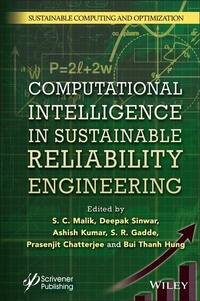
Computational Intelligence in Sustainable Reliability Engineering
Description

The book is a comprehensive guide on how to apply computational intelligence techniques for the optimization of sustainable materials and reliability engineering.
This book focuses on developing and evolving advanced computational intelligence algorithms for the analysis of data involved in reliability engineering, material design, and manufacturing to ensure sustainability. Computational Intelligence in Sustainable Reliability Engineering unveils applications of different models of evolutionary algorithms in the field of optimization and solves the problems to help the manufacturing industries. Some special features of this book include a comprehensive guide for utilizing computational models for reliability engineering, state-of-the-art swarm intelligence methods for solving manufacturing processes and developing sustainable materials, high-quality and innovative research contributions, and a guide for applying computational optimization on reliability and maintainability theory. The book also includes dedicated case studies of real-life applications related to industrial optimizations.
Audience
Researchers, industry professionals, and post-graduate students in reliability engineering, manufacturing, materials, and design.
More details
Other editions
Additional editions
Persons
S. C. Malik, PhD, is a professor of Statistics at Maharshi Dayanand University Rohtak, India. He has published more than 170 research articles in international journals, has participated in about 80 national/international conferences and workshops, as well as authored 3 books.
Deepak Sinwar, PhD, is an assistant professor in the Department of Computer and Communication Engineering, School of Computing & Information Technology at Manipal University Jaipur, Jaipur, Rajasthan, India. His research interests include computational intelligence, data mining, machine learning, reliability theory, computer networks, and pattern recognition.
Ashish Kumar, PhD, is an assistant professor in the Department of Mathematics & Statistics, Manipal University Jaipur, Jaipur. He has published more than 80 research papers in various national/international journals and participated in more than 50 conferences in India and abroad. His area of interest is reliability modeling and analysis, sampling theory, reliability estimation, and data analysis.
Gadde Srinivasa Rao, PhD, is a Professor of Statistics in the Department of Statistics, Dodoma University, Tanzania. He has published more than 140 articles in peer-reviewed journals and participated in more than 70 national and international conferences. His research interests include statistical inference, quality control, and reliability estimation.
Prasenjit Chatterjee, PhD, is the Dean (Research and Consultancy) at MCKV Institute of Engineering, West Bengal, India. He has more than 100 research papers in various international journals and peer-reviewed conferences. He has authored and edited more than 20 books and is one of the developers of two multiple-criteria decision-making methods called Measurement of Alternatives and Ranking according to COmpromise Solution (MARCOS) and Ranking of Alternatives through Functional mapping of criterion sub-intervals into a Single Interval (RAFSI).
Bui Thanh Hung, PhD, is the Director of the Artificial Intelligence Laboratory, Faculty of Information Technology, Ton Duc Thang University, Vietnam, and received his doctorate from Japan Advanced Institute of Science and Technology (JAIST) in 2013. He has published numerous research articles in international journals and conferences as well as 14 book chapters. His main research interests are natural language processing, machine learning, machine translation, text processing, data analytics, computer vision, and artificial intelligence.
Content
Preface xv
Acknowledgment xxi
1 Reliability Indices of a Computer System with Priority and Server Failure 1
S.C. Malik, R.K. Yadav and N. Nandal
1.1 Introduction 2
1.2 Some Fundamentals 4
1.2.1 Reliability 4
1.2.2 Mean Time to System Failure (MTSF) 4
1.2.3 Steady State Availability 4
1.2.4 Redundancy 5
1.2.5 Semi-Markov Process 5
1.2.6 Regenerative Point Process 6
1.3 Notations and Abbreviations 6
1.4 Assumptions and State Descriptions 8
1.5 Reliability Measures 9
1.5.1 Transition Probabilities 9
1.5.2 Mst 10
1.5.3 Reliability and MTCSF 10
1.5.4 Availability 11
1.5.5 Expected Number of Hardware Repairs 12
1.5.6 Expected Number of Software Upgradations 13
1.5.7 Expected Number of Treatments Given to the Server 14
1.5.8 Busy Period of Server Due to H/w Repair 15
1.5.9 Busy Period of Server Due to Software Upgradation 16
1.6 Profit Analysis 17
1.7 Particular Case 18
1.8 Graphical Presentation of Reliability Indices 19
1.9 Real-Life Application 20
1.10 Conclusion 21
References 21
2 Mathematical Modeling and Availability Optimization of Turbine Using Genetic Algorithm 23
Monika Saini, Nivedita Gupta and Ashish Kumar
2.1 Introduction 23
2.2 System Description, Notations, and Assumptions 25
2.2.1 System Description 25
2.2.2 Notations 27
2.2.3 Assumptions 28
2.3 Mathematical Modeling of the System 28
2.4 Optimization 33
2.4.1 Genetic Algorithm 33
2.5 Results and Discussion 34
2.6 Conclusion 36
References 45
3 Development of Laplacian Artificial Bee Colony Algorithm for Effective Harmonic Estimator Design 47
Aishwarya Mehta, Jitesh Jangid, Akash Saxena, Shalini Shekhawat and Rajesh Kumar
3.1 Introduction 48
3.2 Problem Formulation of Harmonics 52
3.3 Development of Laplacian Artificial Bee Colony Algorithm 54
3.3.1 Basic Concepts of ABC 54
3.3.2 The Proposed LABC Algorithm 56
3.4 Discussion 58
3.5 Numerical Validation of Proposed Variant 58
3.5.1 Comparative Analysis of LABC with Other Meta-Heuristics 59
3.5.2 Benchmark Test on CEC-17 Functions 70
3.6 Analytical Validation of Proposed Variant 72
3.6.1 Convergence Rate Test 75
3.6.2 Box Plot Analysis 77
3.6.3 Wilcoxon Rank Sum Test 77
3.6.4 Scalability Test 81
3.7 Design Analysis of Harmonic Estimator 81
3.7.1 Assessment of Harmonic Estimator Design Problem 1 81
3.7.2 Assessment of Harmonic Estimator Design Problem 2 87
3.8 Conclusion 92
References 93
4 Applications of Cuckoo Search Algorithm in Reliability Optimization 97
V. Kaviyarasu and V. Suganthi
4.1 Introduction 98
4.2 Cuckoo Search Algorithm 98
4.2.1 Performance of Cuckoo Search Algorithm 98
4.2.2 Levy Flights 99
4.2.3 Software Reliability 99
4.3 Modified Cuckoo Search Algorithm (MCS) 100
4.4 Optimization in Module Design 102
4.5 Optimization at Dynamic Implementation 103
4.6 Comparative Study of Support of Modified Cuckoo Search Algorithm 104
4.7 Results and Discussions 105
4.8 Conclusion 107
References 108
5 Series-Parallel Computer System Performance Evaluation with Human Operator Using Gumbel-Hougaard Family Copula 109
Muhammad Salihu Isa, Ibrahim Yusuf, Uba Ahmad Ali and Wu Jinbiao
5.1 Introduction 110
5.2 Assumptions, Notations, and Description of the System 112
5.2.1 Notations 112
5.2.2 Assumptions 114
5.2.3 Description of the System 114
5.3 Reliability Formulation of Models 116
5.3.1 Solution of the Model 117
5.4 Some Particular Cases Based on Analytical Analysis of the Model 120
5.4.1 Availability Analysis 120
5.4.2 Reliability Analysis 121
5.4.3 Mean Time to Failure (MTTF) 122
5.4.4 Cost-Benefit Analysis 124
5.5 Conclusions Through Result Discussion 125
References 126
6 Applications of Artificial Intelligence in Sustainable Energy Development and Utilization 129
Aditya Kolakoti, Prasadarao Bobbili, Satyanarayana Katakam, Satish Geeri and Wasim Ghder Soliman
6.1 Energy and Environment 130
6.2 Sustainable Energy 130
6.3 Artificial Intelligence in Industry 4.0 131
6.4 Introduction to AI and its Working Mechanism 132
6.5 Biodiesel 135
6.6 Transesterification Process 136
6.7 AI in Biodiesel Applications 138
6.8 Conclusion 140
References 140
7 On New Joint Importance Measures for Multistate Reliability Systems 145
Chacko V. M.
7.1 Introduction 145
7.2 New Joint Importance Measures 147
7.2.1 Multistate Differential Joint Reliability Achievement Worth (MDJRAW) 148
7.2.2 Multistate Differential Joint Reliability Reduction Worth (MDJRRW) 150
7.2.3 Multistate Differential Joint Reliability Fussel-Vesely (MDJRFV) Measure 152
7.3 Discussion 153
7.4 Illustrative Example 154
7.5 Conclusion 157
References 157
8 Inferences for Two Inverse Rayleigh Populations Based on Joint Progressively Type-II Censored Data 159
Kapil Kumar and Anita Kumari
8.1 Introduction 159
8.2 Model Description 161
8.3 Classical Estimation 163
8.3.1 Maximum Likelihood Estimation 163
8.3.2 Asymptotic Confidence Interval 164
8.4 Bayesian Estimation 166
8.4.1 Tierney-Kadane's Approximation 167
8.4.2 Metropolis-Hastings Algorithm 169
8.4.3 HPD Credible Interval 170
8.5 Simulation Study 170
8.6 Real-Life Application 176
8.7 Conclusions 177
References 177
9 Component Reliability Estimation Through Competing Risk Analysis of Fuzzy Lifetime Data 181
Rashmi Bundel, M. S. Panwar and Sanjeev K. Tomer
9.1 Introduction 182
9.2 Fuzzy Lifetime Data 183
9.2.1 Fuzzy Set 183
9.2.2 Fuzzy Numbers and Membership Function 184
9.2.3 Fuzzy Event and its Probability 187
9.3 Modeling with Fuzzy Lifetime Data in Presence of Competing Risks 187
9.4 Maximum Likelihood Estimation with Exponential Lifetimes 189
9.4.1 Bootstrap Confidence Interval 192
9.5 Bayes Estimation 192
9.5.1 Highest Posterior Density Confidence Estimates 194
9.6 Numerical Illustration 195
9.6.1 Simulation Study 196
9.6.2 Reliability Analysis Using Simulated Data 210
9.7 Real Data Study 212
9.8 Conclusion 212
References 215
10 Cost-Benefit Analysis of a Redundant System with Refreshment 217
M.S. Barak and Dhiraj Yadav
10.1 Introduction 218
10.2 Notations 219
10.3 Average Sojourn Times and Probabilities of Transition States 220
10.4 Mean Time to Failure of the System 223
10.5 Steady-State Availability 223
10.6 The Period in Which the Server is Busy With Inspection 224
10.7 Expected Number of Visits for Repair 227
10.8 Expected Number of Refreshments 227
10.9 Particular Case 228
10. 10 Cost-Benefit Examination 230
10.11 Discussion 230
10.12 Conclusion 233
References 233
11 Fuzzy Information Inequalities, Triangular Discrimination and Applications in Multicriteria Decision Making 235
Ram Naresh Saraswat and Sapna Gahlot
11.1 Introduction 235
11.2 New f-Divergence Measure on Fuzzy Sets 237
11.3 New Fuzzy Information Inequalities Using Fuzzy New f-Divergence Measure and Fuzzy Triangular Divergence Measure 239
11.4 Applications for Some Fuzzy f-Divergence Measures 241
11.5 Applications in MCDM 244
11.5.1 Case Study 246
11.6 Conclusion 247
References 248
12 Contribution of Refreshment Provided to the Server During His Job in the Repairable Cold Standby System 251
M.S. Barak, Ajay Kumar and Reena Garg
12.1 Introduction 252
12.2 The Assumptions and Notations Used to Solve the System 254
12.3 The Probabilities of States Transitions 256
12.4 Mean Sojourn Time 257
12.5 Mean Time to Failure of the System 257
12.6 Steady-State Availability 258
12.7 Busy Period of the Server Due to Repair of the Failed Unit 259
12.8 Busy Period of the Server Due to Refreshment 259
12.9 Estimated Visits Made by the Server 260
12.10 Particular Cases 261
12.11 Profit Analysis 262
12.12 Discussion 262
12.13 Conclusion 264
12.14 Contribution of Refreshment 265
12.15 Future Scope 265
References 265
13 Stochastic Modeling and Availability Optimization of Heat Recovery Steam Generator Using Genetic Algorithm 269
Monika Saini, Nivedita Gupta and Ashish Kumar
13.1 Introduction 270
13.2 System Description, Notations, and Assumptions 271
13.2.1 System Description 271
13.2.2 Notations 272
13.2.3 Assumptions 273
13.3 Mathematical Modeling of the System 273
13.4 Availability Optimization of Proposed Model 278
13.5 Results and Discussion 280
13.6 Conclusion 285
References 285
14 Investigation of Reliability and Maintainability of Piston Manufacturing Plant 287
Monika Saini, Deepak Sinwar and Ashish Kumar
14.1 Introduction 288
14.2 System Description and Data Collection 290
14.3 Descriptive Analysis 294
14.4 Power Law Process Model 295
14.5 Trend and Serial Correlation Analysis 300
14.6 Reliability and Maintainability Analysis 302
14.7 Conclusion 306
References 307
Index 311
Preface
With the design of every new product, the world is witnessing the continuous development brought on by cross-disciplinary technologies. Instead of taking raw materials and sending them through a real manufacturing process that repeatedly combats tolerances, errors, and energy consumption to arrive at the final product, the assembly details can be directly input into the computation model in order to obtain the material characteristics as output to reduce effort and process costs. To ensure maximum reliability of product development, it is desired that the manufacturing process be driven by optimization. However, even though optimization has previously been applied for various fields, over the past two decades, computational optimization has become very popular for industrial optimizations. Computational intelligence-based optimization is one of several computational techniques that help achieve sustainability in product design and development phases. Among computational intelligence-based techniques, metaheuristic optimization is found to be specifically suitable for industrial optimizations. There are mainly two types of metaheuristic approaches; single-solution based and population based. As per the applications in the field of industrial optimization, this book mainly focuses on population-based (swarm intelligence) metaheuristic approaches.
Swarm intelligence is an important sub-area of optimization that helps develop sustainable materials at nano-, micro-, meso- and macro-levels by identifying the optimum values for different parameters. With the exponential rise in demand for sustainable materials for various purposes, optimization has played an important role over the last few years. Not only is materials data available for researchers and scientists, but sufficient processing resources are also available, which need to be optimized through AI techniques.
Traditional techniques employed by researchers are often cumbersome, expensive and lack sustainability. Hence, there is always a need for having recourse to time-efficient, fail-safe, cheaper intelligent technologies to address problems and ensure long-term sustainability. Since the existing literature available in this respect is nonexistent, this book is proposed to serve as a treatise and knowledge base for the community to inspire them to adapt environment-friendly and sustainable solutions for the future.
This book focuses on developing advanced computational intelligence algorithms for the analysis of data involved in reliability engineering, material design, and manufacturing with the objective of ensuring sustainability. It reveals applications of different models of evolutionary algorithms in the field of optimization with the objective of solving problems to help the manufacturing industries. Some special features of this book include a comprehensive guide for utilizing computational models for reliability engineering, state-of-the-art swarm intelligence methods for solving manufacturing processes and developing sustainable materials, high-quality and innovative research contributions, and a guide for applying computational optimization to reliability and maintainability theory. A chapter-wise summary of the information presented herein follows.
Chapter 1 presents a stochastic model for reliability indices of a computer system with priority and server failure. The model is analyzed by using the semi-Markov process and regenerative point technique. The reliability indices, such as mean time to system failure (MTCSF), availability, busy period of the server due to hardware repair and software upgradation, expected number of treatments given to the server, expected number of hardware repair, and software upgradation, are obtained for arbitrary values of the parameters. The profit analysis of the system model has also been carried out to discern the usefulness of the system under different parametric situations.
Chapter 2 presents a study that optimizes the availability of a turbine unit (TU) of a steam turbine power plant (STPP) using mathematical modeling and a genetic algorithm. The mathematical model is developed using the Markovian birth-death process (MBDP) and Chapman-Kolmogorov differential equations derived for the proposed model. The analytical solution of the mathematical model is derived for a particular case by considering exponential distribution for random variables associated with failure and repair rates. By using a nature-inspired algorithm (NIA), namely a genetic algorithm (GA), an effort is made to attain the global solution of the TU.
Chapter 3 covers the development of the Laplacian artificial bee colony (LABC) algorithm for effective harmonic estimator design. For designing the estimator, a hybrid approach based on least square error minimization with the help of a new version of the artificial bee colony algorithm is proposed. The proposed version employs a Laplacian factor-based update equation in the scout bee phase. For proving the modification meaningful, first the proposed algorithm is tested on several standard benchmark problems, and then it is applied to the estimator design problem. Results reported in on both parts indicate that the proposed modification is meaningful and the performance of the LABC algorithm is comparable with that of many other state-of-the-art algorithms.
Chapter 4 discusses the applications of the cuckoo search algorithm in reliability optimization, which is a novel nature-inspired algorithm that is used to solve complex optimization problems. The algorithm depends on the brood-parasitic strategy of cuckoo species. The usage of Lévy flights is used to produce new candidate resolutions. It can improve the relationship between exploration and exploitation towards the potential of searching. It can also be used in solving engineering problems such as embedded systems, distribution of networks, and scheduling problems. In this chapter, a study of the reliability of the software at static and runtime is performed and the results are also discussed.
Chapter 5 carries out a performance evaluation of the series-parallel computer system with a Gumbel-Hougaard copula family. To analyze the reliability of the system, the partial differential equations are derived from the system's schematic diagram in which reliability measures of system strength, such as reliability, availability, mean time to failure (MTTF), and cost function, are computed. The MTTF of devices, such as workstation, hub, and router, obeys exponential distribution whereas the corresponding repair time follows two different distributions, namely general and copula distribution. The findings of the study are depicted with the help of suitable diagrams and tabular representations.
Chapter 6 covers the applications of artificial intelligence (AI) in sustainable energy development and utilization. To combat the energy and environmental crises, clean and renewable fuels like biofuels are popular as petrodiesel replacement fuels. Biofuels can be obtained from different feedstocks and are successfully tested in diesel engines. However, several parameters influence the output results during their production and engine testing. The accurate prediction of end results is considered challenging with the traditional techniques. Therefore, AI techniques have emerged as being the most successful in solving nonlinear problems and achieving a high success rate in prediction. In this chapter, different AI techniques that have been successfully used in finding a feasible solution for complex problems in biodiesel production and engine testing are discussed in detail.
Chapter 7 introduces a new joint reliability achievement worth (JRAW), joint reliability reduction worth (JRRW), and joint reliability Fussell-Vesely (JRFV) measure for three multistate components of a multistate system. This is a new approach to detect the joint effect of a group of components in improving system reliability. The differencing technique is used in the proposed measures. A steady-state performance level distribution restricted to the component's states is used to evaluate the proposed measures. The universal generating function (UGF) technique is applied for the evaluation of proposed joint importance measures with suitable examples. Chapter 8 presents some inferences about inverse Rayleigh distribution based on joint progressive Type-II censoring. The maximum likelihood estimation and the corresponding asymptotic confidence interval estimation are used as the classical estimation methods. The Bayes estimates are calculated under the squared error loss function (SELF) using Tierney-Kadane's approximation and Metropolis-Hastings algorithm, along with the construction of Bayes estimates highest posterior density credible intervals. A Markov chain Monte Carlo simulation study is carried out to compare different estimation methods and a real-life problem is discussed for illustrative purposes.
Chapter 9 deals with component reliability estimation through competing risk analysis of fuzzy lifetime data. In many cases, the lifetimes of systems are not precisely observed, or they are reported in "vague" terms. This imprecision or vagueness in data can be dealt with more accurately by incorporating fuzzy concepts. In this chapter, a competing risk analysis of lifetime data is performed by considering lifetimes as fuzzy numbers. Using different membership functions, the authors provide procedures for maximum likelihood and a Bayesian estimation of component reliability. They also evaluate bootstrap confidence intervals and the highest posterior density intervals. To observe the impact of various membership functions on the considered...
