

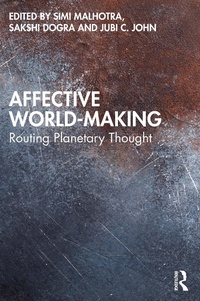
Affective World-Making
Routing Planetary Thought
1st Edition
Published on 5. December 2023
260 pages
978-1-003-80082-8 (ISBN)
Description

This volume fosters a re-imagination of the planet where it is seen not only as a resource, but also as an entity that must not be excluded from the political imperative of care and kinship. The authors go beyond the normative understanding of space by recognizing the potency of touch, where they look at somatic experiences that invite the intensity of affect.
This book questions the dominance of the capitalocene through the existence of social aesthetic and records the affective encounters that facilitate the creation of planetary identity, affinity, and entanglements. With discussions on architecture, poetry, rap music, romantic literature, performance art, digital fashion, Instagram, Netflix shows, YouTube videos, moving image practices, eco-sexual movements, and graphic narratives, the chapters in this volume initiate a conversation on what it means to inhabit the world today.
An important contribution, this book will be of interest to students and researchers of environmental humanities, planetary humanities, affect studies, digital humanities, and media studies, besides also being of interest to those studying interdisciplinary critical/cultural theory, Television and film studies, philosophy, and architectural theory.
This book questions the dominance of the capitalocene through the existence of social aesthetic and records the affective encounters that facilitate the creation of planetary identity, affinity, and entanglements. With discussions on architecture, poetry, rap music, romantic literature, performance art, digital fashion, Instagram, Netflix shows, YouTube videos, moving image practices, eco-sexual movements, and graphic narratives, the chapters in this volume initiate a conversation on what it means to inhabit the world today.
An important contribution, this book will be of interest to students and researchers of environmental humanities, planetary humanities, affect studies, digital humanities, and media studies, besides also being of interest to those studying interdisciplinary critical/cultural theory, Television and film studies, philosophy, and architectural theory.
Reviews / Votes
"This remarkable book of essays theorizes and performs a new planetary worldling emergent in cultural, visual, digital, architectural and place-based aesthetics. Here, planetary entanglements take place in the multiplicitous, more-than-human compositions of ordinary scenes, or in traumas, or sexualities becoming palpable in rap music, performance art, practices of travel, instapoetry, children's games, fan practices, graphic narratives, and YouTube reaction videos. Once-submerged forms of world-making proliferate, both weighted and alive with beautiful and dangerous potential."Kathleen Stewart
More details
Edition
1. Auflage
Language
English
Place of publication
London
United Kingdom
Publishing group
Taylor & Francis Ebooks
Target group
College/higher education
Illustrations
10 Halftones, black and white; 10 Illustrations, black and white
ISBN-13
978-1-003-80082-8 (9781003800828)
Copyright in bibliographic data and cover images is held by Nielsen Book Services Limited or by the publishers or by their respective licensors: all rights reserved.
Schweitzer Classification
Other editions
Additional editions
Book
12/2023
1st Edition
Routledge India
€206.50
Shipment within 10-20 days
Book
12/2023
1st Edition
Routledge India
€67.50
Shipment within 10-20 days
Persons
Simi Malhotra has a cumulative experience of more than twenty-two years of teaching and research guidance at PhD, MPhil, and postgraduate and undergraduate levels. Her latest publications are the co-authored/co-edited books Ocean as Method: Thinking with the Maritime (2022), Terrains of Consciousness: Multilogical Perspectives on Globalization (2021), Food Culture Studies in India: Consumption, Representation and Mediation (2021), and Inhabiting Cyberspace in India: Theory, Perspectives and Challenges (2021). She is the recipient of several grants and awards, the latest being the 2020 DUO-India Professor Fellowship Award.
Sakshi Dogra currently teaches English literature and language at Gargi College (University of Delhi) as Assistant Professor. She is also a PhD research scholar at the Department of English, Jamia Millia Islamia. She is broadly interested in affect theory; study of moods and atmospheres; and emotions, feelings, and their function in constituting people and cultures. She has co-edited Food Culture Studies in India: Consumption, Representation and Mediation (2021) and Inhabiting Cyberspace in India: Theory, Perspectives and Challenges (2021), both published by Springer Nature. She is also the co-editor of Imagining Worlds, Mapping Possibilities: Select Science Fiction Stories (2020). She has presented papers at both national and international conferences.
Jubi C. John is a PhD scholar and Senior Research Fellow at the Department of English, Jamia Millia Islamia, New Delhi, India. She was the co-chief organizer of the Young Researchers' Conference on 'As a Matter of Affect: Making Sense of Planetarity,' conducted by the Department of English, JMI. Her PhD thesis looks at corporeal subjectivity, body politics, and sexual dynamics in Caribbean Island Women's narratives. Her research interests are in the field of embodiment and desire, popular culture and digital spaces, island studies, and memory studies. Previously, she has delivered lectures at the University of Delhi and Jamia Millia Islamia.
Sakshi Dogra currently teaches English literature and language at Gargi College (University of Delhi) as Assistant Professor. She is also a PhD research scholar at the Department of English, Jamia Millia Islamia. She is broadly interested in affect theory; study of moods and atmospheres; and emotions, feelings, and their function in constituting people and cultures. She has co-edited Food Culture Studies in India: Consumption, Representation and Mediation (2021) and Inhabiting Cyberspace in India: Theory, Perspectives and Challenges (2021), both published by Springer Nature. She is also the co-editor of Imagining Worlds, Mapping Possibilities: Select Science Fiction Stories (2020). She has presented papers at both national and international conferences.
Jubi C. John is a PhD scholar and Senior Research Fellow at the Department of English, Jamia Millia Islamia, New Delhi, India. She was the co-chief organizer of the Young Researchers' Conference on 'As a Matter of Affect: Making Sense of Planetarity,' conducted by the Department of English, JMI. Her PhD thesis looks at corporeal subjectivity, body politics, and sexual dynamics in Caribbean Island Women's narratives. Her research interests are in the field of embodiment and desire, popular culture and digital spaces, island studies, and memory studies. Previously, she has delivered lectures at the University of Delhi and Jamia Millia Islamia.
Content
1) Architecture Affects: From Phenomenology to Planetarity 2) In-Between Performances: Worlding, Ethical Consciousness and Affective Responses to Contemporary Choreographies 3) Sound of Resistance: A Study of Climate and Culture through Rap Music 4) Travel, Medical Affect and the Romantic Planetarity 5) Performance Art and 'Affect': Negotiating 'Planetarity' in the context of Global Consumerism and Materiality 6) Feel-ing Poetry: Affective Aesthetics of Instapoetry 7) Child's Play and Survival: Examining Children's Games in the Squid Game 8) The YouTube Reaction Video as a site of Affective Fan Practices 9) 'No one understands the Savagery of this Place': Affect and Sense of a Place in Louise Glueck'sA Village Life 10) Composing the [ ] Inhuman 11) Non-Human Visions: From Experimental Cinema to Hollywood 12) Submergence 'Within' and 'Without': Local and Planetary Memories in Arula Ratnakar's 'Submergence' 13) Erotic environmentalism: The Awegasmic Activism of Ecosexuality 14) To Stare or Not to Stare: An Affective Study of Disability through Select Hindi Films 15) Shame and its Lovers: Unstable Affective Transmissions in Garth Greenwell's Fiction 16) The Politics of Pain and Anger: Representing Sexual Trauma in Graphic Narratives
