

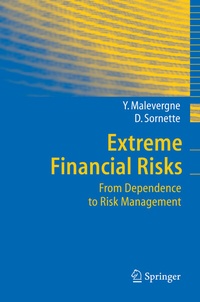
Extreme Financial Risks
Description

Portfolio analysis and optimization, together with the associated risk assessment and management, require knowledge of the likely distributions of returns at different time scales and insights into the nature and properties of dependences between the different assets.
This book offers an original and thorough treatment of these two domains, focusing mainly on the concepts and tools that remain valid for large and extreme price moves. Strong emphasis is placed on the theory of copulas and their empirical testing and calibration, because they offer intrinsic and complete measures of dependences.
Extreme Financial Risks will be useful to:
students looking for a general and in-depth introduction to the field;
financial engineers, economists, econometricians, actuarial professionals;
researchers and mathematicians looking for a synoptic view comparing the pros and cons of different modelling strategies; and
quantitative practitioners for the insights offered on the subtleties and the many dimensional components of both risk and dependence.
In toto, the content of this book will also be useful to a broader scientific community interested in quantifying the complexity of many natural and artificial processes in which a growing emphasis is on the role and importance of extreme phenomena.
Reviews / Votes
From the reviews:
"This book clearly elucidates extreme financial risks associated with rare events such as financial crashes. The highlight of the book is the delineation of various copulas in conjunction with financial dependences among different assets of a portfolio. In particular, the insightful discussion on quadrant and orthant dependences casts new light on the connection between marginal models and financial dependence. . It is well organized and systematically brings a vivid portrayal of the subject to researchers and graduate students in mathematics and statistics." (John Tuhao Chen, Mathematical Reviews, Issue 2006 j)
"Its originality lies in detailed and thorough presentations of the state of the art on (i) the different distributions of financial returns for various applications (Value-at-Risk, stress testing), and (ii) the most important and useful measures of dependences . . Many of the results presented here are novel and have not been published or have been recently obtained by the authors or their colleagues." (Alexandr B. Vasil'ev, Zentralblatt MATH, Vol. 1093 (19), 2006)
"Extreme Financial Risk deals with the modeling of extreme events with applications in finance. . The book is very well structured. . the book is written in a very lucid style, very easy to understand. Detailed proofs of certain results are given in the appendices at the end of each chapter. . The authors also provide a large list of references, which could make this text very attractive for researchers. . Students interested in extreme events in financial markets would find this an interesting text." (Ita Cirovic Donev, MathDL, March, 2006)
More details
Other editions
Additional editions
Content
In this chapter, we investigate the relative information content of several measures of dependence between two random variables X and Y in various models of financial series. We consider measures of dependence especially defined for large and extreme events. These measures of dependence are of two types: (i) unconditional such as with the coefficient of tail dependence already introduced in Chap. 4 and (ii) conditional such as with the correlation coefficient conditional over a given threshold. The introduction of conditioning over values of one or both variables reaching above some threshold is a natural approach to discriminate the dependence in the tails. It explodes the concept of dependence into a multidimensional set of measures, each adapted to certain ranges spanned by the random variables. We present explicit analytical formulas as well as numerical and empirical estimations for these measures of dependence. The main overall insight is that conditional measures of dependence may be very different from the unconditional ones and can often lead to paradoxical interpretations, whose origins are explained in detail.
When the dependence properties are studied as a function of time, one can often observe that conditional measures vary with time. Such time variation has initiated a vigorous discussion in the literature on its possible economic meaning.
We review the mechanism by which conditioning provides a straightforward and general mechanism for explaining changes of correlations based on changes of volatility or of trends: for a given conditional threshold, if the volatility of one or both time series changes in some time interval, then the corresponding quantiles sampled in the conditional measure will also change; as a result, the conditional measure will not sample the same part of the tails of the distributions, effectively changing the deffnition of the conditional measure. In this explanation, the variation with time of conditional measures of dependence results solely from a change of volatility but does not respect a genuine change of dependence. In other words, a constant dependence structure together with time-varying volatility may give rise to changing conditional measures of dependence, which would be incorrectly interpreted as respecting genuine changes of dependence.
Thus, tools based upon conditional quantities should be used with caution since conditioning alone induces a change in the dependence structure which has nothing to do with a genuine change of unconditional dependence. In this respect, for its stability, the coefficient of tail dependence should be preferred to the conditional correlations. Moreover, the various measures of dependence exhibit different and sometimes opposite behaviors, showing that extreme dependence properties possess a multidimensional character that can be revealed in various ways.
As an illustration, the theoretical results and their interpretation presented below are applied to the controversial contagion problem across Latin American markets during the turmoil periods associated with the Mexican crisis in 1994 and with the Argentinean crisis that started in 2001. The analysis of several measures of dependence between the Argentinean, Brazilian, Chilean and Mexican markets shows that the above conditioning effect does not fully explain the behavior of the Latin American stock indexes, confirming the existence of a possible genuine contagion. Our analysis below suggests that the 1994 Mexican crisis has spread over to Argentina and Brazil through contagion mechanisms and to Chile only through co-movements. Concerning the recent Argentinean crisis that started in 2001, no evidence of contagion to the other Latin American countries (except perhaps in the direction of Brazil) can be found but significant co-movements are identified.
