

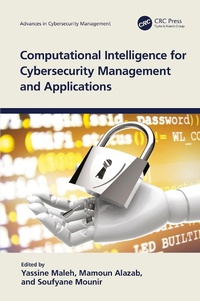
Computational Intelligence for Cybersecurity Management and Applications
1st Edition
Published on 28. April 2023
248 pages
978-1-000-85334-6 (ISBN)
Description

As cyberattacks continue to grow in complexity and number, computational intelligence is helping under-resourced security analysts stay one step ahead of threats. Drawing on threat intelligence from millions of studies, blogs, and news articles, computational intelligence techniques such as machine learning and automatic natural language processing quickly provide the means to identify real threats and dramatically reduce response times.
The book collects and reports on recent high-quality research addressing different cybersecurity challenges. It:
explores the newest developments in the use of computational intelligence and AI for cybersecurity applications
provides several case studies related to computational intelligence techniques for cybersecurity in a wide range of applications (smart health care, blockchain, cyber-physical system, etc.)
integrates theoretical and practical aspects of computational intelligence for cybersecurity so that any reader, from novice to expert, may understand the book's explanations of key topics.
It offers comprehensive coverage of the essential topics, including:
machine learning and deep learning for cybersecurity
blockchain for cybersecurity and privacy
security engineering for cyber-physical systems
AI and data analytics techniques for cybersecurity in smart systems
trust in digital systems
This book discusses the current state-of-the-art and practical solutions for the following cybersecurity and privacy issues using artificial intelligence techniques and cutting-edge technology. Readers interested in learning more about computational intelligence techniques for cybersecurity applications and management will find this book invaluable. They will get insight into potential avenues for future study on these topics and be able to prioritize their efforts better.
The book collects and reports on recent high-quality research addressing different cybersecurity challenges. It:
explores the newest developments in the use of computational intelligence and AI for cybersecurity applications
provides several case studies related to computational intelligence techniques for cybersecurity in a wide range of applications (smart health care, blockchain, cyber-physical system, etc.)
integrates theoretical and practical aspects of computational intelligence for cybersecurity so that any reader, from novice to expert, may understand the book's explanations of key topics.
It offers comprehensive coverage of the essential topics, including:
machine learning and deep learning for cybersecurity
blockchain for cybersecurity and privacy
security engineering for cyber-physical systems
AI and data analytics techniques for cybersecurity in smart systems
trust in digital systems
This book discusses the current state-of-the-art and practical solutions for the following cybersecurity and privacy issues using artificial intelligence techniques and cutting-edge technology. Readers interested in learning more about computational intelligence techniques for cybersecurity applications and management will find this book invaluable. They will get insight into potential avenues for future study on these topics and be able to prioritize their efforts better.
More details
Series
Edition
1. Auflage
Language
English
Place of publication
London
United Kingdom
Publishing group
Taylor & Francis Ltd
Target group
Professional and scholarly
Illustrations
19 Tables, black and white; 36 Line drawings, color; 32 Line drawings, black and white; 36 Illustrations, color; 32 Illustrations, black and white
ISBN-13
978-1-000-85334-6 (9781000853346)
Copyright in bibliographic data and cover images is held by Nielsen Book Services Limited or by the publishers or by their respective licensors: all rights reserved.
Schweitzer Classification
Other editions
Additional editions
Yassine Maleh | Mamoun Alazab | Soufyane Mounir
Computational Intelligence for Cybersecurity Management and Applications
Book
12/2024
1st Edition
CRC Press
€69.40
Shipment within 10-20 days
Yassine Maleh | Mamoun Alazab | Soufyane Mounir
Computational Intelligence for Cybersecurity Management and Applications
Book
04/2023
1st Edition
CRC Press
€165.90
Shipment within 10-20 days
Persons
Yassine Maleh (http://orcid.org/0000-0003-4704-5364) is a PhD of the University Hassan 1st in Morocco in the field of Internet of Things Security and privacy, since 2013. He is Senior Member of IEEE, Member of the International Association of Engineers IAENG and The Machine Intelligence Research Labs. Dr Maleh has made contributions in the fields of information security and privacy, Internet of Things Security, Wireless and Constrained Networks Security. His research interests include Information Security and Privacy, Internet of Things, Networks Security, Information system and IT Governance. He has published over than 50 papers (Book chapters, international journals and conferences/workshops), and 4 edited books and 1 authored book. He is the editor in chief of the International Journal of Smart Security Technologies (IJSST). He serves as an Associate Editor for IEEE Access (2019 Impact Factor 4.098), the International Journal of Digital Crime and Forensics (IJDCF) and the International Journal of Information Security and Privacy (IJISP). He was also a Guest Editor of a special issue on Recent Advances on Cyber Security and Privacy for Cloud-of-Things of the International Journal of Digital Crime and Forensics (IJDCF), Volume 10, Issue 3, July-September 2019. He has served and continues to serve on executive and technical program committees and as a reviewer of numerous international conference and journals such as Elsevier Ad Hoc Networks, IEEE Network Magazine, IEEE Sensor Journal, ICT Express, and Springer Cluster Computing. He was the Publicity chair of BCCA 2019 and the General Chair of the MLBDACP 19 symposium.
Mamoun Alazab (https://orcid.org/0000-0002-1928-3704) is the Associate Professor in the College of Engineering, IT and Environment at Charles Darwin University, Australia. He received his Ph.D. degree is in Computer Science from the Federation University of Australia, School of Science, Information Technology and Engineering. He is a cyber security researcher and practitioner with industry and academic experience. Dr Alazab's research is multidisciplinary that focuses on cyber security and digital forensics of computer systems including current and emerging issues in the cyber environment like cyber-physical systems and the internet of things, by taking into consideration the unique challenges present in these environments, with a focus on cybercrime detection and prevention. He looks into the intersection use of machine learning as an essential tool for cybersecurity, for example, for detecting attacks, analyzing malicious code or uncovering vulnerabilities in software. He has more than 100 research papers. He is the recipient of short fellowship from Japan Society for the Promotion of Science (JSPS) based on his nomination from the Australian Academy of Science. He delivered many invited and keynote speeches, 27 events in 2019 alone. He convened and chaired more than 50 conferences and workshops. He is the founding chair of the IEEE Northern Territory Subsection: (Feb 2019 - current). He is a Senior Member of the IEEE, Cybersecurity Academic Ambassador for Oman's Information Technology Authority (ITA), Member of the IEEE Computer Society's Technical Committee on Security and Privacy (TCSP) and has worked closely with government and industry on many projects, including IBM, Trend Micro, the Australian Federal Police (AFP), the Australian Communications and Media Authority (ACMA), Westpac, UNODC, and the Attorney General's Department.
Soufyane Mounir is Associate Professor in the National School of Applied Sciences of Sultan Moulay Slimane Slimane, Beni Mellal, Morocco, since 2014. He got his PhD in Electronics and Telecommunication, from University Hassan 1st, Morocco. His research is multidisciplinary that focuses on Telecommunications, VoIP, signal processing, embedded systems and cyber security. He is an active member of LaSTI Laboratory, ENSA Khouribga.
Mamoun Alazab (https://orcid.org/0000-0002-1928-3704) is the Associate Professor in the College of Engineering, IT and Environment at Charles Darwin University, Australia. He received his Ph.D. degree is in Computer Science from the Federation University of Australia, School of Science, Information Technology and Engineering. He is a cyber security researcher and practitioner with industry and academic experience. Dr Alazab's research is multidisciplinary that focuses on cyber security and digital forensics of computer systems including current and emerging issues in the cyber environment like cyber-physical systems and the internet of things, by taking into consideration the unique challenges present in these environments, with a focus on cybercrime detection and prevention. He looks into the intersection use of machine learning as an essential tool for cybersecurity, for example, for detecting attacks, analyzing malicious code or uncovering vulnerabilities in software. He has more than 100 research papers. He is the recipient of short fellowship from Japan Society for the Promotion of Science (JSPS) based on his nomination from the Australian Academy of Science. He delivered many invited and keynote speeches, 27 events in 2019 alone. He convened and chaired more than 50 conferences and workshops. He is the founding chair of the IEEE Northern Territory Subsection: (Feb 2019 - current). He is a Senior Member of the IEEE, Cybersecurity Academic Ambassador for Oman's Information Technology Authority (ITA), Member of the IEEE Computer Society's Technical Committee on Security and Privacy (TCSP) and has worked closely with government and industry on many projects, including IBM, Trend Micro, the Australian Federal Police (AFP), the Australian Communications and Media Authority (ACMA), Westpac, UNODC, and the Attorney General's Department.
Soufyane Mounir is Associate Professor in the National School of Applied Sciences of Sultan Moulay Slimane Slimane, Beni Mellal, Morocco, since 2014. He got his PhD in Electronics and Telecommunication, from University Hassan 1st, Morocco. His research is multidisciplinary that focuses on Telecommunications, VoIP, signal processing, embedded systems and cyber security. He is an active member of LaSTI Laboratory, ENSA Khouribga.
Content
Section 1
Big Data and Computational Intelligence for Cybersecurity Management and Applications
Chapter 1
Applications of Big Data and Blockchain for Cybersecurity Management Challenges and Solutions - Swathi Lakkineni, Lo'ai Tawalbeh, and Izzat Alsmadi
Chapter 2
Deep Learning Techniques for Cybersecurity Applications - Balakrishnan S, Aswin G, Mohan Babu Chowdary, V. Arulkumar
Chapter 3
Deep Learning Techniques for Malware Classification - Mustapha Belaissaoui, Yassine Maleh, Soufyane Mounir
Section 2
Computational Intelligence for Cybersecurity Applications
Chapter 4
Machine Learning and Blockchain for Security Management in Banking System - Oshin Sharma, Nidhi Pandey
Chapter 5
Machine Learning Techniques for Fault Tolerance Management - Harinahalli Lokesh Gururaj, Francesco Flammini, Beekanahalli Harish Swathi, Nandini Nagaraj, and Sunil Kumar Byalaru Ramesh
Chapter 6
An efficient approach of Image Detection and Recognition using Artificial Intelligence in Cyber-Physical System - Musarrat Saberin Nipun, Rejwan Bin Sulaiman and Amer Kareem
Section 3
Blockchain and Computational Intelligence for Cybersecurity Applications
Chapter 7
Artificial Intelligence Incorporated in Business Analytics and Blockchain to Enhance Security - Mamata Rath, Subhranshu Sekhar Tripathy,Niva Tripathy, Chhabi Rani Panigrahi, Bibudhendu Pati
Chapter 8
Blockchain solutions for Security and Privacy issues in Smart Healthcare - Pinky Bai, Sushil Kumar, Upasana Dohare
Chapter 9
Algorithm for Trust in Ewom for Digital Systems - B.H. Khoi, B.V.Quang, N.V.T.Truong
Chapter 10
Study of IoT Security for blockchain management: An application to data backup - Cedric Tala Kuate, Franklin Tchakounte, Jean Claude Kamgang
Chapter 11
Blockchain Application for Cybersecurity in Cyber-physical Systems - Soufyane Mounir and Yassine Maleh
Compilation of References
About the Authors
Index
Big Data and Computational Intelligence for Cybersecurity Management and Applications
Chapter 1
Applications of Big Data and Blockchain for Cybersecurity Management Challenges and Solutions - Swathi Lakkineni, Lo'ai Tawalbeh, and Izzat Alsmadi
Chapter 2
Deep Learning Techniques for Cybersecurity Applications - Balakrishnan S, Aswin G, Mohan Babu Chowdary, V. Arulkumar
Chapter 3
Deep Learning Techniques for Malware Classification - Mustapha Belaissaoui, Yassine Maleh, Soufyane Mounir
Section 2
Computational Intelligence for Cybersecurity Applications
Chapter 4
Machine Learning and Blockchain for Security Management in Banking System - Oshin Sharma, Nidhi Pandey
Chapter 5
Machine Learning Techniques for Fault Tolerance Management - Harinahalli Lokesh Gururaj, Francesco Flammini, Beekanahalli Harish Swathi, Nandini Nagaraj, and Sunil Kumar Byalaru Ramesh
Chapter 6
An efficient approach of Image Detection and Recognition using Artificial Intelligence in Cyber-Physical System - Musarrat Saberin Nipun, Rejwan Bin Sulaiman and Amer Kareem
Section 3
Blockchain and Computational Intelligence for Cybersecurity Applications
Chapter 7
Artificial Intelligence Incorporated in Business Analytics and Blockchain to Enhance Security - Mamata Rath, Subhranshu Sekhar Tripathy,Niva Tripathy, Chhabi Rani Panigrahi, Bibudhendu Pati
Chapter 8
Blockchain solutions for Security and Privacy issues in Smart Healthcare - Pinky Bai, Sushil Kumar, Upasana Dohare
Chapter 9
Algorithm for Trust in Ewom for Digital Systems - B.H. Khoi, B.V.Quang, N.V.T.Truong
Chapter 10
Study of IoT Security for blockchain management: An application to data backup - Cedric Tala Kuate, Franklin Tchakounte, Jean Claude Kamgang
Chapter 11
Blockchain Application for Cybersecurity in Cyber-physical Systems - Soufyane Mounir and Yassine Maleh
Compilation of References
About the Authors
Index
