

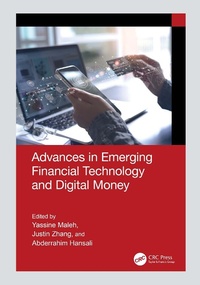
Advances in Emerging Financial Technology and Digital Money
1st Edition
Published on 29. March 2024
408 pages
978-1-003-85823-2 (ISBN)
Description

The financial sector is witnessing rapid technological innovations, leading to the emergence of Fintech (financial technologies), revolutionizing national and international financial landscapes. Fintech is expanding and enhancing financial products and services, making them more accessible and affordable while transforming customer relationships, payment methods, financing, and transfers.
Advances in Emerging Financial Technology and Digital Money provides a platform for collective reflection, bringing together institutions, policymakers, digital and financial service providers, professionals, and academics from various disciplines. The aim is to clarify the challenges, opportunities, and socio-economic impacts of innovations in finance and technology on citizens and businesses in Morocco, Africa, and worldwide. This comprehensive collection offers valuable insights into the current state and prospects of financial technology and digital money.
This book covers all the essential topics, including:
AI and Machine Learning in Fintech and Beyond
Financial Inclusion, Literacy, and Behavior
Fintech Ecosystems, Collaboration, and Analysis
Blockchain, Security, and Sustainability
Fintech Innovations and Applications
In this new book, the authors share their experiences to provide a comprehensive and well-researched overview of the technologies and concepts that will transform the banking industry as we know it. It aspires to be a useful reference for executive managers, CIOs, Fintech professionals, and researchers interested in exploring and implementing an efficient Fintech strategy. The book also presents selected papers from International Fintech Congress (IFC 2022).
Advances in Emerging Financial Technology and Digital Money provides a platform for collective reflection, bringing together institutions, policymakers, digital and financial service providers, professionals, and academics from various disciplines. The aim is to clarify the challenges, opportunities, and socio-economic impacts of innovations in finance and technology on citizens and businesses in Morocco, Africa, and worldwide. This comprehensive collection offers valuable insights into the current state and prospects of financial technology and digital money.
This book covers all the essential topics, including:
AI and Machine Learning in Fintech and Beyond
Financial Inclusion, Literacy, and Behavior
Fintech Ecosystems, Collaboration, and Analysis
Blockchain, Security, and Sustainability
Fintech Innovations and Applications
In this new book, the authors share their experiences to provide a comprehensive and well-researched overview of the technologies and concepts that will transform the banking industry as we know it. It aspires to be a useful reference for executive managers, CIOs, Fintech professionals, and researchers interested in exploring and implementing an efficient Fintech strategy. The book also presents selected papers from International Fintech Congress (IFC 2022).
More details
Series
Edition
1. Auflage
Language
English
Place of publication
London
United Kingdom
Publishing group
Taylor & Francis Ebooks
Target group
College/higher education
Professional and scholarly
Product notice
Reflowable
Illustrations
82 Tables, black and white; 129 Line drawings, black and white; 7 Halftones, black and white; 136 Illustrations, black and white
ISBN-13
978-1-003-85823-2 (9781003858232)
Copyright in bibliographic data and cover images is held by Nielsen Book Services Limited or by the publishers or by their respective licensors: all rights reserved.
Schweitzer Classification
Other editions
Additional editions
Yassine Maleh | Justin Zhang | Abderrahim Hansali
Advances in Emerging Financial Technology and Digital Money
Book
07/2025
1st Edition
CRC Press
€74.50
Shipment within 10-20 days
Yassine Maleh | Justin Zhang | Abderrahim Hansali
Advances in Emerging Financial Technology and Digital Money
Book
03/2024
1st Edition
CRC Press
€174.80
Shipment within 10-20 days
Persons
Yassine Maleh is a double Ph.D. in computer sciences from the University Hassan 1st, Morocco since 2013, and a second Ph.D. in Management from the National School of Business and Management, Settat, Morocco, since 2022. He is a professor of Cybersecurity and IT Governance at the National School of Applied Sciences, Khouribga, Morocco, and was a former IT Service Manager at the National Port Agency, Morocco. He is a Senior Member of IEEE, Member of the International Association of Engineers IAENG, and The Machine Intelligence Research Labs. Dr. Maleh has contributed to information security and privacy, Internet of Things Security, Wireless and Constrained Networks Security. His research interests include Information Security and Privacy, Internet of Things, Networks Security, Information system and IT Governance. He has published over than 140 papers (Book chapters, international journals, and conferences/workshops), 30 edited books, and 5 authored books. He is the editor-in-chief of the International Journal of Information Security and Privacy (IJISP). He is an Associate Editor for IEEE, the International Journal of Digital Crime and Forensics (IJDCF).
Justin Zhang is a faculty member at the Coggin College of Business at the University of North Florida. He received his Ph.D. in Business Administration with a concentration on Management Science and Information Systems from Pennsylvania State University, University Park. His research interests include economics of information systems, knowledge management, electronic business, business process management, information security, and social networking. He is the Editor-in-Chief of the Journal of Global Information Management, an ABET program evaluator, and an IEEE senior member.
Abderrahim Hansali, PhD in Economics and Management, graduate of the Institut Superieur de l'Administration in Rabat and ENA in Paris, and Agrege de l'Electronique et de l'Informatique Industrielle at ENSET in Rabat, is currently a Research Teacher at ENCG in Marrakech and a consultant in digital strategies and change management. His career began as a founding teacher of BTS preparatory classes in Morocco. After working for the Agence Nationale de Reglementation des Telecommunications in Rabat on the implementation of a quality management system (2007) and as an auditor for the Inspectorate General of the Ministry of National Education (2008), he was appointed Deputy Director & National Coordinator of the GENIE program within the same Ministry (2009), where he helped set up the Laboratoire National des Ressources Numeriques. Since 2016, he has taken up teaching and research duties in management sciences at Cadi Ayyad University in Marrakech.
In 2014, he set up the FONDATION MAROC NUMERIQUE, a non-governmental organization dedicated to supporting digital strategies and promoting a citizen digital culture. In 2019, he helped set up ACISS (African Center for Innovative Sustainable Solutions) at Cadi Ayyad University in Marrakech.
Justin Zhang is a faculty member at the Coggin College of Business at the University of North Florida. He received his Ph.D. in Business Administration with a concentration on Management Science and Information Systems from Pennsylvania State University, University Park. His research interests include economics of information systems, knowledge management, electronic business, business process management, information security, and social networking. He is the Editor-in-Chief of the Journal of Global Information Management, an ABET program evaluator, and an IEEE senior member.
Abderrahim Hansali, PhD in Economics and Management, graduate of the Institut Superieur de l'Administration in Rabat and ENA in Paris, and Agrege de l'Electronique et de l'Informatique Industrielle at ENSET in Rabat, is currently a Research Teacher at ENCG in Marrakech and a consultant in digital strategies and change management. His career began as a founding teacher of BTS preparatory classes in Morocco. After working for the Agence Nationale de Reglementation des Telecommunications in Rabat on the implementation of a quality management system (2007) and as an auditor for the Inspectorate General of the Ministry of National Education (2008), he was appointed Deputy Director & National Coordinator of the GENIE program within the same Ministry (2009), where he helped set up the Laboratoire National des Ressources Numeriques. Since 2016, he has taken up teaching and research duties in management sciences at Cadi Ayyad University in Marrakech.
In 2014, he set up the FONDATION MAROC NUMERIQUE, a non-governmental organization dedicated to supporting digital strategies and promoting a citizen digital culture. In 2019, he helped set up ACISS (African Center for Innovative Sustainable Solutions) at Cadi Ayyad University in Marrakech.
Content
Preface. 1. Emerging Fintech and Digital Money: Current Trends and Future Perspectives. 2. E-Payment Fraud Detection in E-Commerce using Supervised Learning Algorithms. 3. Artificial Intelligence Applied to African Stock Market. 4. Machine Learning Clustering: Application on Aggregated & Non-Aggregated Financial Data. 5. Candlestick Patterns Recognition in Bitcoin Price Action Graph Chart Using Deep Learning. 6. Prediction of Stock Markets using Deep Learning Architectures. 7. Improving Credit Card Fraud Detection with Distributed Machine Learning and Bfloat-16. 8. A Semi-Decentralized Approach of Federated Learning for Enhancing CCFD using CS-SVM and K-means Algorithms. 9. Medical-DCGAN: Deep Convolutional GAN for Medical imaging. 10. Financial inclusion and economic growth in the presence of a cross-sectional dependence. 11. The role of tax policy in stimulating and encouraging investment in Jordan. 12. Financial inclusions, human capital and economic growth in Asian countries. 13. Importance of Financial Literacy Education & Financial Behavior for Developing Nations in the World. 14. A literature review on Financial Stability. 15. The Behavior of Firms Regarding the Introduction of Financing by Profit and Loss Sharing Products (PLS) in Morocco. 16. Influence of Financial Innovation on Business Performance: Evidence from SME Food Industry in Malaysia. 17. The Role of Collaborative Skills and Knowledge Sharing in the Emergence of Fintech-Ecosystems, Case of Casablanca Finance City. 18. Towards Characterization of the Fintech Ecosystem: A Systematic Literature Review. 19. Analyzing the Impact of the Fear from COVID-19 on Stock Market Returns using Twitter Text Mining. 20. Behavior Analysis of Lender in P2P Lending Platforms: Identifying Cognitive Effort by Responses Time Method. 21. Conceiving a Blockchain-Based Upstream Supply Chain Management System Enhancing Innovation and Sustainability. 22. Green Finance in Moroccan Mining Sector: Cases of Sustainable Development and CSR. 23. Cloud Data Integrity Auditing and Deduplication Using an Optimized Method Based on Blockchain and MAS. 24. Securing Crowdfunding Platforms with Blockchain to Boost the Real Estate Sector. 25. Blockchain Technology: A Proposed Solution to Hike the Tax to GDP Ratio in Bangladesh. 26. Approach for Strengthening the Network Security Based on Boosting Algorithms: Performance Study. 27. Smart cities technologies in Covid-19 context: A bibliometric analysis. 28. Fintech Innovations for Supply Chain Resilience. 29. Strategic Tools for the Decision to Outsource Maintenance Activities in Moroccan Airports. 30. Sustainable Finance and FinTech: Facilitating a Sustainable Future with the Utilization of Socio-Economic Financial Services. 31. Information Society Services in Morocco: Regulatory Status and Outlook for Development. 32. Cartography of Mobile Payment Technologies Used in Morocco. 33. A Machine Learning-based Recommendation System for smart mobility trip planning in Morocco.
