

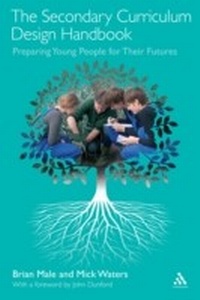
The Secondary Curriculum Design Handbook
Preparing Young People for Their Futures
1st Edition
Published on 20. December 2012
224 pages
978-1-4411-1074-9 (ISBN)
Description

Schools across the world are struggling to balance the statutory requirements of a national curriculum with their desire to provide the wide, engaging and exciting curriculum that they know children need. Concerns about standards often lead to a narrowing of the curriculum and many schools lack the confidence and approach to design that would enable them to resolve what seems like an impossible dilemma.
In this authoritative yet engaging book, Brian Male and Mick Waters look at how schools can meet the requirements of a national curriculum and yet be flexible enough to meet the needs, interests and concerns of pupils, to be rooted in their lives and localities and to give scope for teachers to use their own creativity.
The Secondary Curriculum Design Handbook is a practical guide to designing a curriculum that will engage children's interest, excite their imaginations and at the same time provide them with the knowledge, skills and understanding they need to live successfully in the 21st Century.
In this authoritative yet engaging book, Brian Male and Mick Waters look at how schools can meet the requirements of a national curriculum and yet be flexible enough to meet the needs, interests and concerns of pupils, to be rooted in their lives and localities and to give scope for teachers to use their own creativity.
The Secondary Curriculum Design Handbook is a practical guide to designing a curriculum that will engage children's interest, excite their imaginations and at the same time provide them with the knowledge, skills and understanding they need to live successfully in the 21st Century.
Reviews / Votes
'For the first time, a book has been written which actually integrates analytical thinking about the nature of the Curriculum with practical curriculum design in secondary schools. It also weaves in a fundamental understanding of the links between the nature of learning and the curriculum. The low key nature of its title belies its aspirations. This is a book with a global reach which has world-class quality.' John Bangs, Honorary Research Associate at Cambridge University, UK, and former Head of Education at the NUT 'This handbook should be essential reading for all those who believe that the school curriculum is too constrained by national requirements and accountability processes. It is both practical and thought-provoking and encourages the reader to think beyond the box of custom and practice while placing the learner firmly at the centre of planning. It would be both useful and inspiring for anyone involved in curriculum planning in secondary schools.' Sue Kirkham, Education Policy Specialist, Association of School and College Leaders (ASCL), UK 'At last, a book about curriculum design that tells it how it is. It's realistic about the difficulties involved, balances opportunities with pitfalls and doesn't indulge in starry-eyed promotion of one particular approach. The authors observe, 'Whatever the new National Curriculum says, it will be schools that interpret it into learning experiences for students.' They throw down that gauntlet to schools, and then take them helpfully and pragmatically through the stages of thinking necessary to the creation of a curriculum fit for, well, the 21st Century (having looked critically at the 20th Century one we follow, and identified its striking similarities to the 19th Century model!). A connected website provides a wealth of examples and timetable models. There is inspiration, too. The authors include a chapter of guidance on the vital but too often overlooked topic of 'making learning irresistible'. That's a challenge for all teachers - but furnishes a glimpse of a thrilling prospect, too, for those with the courage to face that challenge. This is truly a handbook, a volume to keep close to hand indeed, a 'must-have' for school leaders engaged in designing and building the curriculum.' Bernard Trafford, Headmaster, the Royal Grammar School, Newcastle upon Tyne, UKMore details
Edition
1. Auflage
Language
English
Place of publication
New York
United States
Target group
Professional and scholarly
Illustrations
60
ISBN-13
978-1-4411-1074-9 (9781441110749)
Copyright in bibliographic data and cover images is held by Nielsen Book Services Limited or by the publishers or by their respective licensors: all rights reserved.
Schweitzer Classification
Other editions
Additional editions
Brian Male | Mick Waters
The Secondary Curriculum Design Handbook
Preparing Young People for Their Futures
Book
06/2012
Continuum Publishing Corporation
€60.84
Article exhausted; check different version
Persons
Brian Male is a curriculum design consultant to UNESCO and a director of the Curriculum Foundation. Brian was formerly a head teacher, inspector, advisor, lecturer, and principal consultant to the Qualifications and Curriculum Authority (QCA).
Mick Waters is Professor of Education at the University of Wolverhampton, UK. Mick was Director of Curriculum at the QCA, after being Chief Education Officer for Manchester. He was a head teacher, lecturer, and then became Head of Birmingham's Advisor and Support Service when Tim Brighouse was CEO.
John Dunford is chair of Whole Education, the Chartered Institute of Educational Assessors and WorldWide Volunteering. He was formerly general secretary of the Association of School and College Leaders, UK.
Mick Waters is Professor of Education at the University of Wolverhampton, UK. Mick was Director of Curriculum at the QCA, after being Chief Education Officer for Manchester. He was a head teacher, lecturer, and then became Head of Birmingham's Advisor and Support Service when Tim Brighouse was CEO.
John Dunford is chair of Whole Education, the Chartered Institute of Educational Assessors and WorldWide Volunteering. He was formerly general secretary of the Association of School and College Leaders, UK.
Content
Introduction \ Section 1: How do we Design a Curriculum? \ 1. Curriculum Design \ 2. A 21st-Century Curriculum? \ 3. A Framework for the Curriculum \ Section 2: How do we Organise Learning? \ 4. The Curriculum Tree \ 5. The Deep Roots of Learning \ 6. A Canopy of Leaves: the Subject Disciplines \ 7. How do Key Concepts and Key Skills impact on learning? \ 8. Qualifications \ 9. Vocational Contexts and Work-Based Learning \ 10. Making Learning Irresistible \ 11. National Expectations in a Local Context \ 12. How will this Ever Work on the Timetable? \ Section 3: How will we Know if we have been Successful? \ 13. Assessing Success \ 14. Keeping an Overview: Evaluation \ Section 4: How do we Make it Work in Schools? \ 15. Making the Change \ 16. Managing the Institutional Challenge \ 17. Postscript: a World-Class Curriculum \ Index
