

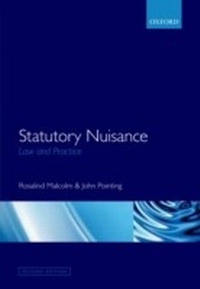
Statutory Nuisance: Law and Practice
1st Edition
Published on 22. September 2011
468 pages
978-0-19-102849-6 (ISBN)
Description

Statutory Nuisance: Law and Practice offers a comprehensive resource for practitioners in the legal and environmental health professions, guiding the reader through the complex practical and legal issues associated with statutory nuisance. It focuses on the problems that local authorities face in enforcing this area, as well as the issues facing those advising defendants. This title examines the role, powers, and duties of the local authorities, and the problems associatedwith drafting abatement notices and with the prosecution of nuisances. It also covers defences and proceedings brought by private individuals against neighbours and local authority landlords. The book analyses what happens in court, considering in detail the procedure and requirements in appeals against notices and in prosecutions, as well as the grounds for bringing further appeals and judicial review. It covers important recent decisions and key legislation. This new edition provides an update on the various types of statutory nuisance, additional chapters on new forms of statutory nuisance, and expanded material on adjacent areas of enforcement to statutory nuisance, notably those arising from the Anti-Social Behaviour agenda.
More details
Other editions
Additional editions
Book
09/2011
2nd Edition
Oxford University Press
€195.31
Article exhausted; check different version
Content
- Cover
- Contents
- Table of Cases
- Tables of Legislation
- List of Abbreviations
- 1. Synopsis
- Introduction
- Part I: Structure and Framework
- Part II: The Specific Nuisances
- Part III: Procedure and Evidence
- Appendices
- PART I: STRUCTURE AND FRAMEWORK
- 2. The Regulatory Framework
- Enforcement authorities in the UK
- Devolution
- General powers of local authorities
- Local authority decisions
- Limits to local authority powers
- Power of local authorities to prosecute
- Appearance in legal proceedings
- Environmental health regulation by local authorities
- Environment Agency
- European Union law
- Regulatory reform
- 3. The Historical Context of Statutory Nuisance and Public Health Legislation
- Origins
- Conceptual uncertainty
- Legislative history
- Early alternatives to statutory nuisance
- Nuisance in the Industrial Revolution
- Growth of a 'sanitary paradigm'
- Present-day historicism
- Legislative intention
- 4. The Concept of Statutory Nuisance
- Introduction
- The list of statutory nuisances
- 'Prejudicial to health or a nuisance'
- Origins of the two limbs of statutory nuisance
- The modern judicial approach
- The nuisance limb
- Public nuisance
- Private nuisance
- Public, private, and statutory nuisances: differences and overlaps
- The nuisance limb and the health limb
- Is the nuisance limb limited to those matters which might also be 'prejudicial to health'?
- Distinguishing the health and nuisance limbs
- Reasonableness as a central concept of common law nuisance and its relevance to statutory nuisance
- The health limb
- PART II: THE SPECIFIC NUISANCES
- 5. Premises
- Premises as a statutory nuisance
- Meaning of 'premises in such a state . . .'
- 'State' of the premises
- Meaning of 'premises' under section 79(1)(a)
- Vessels
- Premises suffering from dampness, condensation, and mould
- Can empty premises be prejudicial to health?
- Identifying the premises
- Liability for escape of the land itself
- Public sewers
- Defining 'premises' in other contexts
- Defences
- Alternative provisions relating to premises
- Leasehold premises
- 6. Noise
- Introduction
- Noise and statutory nuisance
- Noise and public nuisance
- Legislative background of statutory noise nuisance
- 'Noise emitted from premises so as to be prejudicial to health or a nuisance'
- Noise and prejudice to health
- Legal requirements and the role of enforcement officers
- Establishing liability for statutory noise nuisance
- Scope of noise nuisance
- Neighbour or domestic noise
- Entertainment noise
- Noise emitted from industrial, trade, and business premises
- Noise in the street and other public places
- Transportation noise
- Drafting noise abatement notices under the EPA 1990
- Noise Act 1996
- Noise from construction sites
- Other forms of noise control
- 7. Atmospheric Emissions
- Origins
- Smoke emitted from premises: application of section 79(1)(b)
- Fumes or gases emitted from premises: application of section 79(1)(c)
- Dust, steam, smell, etc: application of section 79(1)(d)
- Smoke, fumes, or gases from vehicles, etc on a street: application of section 79(1)(gb)
- 8. Animals
- Origins
- Definition of 'animals'
- Animals as a statutory nuisance
- Bye-laws
- 9. Accumulations and Deposits
- Origins
- The waste management regime
- Overlapping jurisdictions
- Definitions
- The obligation to remove accumulations
- The nuisance or health limb requirement
- Defences
- 10. Artificial Light
- The problem and background
- Types of light included in the nuisance
- The meaning of 'premises'
- Comparison with noise nuisance
- Is light nuisance measurable?
- Establishing a light nuisance
- Nuisance limb or health limb?
- Defences
- Overlapping jurisdictions
- 11. Insects
- Introduction
- What is an insect?
- Nuisance limb or health limb?
- Insects as nuisances
- Insects and climate change
- Proving the nuisance
- Identifying the person responsible
- Insects that can constitute a statutory nuisance
- Relevant premises
- Defences
- Abating an insect nuisance
- 12. Miscellaneous Nuisances in Other Legislation
- Introduction
- Statutory water nuisance in Scotland
- Statutory nuisances and watercourses in England and Wales
- Meaning of watercourses
- Persons who may be liable
- Land Drainage Act 1991
- Drainage of buildings
- Tents, vans, sheds, and similar structures
- Domestic water supply
- Fencing of abandoned and disused mines and quarries
- PART III: PROCEDURE AND EVIDENCE
- 13. Implications of the Human Rights Act 1998
- Background to the Human Rights Act 1998
- Application to acts of private individuals
- Relationship between Convention rights and UK legislation
- Persons entitled to bring judicial review proceedings under the Human Rights Act 1998
- Impact of the Human Rights Act 1998 on local authority decision-making
- Implications of the Human Rights Act 1998 for drafting abatement notices
- The right to property
- Article 8: Right to respect for private and family life
- Article 7: No punishment without law
- Article 6: Right to a fair trial
- Regulation of Investigatory Powers Act 2000
- Application to statutory nuisance
- 14. Enforcement: Use of Abatement Notices
- Introduction
- Duty to inspect
- Duty to respond to complaints
- Is there a duty to consult?
- Abatement notices: technical requirements
- Time limit for undertaking work
- Service of notices
- Suspension of abatement notices
- Withdrawing notices
- Amending notices
- 15. Appeals against Abatement Notices
- Introduction
- Suspension of notice
- Grounds of appeal
- Abatement notice not justified
- Informality, defect, or error
- Unreasonableness
- Insufficient time for compliance
- Best practicable means
- Noise conditions in abatement notice more onerous than in other notices or consents
- Disputed service
- Amending the grounds of appeal
- Pre-trial procedures
- Court's powers on appeal
- Conduct of the trial
- Court's powers in respect of third parties
- Costs
- Appeals to the Crown Court
- Appeals to the High Court
- 16. Offences and Prosecution for Breach of an Abatement Notice
- Introduction
- Offence of breach of abatement notice
- Obstruction offences
- Scope of 'obstruction'
- Powers to seize and remove noise-making equipment
- The decision to prosecute
- Crown Prosecution Service Guidelines for bringing a prosecution
- Public interest factors
- The Enforcement Concordat
- Simple cautions
- Who to prosecute
- The verdict
- Sentencing
- Compensation orders
- Costs
- Where the prosecution succeeds
- Defendant's costs
- Wasted costs
- Appeals to the Crown Court
- Appeals to the Divisional Court
- 17. Defences
- Defence of best practicable means
- Without reasonable excuse
- Statutory authority
- Licences and consents
- 18. Section 82 Proceedings
- Introduction
- Section 82 and housing defects
- Person aggrieved
- Person responsible
- Nature of the proceedings
- The procedure
- Abatement order
- Compensation orders
- Costs
- Defences
- Appeals
- Default proceedings
- Checklist for lay prosecutor starting proceedings under section 82
- 19. Other Remedies and Alternative Proceedings to the Abatement Notice Procedure
- Introduction
- Public nuisance
- Injunctions
- Procedure in applying for an injunction
- Injunctions by social landlords
- Anti-social behaviour
- Harassment
- Overlaps with other statutory regimes
- Contaminated land
- Integrated Pollution Prevention and Control
- Statutory nuisance and planning conditions
- Judicial review
- Grounds for judicial review
- The Wednesbury principle and human rights
- Applying for judicial review
- Alternative dispute resolution
- Complaints to the Local Government Ombudsman
- 20. Overview of Evidential Issues and Preparation for Court
- Introduction
- The investigation
- Using photographs
- Using noise measurements
- Using audio recordings
- Using other technical and scientific data
- Using documentary evidence
- Using expert witnesses and opinion evidence
- Use of notebooks in court
- Using evidence from interviewing suspects and witnesses
- Using witness statements
- Advance disclosure
- Disclosure of expert evidence
- Appendices
- Appendix A: Environmental Legislation
- Environmental Protection Act 1990-Extracts
- Clean Neighbourhoods and Environment Act (Northern Ireland) 2011-Extract
- Appendix B: Statutory Nuisance (Appeals) Regulations 1995 (SI 1995/2644)
- Appendix C: Other Legislation
- Police and Criminal Evidence Act 1984
- Clean Air Act 1993
- Criminal Justice and Public Order Act 1994
- Noise Act 1996
- Magistrates' Courts (Advance Notice of Expert Evidence) Rules 1997 (SI 1997/705)
- Magistrates' Courts (Hearsay Evidence in Civil Proceedings) Rules 1999 (SI 1999/681)
- Regulation of Investigatory Powers Act 2000-Part II
- Index
- A
- B
- C
- D
- E
- F
- G
- H
- I
- J
- K
- L
- M
- N
- O
- P
- Q
- R
- S
- T
- U
- V
- W
- Y
