

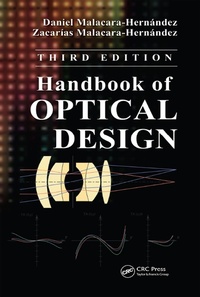
Handbook of Optical Design
3rd Edition
Published on 19. December 2017
585 pages
978-1-351-83292-2 (ISBN)
Description

Handbook of Optical Design, Third Edition covers the fundamental principles of geometric optics and their application to lens design in one volume. It incorporates classic aspects of lens design along with important modern methods, tools, and instruments, including contemporary astronomical telescopes, Gaussian beams, and computer lens design. Written by respected researchers, the book has been extensively classroom-tested and developed in their lens design courses.
This well-illustrated handbook clearly and concisely explains the intricacies of optical system design and evaluation. It also discusses component selection, optimization, and integration for the development of effective optical apparatus. The authors analyze the performance of a wide range of optical materials, components, and systems, from simple magnifiers to complex lenses used in photography, ophthalmology, telescopes, microscopes, and projection systems. Throughout, the book includes a wealth of design examples, illustrations, and equations, most of which are derived from basic principles. Appendices supply additional background information.
What's New in This Edition
Improved figures, including 32 now in color
Updates throughout, reflecting advances in the field
New material on Buchdahl high-order aberrations
Expanded and improved coverage of the calculation of wavefront aberrations based on optical path
An updated list of optical materials in the appendix
A clearer, more detailed description of primary aberrations
References to important new publications
Optical system design examples updated to include newly available glasses
25 new design examples
This comprehensive book combines basic theory and practical details for the design of optical systems. It is an invaluable reference for optical students as well as scientists and engineers working with optical instrumentation.
This well-illustrated handbook clearly and concisely explains the intricacies of optical system design and evaluation. It also discusses component selection, optimization, and integration for the development of effective optical apparatus. The authors analyze the performance of a wide range of optical materials, components, and systems, from simple magnifiers to complex lenses used in photography, ophthalmology, telescopes, microscopes, and projection systems. Throughout, the book includes a wealth of design examples, illustrations, and equations, most of which are derived from basic principles. Appendices supply additional background information.
What's New in This Edition
Improved figures, including 32 now in color
Updates throughout, reflecting advances in the field
New material on Buchdahl high-order aberrations
Expanded and improved coverage of the calculation of wavefront aberrations based on optical path
An updated list of optical materials in the appendix
A clearer, more detailed description of primary aberrations
References to important new publications
Optical system design examples updated to include newly available glasses
25 new design examples
This comprehensive book combines basic theory and practical details for the design of optical systems. It is an invaluable reference for optical students as well as scientists and engineers working with optical instrumentation.
Reviews / Votes
"An excellent update to an excellent book. A comprehensive handbook on optical design and geometrical optics that covers the basic theory as well as practical details."-James C. Wyant, College of Optical Sciences, University of Arizona, USA
"Even with modern 'easy-to-use' lens design software and global optimization, the understanding of aberration theory is essential to finding high-performing cost-effective design solutions. This book not only teaches the students the basics of aberration theory but adds in the needed understanding of higher order aberrations for modern optical systems. The chapter on wavefront aberrations and Zernike polynomials has been greatly improved and follows a notation becoming a standard in the industry."
-Dr. Julie L. Bentley, University of Rochester, New York, USA
"This is a new edition of a book that has been used in the course of lens design by the authors for many years. So it covers many aspects of optics taking in the progress in the individual field. Also the authors are trying to make the students of the course changing the order of materials as well as adding new ones."-Kyoji Nariai, National Astronomical Observatory of Japan, Mitaka, Tokyo
Praise for Previous Editions
"Many helpful references are given at the end of each chapter and the appendices, and these have been expanded from the first edition. ... Overall, the changes made in this edition have enhanced the book's value as an important reference for the optics community."
-Optics and Photonics News, Feb. 2006
"... the book makes liberal use of figures and diagrams, and covers both the basic principles of geometrical optics as well as their application to lens design. ... this book is recommended for academic libraries with active programs in optical engineering, and certainly for libraries owning well-used copies of the first edition."
-E-Streams, Vol. 7, No. 5, May 2004
"I found the book to be well presented and easy to read. ... For those interested in optical systems, this is a useful book to have on hand."
-The Physicist, Vol. 41, No. 2, March/April 2004
"Not only the basic theory is treated in this book, but many practical details for the design of important optical systems are given. ... [A] book which is important and helpful and should not be missed in any optical laboratory."
-Optik-International Journal for Light and Electron Optics, Vol. 115, No. 10, 2004 "An excellent update to an excellent book. A comprehensive handbook on optical design and geometrical optics that covers the basic theory as well as practical details."
-James C. Wyant, College of Optical Sciences, University of Arizona, USA
"Even with modern 'easy-to-use' lens design software and global optimization, the understanding of aberration theory is essential to finding high-performing cost-effective design solutions. This book not only teaches the students the basics of aberration theory but adds in the needed understanding of higher order aberrations for modern optical systems. The chapter on wavefront aberrations and Zernike polynomials has been greatly improved and follows a notation becoming a standard in the industry."-Dr. Julie L. Bentley, University of Rochester, New York, USA
"This is a new edition of a book that has been used in the course of lens design by the authors for many years. So it covers many aspects of optics taking in the progress in the individual field. Also the authors are trying to make the students of the course changing the order of materials as well as adding new ones."-Kyoji Nariai, National Astronomical Observatory of Japan, Mitaka, Tokyo
Praise for Previous Editions
"Many helpful references are given at the end of each chapter and the appendices, and these have been expanded from the first edition. ... Overall, the changes made in this edition have enhanced the book's value as an important reference for the optics community."-Optics and Photonics News, Feb. 2006
"... the book makes liberal use of figures and diagrams, and covers both the basic principles of geometrical optics as well as their application to lens design. ... this book is recommended for academic libraries with active programs in optical engineering, and certainly for libraries owning well-used copies of the first edition."
-E-Streams, Vol. 7, No. 5, May 2004"I found the book to be well presented and easy to read. ... For those interested in optical systems, this is a useful book to have on hand."-The Physicist, Vol. 41, No. 2, March/April 2004
"Not only the basic theory is treated in this book, but many practical details for the design of important optical systems are given. ... [A] book which is important and helpful and should not be missed in any optical laboratory."-Optik-International Journal for Light and Electron Optics, Vol. 115, No. 10, 2004
More details
Edition
3rd edition
Language
English
Place of publication
London
United Kingdom
Publishing group
Taylor & Francis Ltd
Target group
Professional and scholarly
Product notice
Reflowable
Illustrations
65 Tables, black and white; 32 Illustrations, color; 393 Illustrations, black and white
File size
14,06 MB
ISBN-13
978-1-351-83292-2 (9781351832922)
Copyright in bibliographic data and cover images is held by Nielsen Book Services Limited or by the publishers or by their respective licensors: all rights reserved.
Schweitzer Classification
Other editions
Additional editions
Daniel Malacara-Hernandez | Zacarias Malacara-Hernandez
Handbook of Optical Design
Book
02/2013
3rd Edition
CRC Press
€234.10
Shipment within 15-20 days
Persons
Daniel Malacara-Hernandez is a professor and researcher at Centro de Investigaciones en Optica in Leon, Mexico.
Zacarias Malacara-Hernandez is a researcher at Centro de Investigaciones en Optica in Leon, Mexico.
Zacarias Malacara-Hernandez is a researcher at Centro de Investigaciones en Optica in Leon, Mexico.
Content
Geometrical Optics Principles. Thin Lenses and Spherical Mirrors. Systems of Several Lenses and Thick Lenses. Chromatic Aberrations. Spherical Aberration. Monochromatic Off-Axis Aberrations. Aberration Polynomials and High-Order Aberrations. Computer Evaluation of Optical Systems. Diffraction in Optical Systems. Prisms. Basic Optical Systems and Simple Photographic Lenses. Complex Photographic Lenses. The Human Eye and Ophthalmic Lenses. Astronomical Telescopes. Visual Systems and Afocal Systems. Microscopes. Projection Systems. Lens Design Optimization. Appendices. Index.
