

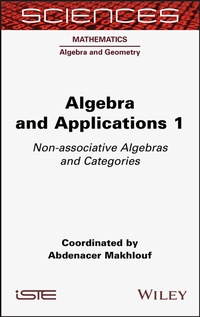
Algebra and Applications 1
Description

SCIENCES collection published by ISTE and Wiley, and the first of three
volumes specifically focusing on algebra and its applications. Algebra
and Applications 1 centers on non-associative algebras and includes an
introduction to derived categories. The chapters are written by
recognized experts in the field, providing insight into new trends, as well
as a comprehensive introduction to the theory.
The book incorporates
self-contained surveys with the main results, applications and
perspectives.
The chapters in this volume cover a wide variety of algebraic structures
and their related topics. Jordan superalgebras, Lie algebras,
composition algebras, graded division algebras, non-associative C*-
algebras, H*-algebras, Krichever-Novikov type algebras, preLie algebras
and related structures, geometric structures on 3-Lie algebras and
derived categories are all explored.
Algebra and Applications 1 is of great interest to graduate students and
researchers.
Each chapter combines some of the features of both a
graduate level textbook and of research level surveys.
More details
Other editions
Additional editions
Person
department at the University of Haute Alsace, France. His research
covers structure, representation theory, deformation theory and
cohomology of various types of algebras, including non-associative
algebras, Hopf algebras and n-ary algebras.
Content
Abdenacer MAKHLOUF
Chapter 1. Jordan Superalgebras 1
Consuelo MARTINEZ and Efim ZELMANOV
Chapter 2. Composition Algebras 27
Alberto ELDUQUE
Chapter 3. Graded-Division Algebras 59
Yuri BAHTURIN, Mikhail KOCHETOV and Mikhail ZAICEV
Chapter 4. Non-associative C¯*-algebras 111
Ángel RODRÍGUEZ PALACIOS and Miguel CABRERA GARCÍA
Chapter 5. Structure of H¯*-algebras 155
José Antonio CUENCA MIRA
Chapter 6. Krichever-Novikov Type Algebras: Definitions and Results 199
Martin SCHLICHENMAIER
Chapter 7. An Introduction to Pre-Lie Algebras 245
Chengming BAI
Chapter 8. Symplectic, Product and Complex Structures on 3-Lie Algebras 275
Yunhe SHENG and Rong TANG
Chapter 9. Derived Categories 321
Bernhard KELLER
List of Authors 347
Index 349
1
Jordan Superalgebras
Consuelo MARTINEZ1 and Efim ZELMANOV2
1Department of Mathematics, University of Oviedo, Spain
2Department of Mathematics, University of California San Diego, USA
1.1. Introduction
Superalgebras appeared in a physical context in order to study, in a unified way, supersymmetry of elementary particles. Jordan algebras grew out of quantum mechanics and gained prominence due to their connections to Lie theory. In this chapter, we survey Jordan superalgebras focusing on their connections to other subjects. In this section we introduce some basic definitions and in section 1.2 we give the Tits-Kantor-Koecher construction that shows the way in which Lie and Jordan structures are connected. In section 1.3, we show examples of some basic superalgebras (the so-called classical superalgebras). Section 1.4 is about the notion of brackets and explains how to construct superalgebras using different types of brackets. Section 1.5 explains Cheng-Kac superalgebras, an important class of superalgebras that appeared for the first time in the context of superconformal algebras. The classification of Jordan superalgebras is explained in section 1.6, and it includes the cases of an algebraically closed field of zero characteristics, the case of prime characteristic, both for Jordan superalgebras with semisimple even part and with non-semisimple even part, and the case of non-unital Jordan superalgebras. Finally, in section 1.7, we give some general ideas about Jordan superconformal algebras. Throughout the chapter, all algebras are considered over a field F, charF ? 2.
DEFINITION 1.1.- A (linear) Jordan algebra is a vector space J with a linear binary operation (x, y) ? xy satisfying the following identities:
(J1) xy = yx (commutativity);
(J2) (x2y)x = x2(yx) ?x, y ? J (Jordan identity).
Instead of (J2) we can consider the corresponding linearized identity:
(J'2) (xy)(zu) + (xz)(yu) + (xu)(yz) = ((xy)z)u + ((xu)z)y + ((yu)z)x ?x, y, z, u ? J.
REMARK 1.1.- A Lie algebra L is a vector space with a linear binary operation (x, y) ? [x, y] satisfying the following identities:
(L1) [x, y] = -[y, x] (anticommutativity);
(L2) [[x, y], z] + [[y, z], x] + [[z, x], y] = 0 for arbitrary elements x, y, z ? J (Jacobi identity).
EXAMPLE 1.1.- If A is an associative algebra, then (A(+), ), where a b = ab + ba is a Jordan algebra, and (A(-), [, ]), where [a, b] = ab - ba is a Lie algebra. Both A(+) and A(-) have the same underlying vector space as A.
DEFINITION 1.2.- A superalgebra A is an algebra with a Z/2Z-grading. So is a direct sum of two vector spaces and
Elements of are called homogeneous elements. The parity of a homogeneous element a, denoted |a|, is defined by |a| = 0 if and |a| = 1 if .
Elements in are called even and elements in are called odd.
Note that is a subalgebra of A, but is not, instead it can be seen as a bimodule over .
EXAMPLE 1.2.- If V is a vector space of countable dimension, then G = G(V) denotes the Grassmann (or exterior) algebra over V, that is, the quotient of the tensor algebra over the ideal generated by the symmetric tensors v ? w + w ? v, v, w ? V. This algebra G(V) is Z/2Z-graded. Indeed, , where the "even part" is the linear span of all tensors of even length and the "odd part" is the linear span of all tensors of odd length.
G(V) is an example of a superalgebra.
DEFINITION 1.3.- Consider a variety of algebras V defined by homogeneous identities (see Jacobson (1968) or Zhevlakov et al. (1982)). We say that a superalgebra is a V-superalgebra if the even part of A ?F G(V) lies in the variety, that is
DEFINITION 1.4.- The algebra is called the Grassmann envelope of the superalgebra A and will be denoted as G(A).
Let us consider V the variety of associative, commutative, anticommutative, Jordan or Lie algebras, respectively. Then we get:
EXAMPLE 1.3.- A superalgebra is an associative superalgebra if and only if it is a Z/2Z-graded associative algebra.
EXAMPLE 1.4.- A superalgebra is a commutative superalgebra if it satisfies:
for any x, y homogeneous elements of A.
EXAMPLE 1.5.- A superalgebra A is an anticommutative superalgebra if
for every x, y homogeneous elements of A.
EXAMPLE 1.6.- A Jordan superalgebra is a superalgebra that is commutative and satisfies the graded identity:
for every homogeneous elements .
EXAMPLE 1.7.- An anticommutative superalgebra A is a Lie superalgebra if it satisfies:
for every .
DEFINITION 1.5.- If is a Jordan superalgebra and , then their triple product is defined by:
Note that every algebra is a superalgebra with the trivial grading, that is, .
1.2. Tits-Kantor-Koecher construction
Tits (1962, 1966) made an important observation that relates Lie and Jordan structures. Let L be a Lie superalgebra whose even part contains an -triple {e, f, h}, that is,
DEFINITION 1.6.- An -triple e, f, h is said to be "good" if ad(h) : L L is diagonalizable and the eigenvalues are only -2, 0, 2.
In such a case, L = L- 2 + L0 + L2 decomposes as a direct sum of eigenspaces. We can define a new product in L2 by:
With this new product, J = (L2, ) becomes a Jordan superalgebra.
Moreover, (Tits 1962, 1966; Kantor 1972) and (Koecher 1967) showed that every Jordan superalgebra can be obtained in this way. The corresponding Lie superalgebra is not unique, but any two such Lie superalgebras are centrally isogenous, that is, they have the same central cover. Let us recall the construction of L = TKK(J), the universal Lie superalgebra in this class (see Martin and Piard (1992)).
CONSTRUCTION.- Consider J a unital Jordan superalgebra, and {ei}i?I a basis of J.
Let
Define a Lie superalgebra K by generators and relations
This Lie superalgebra has a short grading K = K-1 + K0+ K1 where
K is the universal Tits-Kantor-Koecher Lie superalgebra of the unital Jordan superalgebra J:
1.3. Basic examples (classical superalgebras)
Let be an associative superalgebra. The new operation in the underlying vector space A given by:
defines a structure of a Jordan superalgebra on A that is denoted A(+).
DEFINITION 1.7.- Those Jordan superalgebras that can be obtained as subalgebras of a superalgebra A(+), with A an associative superalgebra, are called special. Superalgebras that are not special are called exceptional.
REMARK 1.2.- If we consider in the original associative superalgebra the new product given by:
we get a Lie superalgebra that is denoted as A(-).
DEFINITION 1.8.- A superalgebra A is simple if it does not have non-trivial graded ideals. A graded ideal is an ideal I ? A such that for every a = a0 + a1 ? I, it follows that a0, a1 ? I. So every graded ideal I satisfies .
Wall (1963, 1964) proved that an arbitrary simple finite dimensional superalgebra over an algebraically closed field is isomorphic to one of the following two types:
- I) .
- II) .
Consequently, we can easily get the first examples of simple finite dimensional Jordan superalgebras as explained above.
EXAMPLE 1.8.- .
EXAMPLE 1.9.- J = Q(n)(+), n = 2.
DEFINITION 1.9.- Let A be an associative superalgebra. A map * : A A is a superinvolution if it satisfies:
- i) (a*)* = a, ?a ? A;
- ii) .
If * : A A is a superinvolution of the associative superalgebra A, then the set of symmetric elements H(A, *) is a Jordan superalgebra of A(+). Similarly, the subspace of skew-symmetric elements K(A, *)= {a ? A | a* = -a} is a Lie subsuperalgebra of A(-).
The...
