

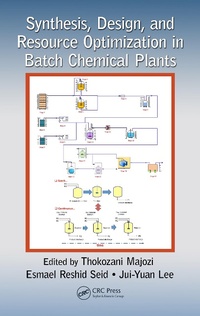
Synthesis, Design, and Resource Optimization in Batch Chemical Plants
Published on 4. March 2015
450 pages
978-1-4822-5242-2 (ISBN)
Description

The manner in which time is captured forms the foundation for synthesis, design, and optimization in batch chemical plants. However, there are still serious challenges with handling time in batch plants. Most techniques tend to assume either a fixed time dimension or adopt time average models to tame the time dimension, thereby simplifying the resu
Reviews / Votes
"... deals with a very important element-water. ... covers desalination, water networks, and water conservation. ... treats water as part of the operational and design optimization, which is not the case in most contributions."-Iiro Harjunkoski, ABB Corporate Research, Frankfurt, Germany
"... combines theoretical topics-for instance, a new technique for scheduling of multipurpose batch plants, which is at the early stages of development and is applied to small-size examples-with more applied ones, like the challenges of planning and scheduling in the biopharmaceutical industry. ... draws the attention of the reader and makes him/her interested in the field of batch plants."
-Gabriela P. Henning, INTEC (Universidad Nacional del Litoral - CONICET), Santa Fe, Argentina
"The topics selected by the authors are of importance for researchers and specialists who are interested in the design and synthesis of batch plants, especially on the utilization of energy and water."
-Yongzhong Liu, Xi'an Jiaotong University, China
"The main strength of the book is the systems approach to the design and operation of batch processes, with the inclusion of the different resources that can be involved in the process in the definition of the optimization problem. ... Another important topic is the design/retrofit of a sustainable process, with multi-objective optimization being used to evaluate the tradeoff between economic and environmental impact."
-Pedro M. Castro, University of Lisbon, Portugal
"... highly descriptive-includes detailed methodologies and relevant case studies. The methods are presented clearly and demonstrated well by case studies. The structure of the book is well thought out and has sufficient depth and breadth to cover the topic."
-Martin Atkins, University of Waikato, Hamilton, New Zealand
"... presents state-of-the art models for the scheduling, synthesis, design, and resource optimization of batch chemical processes. ... an excellent reference book for those interested in the latest research developments in this area."
-Ignacio Grossmann, Carnegie Mellon University, Pittsburgh, Pennsylvania, USA
"Great novelty of this book is that it bridges disciplines such as reaction engineering, modelling and simulation, water and energy optimization and design for providing comprehensive understanding of batch reactor systems widely used in many process industries."
-Dr. P. Mondal, Associate Professor, Department of chemical Engineering, Indian Institute of Technology Roorkee, Uttarakhand, India
"... is an excellent collection of very relevant chapters, written by the experts from different parts of the globe, covering the various aspects of scheduling, design & synthesis, and resource conservation for batch chemical plants. The environmental aspects have been addressed in the form of energy and water conservation. The emphasis has been placed on the rigor and essence of scheduling framework in batch chemical plants. It has also included the most recent and state-of-the-art techniques for scheduling of multipurpose batch plants including pipeless batch plants, which are the most complex type in this category."
-Prof. Pramod K. Bajpai, Department of Chemical Engineering, Thapar University, Patiala
More details
Language
English
Place of publication
London
United Kingdom
Publishing group
Taylor & Francis Ltd
Target group
College/higher education
Illustrations
136 s/w Abbildungen, 94 s/w Tabellen
136 b/w images, 94 tables and Line of Equations 648 - Total Equations 1932
File size
8,63 MB
ISBN-13
978-1-4822-5242-2 (9781482252422)
Copyright in bibliographic data and cover images is held by Nielsen Book Services Limited or by the publishers or by their respective licensors: all rights reserved.
Schweitzer Classification
Other editions
Additional editions
Thokozani Majozi | Esmael Reshid Seid | Jui-Yuan Lee
Synthesis, Design, and Resource Optimization in Batch Chemical Plants
Book
07/2017
1st Edition
CRC Press
€144.08
Shipment within 10-20 days
Thokozani Majozi | Esmael Reshid Seid | Jui-Yuan Lee
Synthesis, Design, and Resource Optimization in Batch Chemical Plants
Book
03/2015
1st Edition
CRC Press
€378.50
Article not available for order
Persons
Thokozani Majozi is a full professor in the School of Chemical and Metallurgical Engineering, University of Witwatersrand, Johannesburg, South Africa, where he also holds an NRF/DST chair in sustainable process engineering. He was previously an associate professor at the University of Pannonia, Veszprem, Hungary. Highly decorated and widely published, he holds a Ph.D from the University of Manchester Institute of Science and Technology, UK, and is a member of the Academy of Sciences and a fellow of the Academy of Engineering, both of South Africa.
Esmael Reshid Seid obtained his B.Sc in chemical engineering from Bahir Dar University, Ethiopia. He worked in the process industry for three years before joining the University of Pretoria, South Africa, where he obtained his M.Sc.Eng and Ph.D in chemical engineering. Dr. Seid has had several publications on design, synthesis, scheduling, and resource conservation, with particular emphasis on water and energy for multipurpose batch plants, featured in international refereed journals.
Jui-Yuan Lee is an assistant professor in the Department of Chemical Engineering and Biotechnology at the National Taipei University of Technology, Taiwan. He received his B.Sc from National Cheng Kung University, Taiwan, and his Ph.D from National Taiwan University (NTU). He spent two and a half more years at NTU doing postdoctoral research, before joining the School of Chemical and Metallurgical Engineering, University of the Witwatersrand, Johannesburg, South Africa, where he stayed eight months as a postdoctoral fellow. Widely published, Dr. Lee focuses his research on process integration for energy savings and waste reduction using mathematical programming.
Esmael Reshid Seid obtained his B.Sc in chemical engineering from Bahir Dar University, Ethiopia. He worked in the process industry for three years before joining the University of Pretoria, South Africa, where he obtained his M.Sc.Eng and Ph.D in chemical engineering. Dr. Seid has had several publications on design, synthesis, scheduling, and resource conservation, with particular emphasis on water and energy for multipurpose batch plants, featured in international refereed journals.
Jui-Yuan Lee is an assistant professor in the Department of Chemical Engineering and Biotechnology at the National Taipei University of Technology, Taiwan. He received his B.Sc from National Cheng Kung University, Taiwan, and his Ph.D from National Taiwan University (NTU). He spent two and a half more years at NTU doing postdoctoral research, before joining the School of Chemical and Metallurgical Engineering, University of the Witwatersrand, Johannesburg, South Africa, where he stayed eight months as a postdoctoral fellow. Widely published, Dr. Lee focuses his research on process integration for energy savings and waste reduction using mathematical programming.
Content
Introduction to Batch Chemical Processes. Effective Technique for Scheduling in Multipurpose Batch Plants. Short-Term Scheduling of Multipurpose Pipeless Plants. Evolution of Unit-Specific Event-Based Models in Batch Process Scheduling. Planning and Scheduling in the Biopharmaceutical Industry: An Overview. Design and Synthesis of Multipurpose Batch Plants. Process Synthesis Approaches for Enhancing Sustainability of Batch Process Plants. A Mixed-Integer Linear Programming Model for Optimal Synthesis of Polygeneration Systems with Material and Energy Storage for Cyclic Loads. Scheduling and Design of Multipurpose Batch Facilities: Periodic versus Nonperiodic Operation Mode through a Multi-Objective Approach. Flexibility Analyses and Their Applications in Solar-Driven Membrane Distillation Desalination System Designs. Automated Targeting Model for Batch Process Integration. Integration of Batch Process Schedules and Water Allocation Network. Synthesis of Water Networks with Mixed Batch and Continuous Process Units. Water Conservation in Fixed Scheduled Batch Processes. Simultaneous Optimization of Energy and Water Use in Multipurpose Batch Plants. Retrofit of Industrial Water Network with Mixed Batch and Semicontinuous Processes: Economic versus Environmental Impact.
