

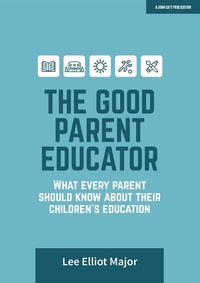
The Good Parent Educator
What every parent should know about their children's education
Published on 23. August 2021
182 pages
978-1-914351-38-9 (ISBN)
Description

How can you help your children do well at school and beyond? It's a question millions of parents are asking themselves as they go to ever greater lengths to secure the best education results for their children. By the time they leave home, many parents will spend 10,000 days trying to help their children prepare for adulthood. Here for the first time are the essential evidence-informed tips to make you an effective parent educator.
The Good Parent Educator provides the tools that will turn excessive parenting into effective learning. Whether it is helping children learn to read or revise, engaging with teachers, paying for private tutors, choosing a school, or deciding which degree or apprenticeship to apply for, this is the must-have expert guide. It reveals what really matters in education, debunking the many education myths and misconceptions that can harm children's learning.
Enabling parents to focus on effective uses of their time will lead to better outcomes, but also to a more balanced life. Based on the findings of thousands of studies, but also filled with personal parenting stories, the book's ultimate aim is to empower children through education so they become independent thinkers ready to prosper in the world.
The Good Parent Educator provides the tools that will turn excessive parenting into effective learning. Whether it is helping children learn to read or revise, engaging with teachers, paying for private tutors, choosing a school, or deciding which degree or apprenticeship to apply for, this is the must-have expert guide. It reveals what really matters in education, debunking the many education myths and misconceptions that can harm children's learning.
Enabling parents to focus on effective uses of their time will lead to better outcomes, but also to a more balanced life. Based on the findings of thousands of studies, but also filled with personal parenting stories, the book's ultimate aim is to empower children through education so they become independent thinkers ready to prosper in the world.
More details
Language
English
Place of publication
Saxmundham, Suffolk
United Kingdom
Target group
College/higher education
Professional and scholarly
Primary & secondary/elementary & high school
Interest Age: From 18 to 99 years
Product notice
Fixed format
Hochformat
File size
1,75 MB
ISBN-13
978-1-914351-38-9 (9781914351389)
Copyright in bibliographic data and cover images is held by Nielsen Book Services Limited or by the publishers or by their respective licensors: all rights reserved.
Schweitzer Classification
Other editions
Additional editions
Lee Elliot Major
The Good Parent Educator: What every parent should know about their children's education
Book
08/2021
John Catt Educational Ltd
€35.48
Shipment within 3-4 weeks
Person
Lee Elliot Major is Britain's first Professor of Social Mobility, appointed by the University of Exeter to be a global leader in the field. His work is dedicated to improving the prospects of disadvantaged children and young people.
He has written several award-winning books about education and social mobility, including Social Mobility and Its Enemies and What Works? Research and evidence for successful teaching.
His work has helped 100,000s of teachers. He is focused on the practical impact of research, working closely with school leaders, universities, employers and Government policy makers.
Lee is one of the most influential public voices in national education debates, appearing regularly in the press. He was formerly Chief Executive of the Sutton Trust. He is the first in his family to go to university. In 2019, Lee was awarded an OBE in 2019 for services to social mobility.
He has written several award-winning books about education and social mobility, including Social Mobility and Its Enemies and What Works? Research and evidence for successful teaching.
His work has helped 100,000s of teachers. He is focused on the practical impact of research, working closely with school leaders, universities, employers and Government policy makers.
Lee is one of the most influential public voices in national education debates, appearing regularly in the press. He was formerly Chief Executive of the Sutton Trust. He is the first in his family to go to university. In 2019, Lee was awarded an OBE in 2019 for services to social mobility.
Content
- Cover
- About the author
- Copyright
- Testimonials
- Acknowledgements
- Contents
- 1. Navigating the ever-escalating educational arms race
- Becoming a parent
- Home schooling
- Educational arms race
- More harm than good?
- Reading and references
- 2. The good parent educator
- Fucking them up?
- What parent type are you?
- Parenting problems
- Education home truths
- Age of enlightenment
- Not just grades
- The good parent educator
- Reading and references
- 3. Helping your children to read
- A pleasing discovery
- Reading's big dilemma
- What you can do
- Reading and references
- 4. Choosing a school: what really matters
- Back to school
- Debunking myths
- Ask about the best teachers
- Ask about setting
- League tables - treat with care
- Beware hothouses
- Moving schools
- Reading and references
- 5. Mind matters: motivating learning
- Growth mindset
- Goodhew's law: stretching but realistic goals
- Reading and references
- 6. Homework
- Homework scars
- What you can do
- Reading and references
- 7. Arts and sports
- More to life than academic grades
- Benefits
- What you can do
- Reading and references
- 8. Safeguarding summer-born children
- Summer-born disadvantage
- Education gaps
- What you can do
- Reading and references
- 9. Private tutors
- Money well spent?
- What you can do
- Reading and references
- 10. Revision strategies: thinking hard or thinking lazy?
- How to remember things
- Limits of highlighting, re-reading and summarising
- Test yourself
- A little a lot, not a lot at once
- Alternate between types of questions and topics
- Mnemonics
- Final comments
- Reading and references
- 11. Helicopter awareness of learning
- Helicopter learning
- Metacognition and self-regulation
- What you can do
- Reading and references
- 12. Mind matters: managing cognitive load
- Cognitive load theory
- What you can do
- Reading and references
- 13. Academic selection
- Lifetime scars
- Set ways
- Faulty assumptions
- What you can do
- Reading and references
- 14. Digital dilemmas
- Jekyll and Hyde
- Stop watching the clock
- Future skills
- Education value
- What you can do
- Reading and references
- 15. Seeking feedback
- Teaching's impossible challenge
- Individualised feedback
- What you can do
- Reading and references
- 16. Mind matters: learning styles and other myths
- Learning styles
- Reading and references
- 17. Exploring apprenticeships
- The dinner table test
- Benefits
- A renaissance in apprenticeships
- What you can do
- Reading and references
- 18. Choosing a university degree
- Wrong choices
- What to do
- Reading and references
- 19. Debunking Oxbridge myths
- A Cambridge education
- Myths
- What you can do
- Reading and references
- 20. Life skills for job hunting
- Boomerang generation
- Nurturing essential life skills
- What you can do
- Reading and references
- 21. What's fair game?
- In the dock
- Fine lines
- The costs of cheating
- Reading and references
- 22. The good parent educator quiz
- Questions
- Answers
