

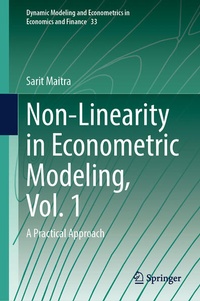
Non-Linearity in Econometric Modeling, Vol. 1
Description

More details
Other editions
Additional editions
Person
Sarit Maitra received his Ph.D. in Information Technology from Universiti Teknologi PETRONAS, Malaysia. He is currently affiliated with Alliance School of Business, Alliance University, Bengaluru, India as Professor, Business Analytics. He comes with nearly three decades of industry experience, specialized in data / big data and business analytics. With deep expertise in data strategy and decision science, he leverages both linear and non-linear modeling approaches to power simulation, optimization, and decision-support systems consistently translating complex data into measurable business outcomes. He leverages his industry to transform data into actionable insights, lead high-performing teams, and align analytics initiatives with organizational goals. He has contributed to several scholarly works and publications in leading academic journals. He plays a key role in multiple consulting engagements, spearheading analytics strategy and data driven business decisions to deliver business strategy and success.
Content
Importance of Filters in Data Processing Pipeline discusses about the challenges of dealing with real-world data and application of Kalman Filter to improve the reliability and accuracy of models.- Volatility Modeling discusses the common problem with volatility or variance and covers how volatility can be computed and modeled.- Hybrid Volatility Modeling discusses while GARCH volatility models remain valuable, a combination of GARCH and Neural Networks can offer better output considering the availability of data, computational power, and algorithmic advancements.- Dynamic Volatility and Option Valuation provides a practical and theoretical framework for pricing and analyzing options, utilizing advanced volatility modeling techniques.- Markov Switching Models, Threshold Auto Regressive Models, and Smooth Transition Model discusses the application Markov Switching Auto Regressive Model (MSAR) and Smooth Transition Auto Regressive (STAR) Model.
