

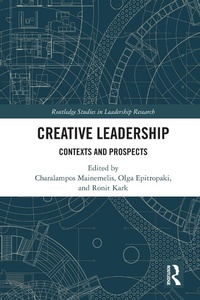
Creative Leadership
Contexts and Prospects
1st Edition
Published on 3. September 2018
284 pages
978-1-351-36228-3 (ISBN)
Description

There has never been a better time to study, practice, and experience creative leadership. In the fluid and turbulent economic and social environments of the 21st century, creative leadership has become a cardinal force in the creation and evolution of adaptive organizations. In the last two decades, organizational science has witnessed a rapid increase in the number of studies on the nature, skills, and processes of creative leadership. The resulting accumulated body of knowledge has remained for many years dispersed and fragmented across multiple strands of organizational research. This volume seeks to foster the cross-fertilization of scientific knowledge and insight by bringing together authoritative contributions from leading scholars whose work is located in different strands of creative leadership research.
Creative Leadership: Contexts and Prospects builds upon a recently introduced multi-context framework that integrates metatheoretically three conceptualizations of creative leadership found in the extant literature: Facilitating employee creativity; Directing the materialization of a leader's creative vision; and Integrating heterogeneous creative contributions. These three conceptualizations reflect essential differences in the enactment of creative leadership across various collaborative contexts of creative work, and they underlie the intellectual efforts of different research strands.
The collection of chapters in Creative Leadership: Contexts and Prospects offers the latest thinking on creative leadership in facilitative, directive, and integrative contexts, and a stimulating set of ideas for crafting the next generation of nuanced theories and empirical studies in the field.
Creative Leadership: Contexts and Prospects builds upon a recently introduced multi-context framework that integrates metatheoretically three conceptualizations of creative leadership found in the extant literature: Facilitating employee creativity; Directing the materialization of a leader's creative vision; and Integrating heterogeneous creative contributions. These three conceptualizations reflect essential differences in the enactment of creative leadership across various collaborative contexts of creative work, and they underlie the intellectual efforts of different research strands.
The collection of chapters in Creative Leadership: Contexts and Prospects offers the latest thinking on creative leadership in facilitative, directive, and integrative contexts, and a stimulating set of ideas for crafting the next generation of nuanced theories and empirical studies in the field.
Reviews / Votes
"Based at universities in Athens, Durham and Tel Aviv, the leading contemporary trio of academic researchers on creative leadership have gathered a state-of-the-field reader. Organized around their great insight that creative leaders variously facilitate, direct and integrate others' contributions in producing creative work, this collection of 14 articles provides a wealth of valuable insights, both theoretical and practical." - David Slocum, "The Top 10 Creative Leadership Books From 2018," Forbes.com, January 13, 2019More details
Series
Edition
1. Auflage
Language
English
Place of publication
London
United Kingdom
Publishing group
Taylor & Francis Ltd
Target group
College/higher education
Illustrations
11 Tables, black and white
ISBN-13
978-1-351-36228-3 (9781351362283)
Copyright in bibliographic data and cover images is held by Nielsen Book Services Limited or by the publishers or by their respective licensors: all rights reserved.
Schweitzer Classification
Other editions
Additional editions
Book
12/2020
1st Edition
Routledge
€54.46
Shipment within 15-20 days
Book
08/2018
1st Edition
Routledge
€206.70
Shipment within 10-20 days
Persons
Charalampos Mainemelis is Professor of Organizational Behavior and Director of the SEV Center of Excellence in Creative Leadership at ALBA Graduate Business School, The American College of Greece, Greece.
Olga Epitropaki is Professor of Management at Durham University Business School, UK.
Ronit Kark is Associate Professor of Organizational and Leadership Studies at the Department of Psychology at Bar Ilan University, Israel.
Olga Epitropaki is Professor of Management at Durham University Business School, UK.
Ronit Kark is Associate Professor of Organizational and Leadership Studies at the Department of Psychology at Bar Ilan University, Israel.
Content
Part I: Foundations of Creative Leadership
1. Introduction: Connecting Creative Leadership's Strands of Research
Charalampos Mainemelis, Olga Epitropaki, and Ronit Kark
2. On the Relationship Between Creative Leadership and Contextual Variability
Charalampos Mainemelis
3. Unpacking the Socio-cognitive Foundations of Creative Leadership: Bridging Implicit Leadership and Implicit Creativity Theories
Olga Epitropaki, Jennifer S. Mueller, and Robert G. Lord
Part II: Creative Leadership in Facilitative Contexts
4. Leading Creative Efforts: Common Functions and Common Skills
Michael D. Mumford, Colleen Durban, Yash Gujar, Julia Buck, and E. Michelle Todd
5. Leader Behaviors and Employee Creativity: Taking Stock of the Current State of Research
Christina E. Shalley and G. James Lemoine
6. Empowering Leadership and Team Creativity: The Roles of Team Learning Behavior, Team Creative Efficacy, and Team Task Complexity
Xiaomeng Zhang and Ho Kwong Kwan
7. Fostering the Creativity of Work Teams: Creative Leadership in the Midst of Diversity
Maria Kakarika
Part III: Creative Leadership in Directive Contexts
8. Creativity is not Enough: The WICS Model of Leadership
Robert J. Sternberg
9. The Creative Leadership Practices of Haute Cuisine Chefs
Isabelle Bouty, Marie-Leandre Gomez, and Marc Stierand
10. "It Must Give Birth to a World": Temporality and Creative Leadership for Artistic Innovation
Silviya Svejenova
Part IV: Creative Leadership in Integrative Contexts
11. Leading for Creative Synthesis: A Process-Based Model for Creative Leadership
Sarah Harvey, Chia-yu Kou, and Wenxin Xie
12. Brokerage and Creative Leadership: Process, Practice, and Possibilities
Elizabeth Long-Lingo
13. A Curatorial Metaphor for Creative Leadership
Robert Litchfield and Lucy L. Gilson
14. Exploring Integrative Creative Leadership in the Filmmaking Industry
Nicole Flocco, Filomena Canterino, Stefano Cirella, Jean-Francois Coget, and Abraham B. (Rami) Shani
1. Introduction: Connecting Creative Leadership's Strands of Research
Charalampos Mainemelis, Olga Epitropaki, and Ronit Kark
2. On the Relationship Between Creative Leadership and Contextual Variability
Charalampos Mainemelis
3. Unpacking the Socio-cognitive Foundations of Creative Leadership: Bridging Implicit Leadership and Implicit Creativity Theories
Olga Epitropaki, Jennifer S. Mueller, and Robert G. Lord
Part II: Creative Leadership in Facilitative Contexts
4. Leading Creative Efforts: Common Functions and Common Skills
Michael D. Mumford, Colleen Durban, Yash Gujar, Julia Buck, and E. Michelle Todd
5. Leader Behaviors and Employee Creativity: Taking Stock of the Current State of Research
Christina E. Shalley and G. James Lemoine
6. Empowering Leadership and Team Creativity: The Roles of Team Learning Behavior, Team Creative Efficacy, and Team Task Complexity
Xiaomeng Zhang and Ho Kwong Kwan
7. Fostering the Creativity of Work Teams: Creative Leadership in the Midst of Diversity
Maria Kakarika
Part III: Creative Leadership in Directive Contexts
8. Creativity is not Enough: The WICS Model of Leadership
Robert J. Sternberg
9. The Creative Leadership Practices of Haute Cuisine Chefs
Isabelle Bouty, Marie-Leandre Gomez, and Marc Stierand
10. "It Must Give Birth to a World": Temporality and Creative Leadership for Artistic Innovation
Silviya Svejenova
Part IV: Creative Leadership in Integrative Contexts
11. Leading for Creative Synthesis: A Process-Based Model for Creative Leadership
Sarah Harvey, Chia-yu Kou, and Wenxin Xie
12. Brokerage and Creative Leadership: Process, Practice, and Possibilities
Elizabeth Long-Lingo
13. A Curatorial Metaphor for Creative Leadership
Robert Litchfield and Lucy L. Gilson
14. Exploring Integrative Creative Leadership in the Filmmaking Industry
Nicole Flocco, Filomena Canterino, Stefano Cirella, Jean-Francois Coget, and Abraham B. (Rami) Shani
