

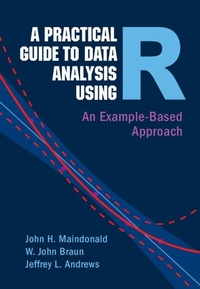
A Practical Guide to Data Analysis Using R
An Example-Based Approach
Published on 23. May 2024
978-1-009-28226-0 (ISBN)
Description

Using diverse real-world examples, this text examines what models used for data analysis mean in a specific research context. What assumptions underlie analyses, and how can you check them? Building on the successful 'Data Analysis and Graphics Using R,' 3rd edition (Cambridge, 2010), it expands upon topics including cluster analysis, exponential time series, matching, seasonality, and resampling approaches. An extended look at p-values leads to an exploration of replicability issues and of contexts where numerous p-values exist, including gene expression. Developing practical intuition, this book assists scientists in the analysis of their own data, and familiarizes students in statistical theory with practical data analysis. The worked examples and accompanying commentary teach readers to recognize when a method works and, more importantly, when it doesn't. Each chapter contains copious exercises. Selected solutions, notes, slides, and R code are available online, with extensive references pointing to detailed guides to R.
Reviews / Votes
'A Practical Guide to Data Analysis Using R is an unusually rich and practical resource for data analysts. It gives coverage to important classical and modern methods of data analysis, while modeling a statistician's thinking and workflow using a wide range of real-world examples. It has broad appeal and application.' Sue Finch, University of Melbourne 'This book hits the sweet spot in introducing classical and modern statistical methods, full of examples and providing R code and output. Statistical consultants will find this book useful as it gathers together so much of the wisdom that the authors have gained over the years. The content has been brought comprehensively into the 21st century with an accent on learning from data, without the need to tackle the tidyverse. It also addresses statistical hot topics such as causal inference, reproducibility, the future for p values, false discovery rate, among others. I can definitely recommend it to student researchers looking for a combination of statistical thinking, statistical methods and R tutorial. It tackles all of those curly little questions like what change in AIC should I care about, for all of which it can be hard to find a pithy exposition.' Alice Richardson, Australian National University 'This is one of the very few practically useful expositions I've seen on linear models and related statistics. Its title could be 'How Statistics Works in the Real World, and What to Do about It'! Carefully reasoned and interweaved with interesting examples in R, this belongs on every serious data analyst's bookshelf.' Norman S. Matloff, University of California, Davis 'This updated and expanded version of the popular 'DAAG' text presents a modern approach to data science, with emphasis on understanding data, the value of graphical displays, careful attention to statistical methods and their limitations, and a welcome emphasis on the importance of communication in advancing the science of uncertainty.' Nancy Reid, University of TorontoMore details
Language
English
Place of publication
Cambridge
United Kingdom
Target group
College/higher education
Illustrations
Worked examples or Exercises
File size
14,49 MB
ISBN-13
978-1-009-28226-0 (9781009282260)
Copyright in bibliographic data and cover images is held by Nielsen Book Services Limited or by the publishers or by their respective licensors: all rights reserved.
Schweitzer Classification
Other editions
Additional editions
John H. Maindonald | W. John Braun | Jeffrey L. Andrews
A Practical Guide to Data Analysis Using R
An Example-Based Approach
Book
05/2024
Cambridge University Press
€131.40
Shipment within 15-20 days
Persons
Content
1. Learning from data, and tools for the task; 2. Generalizing from models; 3. Multiple linear regression; 4. Exploiting the linear model framework; 5. Generalized linear models and survival analysis; 6. Time series models; 7. Multilevel models, and repeated measures; 8. Tree-based classification and regression; 9. Multivariate data exploration and discrimination; Epilogue; A. The R system - a brief overview; References; References to R packages; Index of R functions; Subject index.
