

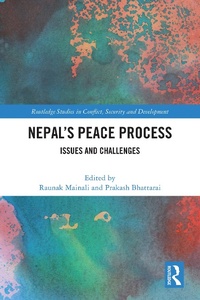
Nepal's Peace Process
Issues and Challenges
1st Edition
Published on 3. June 2024
176 pages
978-1-040-03676-1 (ISBN)
Description

This volume provides a holistic overview of the long peace process in Nepal following the signing of the Comprehensive Peace Agreement (CPA) in 2006.
The date of 21 November 2021 marked the 15th anniversary of the Comprehensive Peace Agreement (CPA) which concluded the decade-long civil war that had ravaged Nepal. Despite avoiding a resurgence of statewide conflict, Nepal's post-conflict era has been far from perfect. This era has witnessed ethnic violence, rampant corruption, the politicisation of key public institutions and a failure to fully implement the provisions of the CPA. The resulting lack of socio-economic progress has led to large-scale dissatisfaction within the country and even given rise to elements within Nepal who reject the framework of the CPA and the 2015 constitution.
With a focus on the years following the 2015 constitution, this book offers an analysis of post-conflict Nepal and explores issues relating to ex-combatants, transitional justice, women, socio-economic affairs, and federal governance. The contributors are all scholar-practitioners, some of whom had direct involvement in the peace process, and are therefore able to offer unique insights into the processes and challenges of Nepal's long journey to addressing past grievances and promoting future peace in the country.
This book will be of interest to students of peace studies, Asian politics, security studies and International Relations.
The date of 21 November 2021 marked the 15th anniversary of the Comprehensive Peace Agreement (CPA) which concluded the decade-long civil war that had ravaged Nepal. Despite avoiding a resurgence of statewide conflict, Nepal's post-conflict era has been far from perfect. This era has witnessed ethnic violence, rampant corruption, the politicisation of key public institutions and a failure to fully implement the provisions of the CPA. The resulting lack of socio-economic progress has led to large-scale dissatisfaction within the country and even given rise to elements within Nepal who reject the framework of the CPA and the 2015 constitution.
With a focus on the years following the 2015 constitution, this book offers an analysis of post-conflict Nepal and explores issues relating to ex-combatants, transitional justice, women, socio-economic affairs, and federal governance. The contributors are all scholar-practitioners, some of whom had direct involvement in the peace process, and are therefore able to offer unique insights into the processes and challenges of Nepal's long journey to addressing past grievances and promoting future peace in the country.
This book will be of interest to students of peace studies, Asian politics, security studies and International Relations.
More details
Series
Edition
1. Auflage
Language
English
Place of publication
London
United Kingdom
Publishing group
Taylor & Francis Ltd
Target group
College/higher education
Professional and scholarly
Illustrations
1 Tables, black and white
ISBN-13
978-1-040-03676-1 (9781040036761)
Copyright in bibliographic data and cover images is held by Nielsen Book Services Limited or by the publishers or by their respective licensors: all rights reserved.
Schweitzer Classification
Other editions
Additional editions
Book
09/2025
1st Edition
Routledge
€62.70
Shipment within 10-20 days
Book
06/2024
1st Edition
Routledge
€193.40
Shipment within 10-20 days
Persons
Raunak Mainali is a Research Fellow at the Centre for Social Change, Nepal.
Prakash Bhattarai is Executive Director at the Centre for Social Change, Nepal.
Prakash Bhattarai is Executive Director at the Centre for Social Change, Nepal.
Content
Introduction 1. The Road to the Comprehensive Peace Agreement 2. Evaluating the Comprehensive Peace Agreement 3. Rural Attitudes Towards the Peace Process in Nepal: Voice of the Villages 4. Transitional Justice in Nepal: An Insider's Perspective 5. Governing Conflict Victims in Nepal 6. Reflection on Past Assumptions Vs. Present Realities of Social Reintegration in Nepal 7. The Post-Conflict Context of Marginalised Groups in Nepal: Unmet Expectations 8. Analysing the Peace Process of Nepal through A Gender Lens 9. Governance Challenges and Opportunities in Young Federal Nepal: Growing Pains Conclusion
