

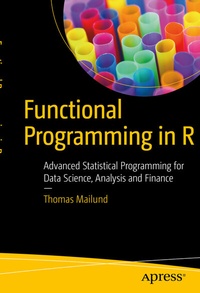
Functional Programming in R
Advanced Statistical Programming for Data Science, Analysis and Finance
Published on 27. March 2017
XV, 104 pages
978-1-4842-2746-6 (ISBN)
Description

Master functions and discover how to write functional programs in R. In this concise book, you'll make your functions pure by avoiding side-effects; you'll write functions that manipulate other functions, and you'll construct complex functions using simpler functions as building blocks.
In Functional Programming in R , you'll see how we can replace loops, which can have side-effects, with recursive functions that can more easily avoid them. In addition, the book covers why you shouldn't use recursion when loops are more efficient and how you can get the best of both worlds.
Functional programming is a style of programming, like object-oriented programming, but one that focuses on data transformations and calculations rather than objects and state. Where in object-oriented programming you model your programs by describing which states an object can be in and how methods will reveal or modify that state, in functional programming you model programs by describing how functions translate input data to output data. Functions themselves are considered to be data you can manipulate and much of the strength of functional programming comes from manipulating functions; that is, building more complex functions by combining simpler functions.
What You'll Learn
Who This Book Is For
Those with atleast some experience with programming in R.
In Functional Programming in R , you'll see how we can replace loops, which can have side-effects, with recursive functions that can more easily avoid them. In addition, the book covers why you shouldn't use recursion when loops are more efficient and how you can get the best of both worlds.
Functional programming is a style of programming, like object-oriented programming, but one that focuses on data transformations and calculations rather than objects and state. Where in object-oriented programming you model your programs by describing which states an object can be in and how methods will reveal or modify that state, in functional programming you model programs by describing how functions translate input data to output data. Functions themselves are considered to be data you can manipulate and much of the strength of functional programming comes from manipulating functions; that is, building more complex functions by combining simpler functions.
What You'll Learn
-
Write functions in R including infix operators and replacement functions
-
Create higher order functions
-
Pass functions to other functions and start using functions as data you can manipulate
-
Use Filer, Map and Reduce functions to express the intent behind code clearly and safely
-
Build new functions from existing functions without necessarily writing any new functions, using point-free programming
-
Create functions that carry data along with them
Who This Book Is For
Those with atleast some experience with programming in R.
Reviews / Votes
"The book is written in an exhaustive, text-book-like manner with theoretical paragraphs accompanied by lots of examples presented from various angles. The book is intended for readers with a fairly good command of R who wish to extend their programming skills towards a functional approach on data handling. ... it is a great addition to a programming library for mathematicians, computer scientists and applied life scientists alike." (Irina Ioana Mohorianu, zbMATH 1376.68002, 2018)More details
Series
Edition
1st ed.
Language
English
Place of publication
Berkeley
United States
Publishing group
APRESS
Target group
Professional and scholarly
Product notice
Reflowable
Illustrations
XV, 104 p. 7 illus., 1 illus. in color.
File size
0,99 MB
ISBN-13
978-1-4842-2746-6 (9781484227466)
DOI
10.1007/978-1-4842-2746-6
Schweitzer Classification
Other editions
Additional editions
Thomas Mailund
Functional Programming in R
Advanced Statistical Programming for Data Science, Analysis and Finance
Book
03/2017
1st Edition
APress
€48.14
Article exhausted; check for reprint
Person
Thomas Mailund
is an associate professor in bioinformatics at Aarhus University, Denmark. He has a background in math and computer science. For the last decade, his main focus has been on genetics and evolutionary studies, particularly comparative genomics, speciation, and gene flow between emerging species. He has published Beginning Data Science in R with Apress as well as other books out there.
Content
1. Functions in R.- 2. Pure Functional Programming.- 3. Scope and Closures.- 4. Higher-order Functions.- 5. Filer, Map, and Reduce.- 6. Point-free Programming.- Afterword.
