

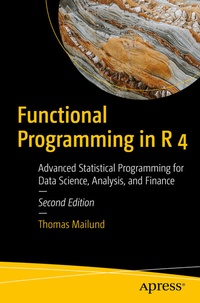
Functional Programming in R 4
Description

In Functional Programming in R 4 , you'll see how to replace loops, which can have side-effects, with recursive functions that can more easily avoid them. In addition, the book covers why you shouldn't use recursion when loops are more efficient and how you can get the best of both worlds.
Functional programming is a style of programming, like object-oriented programming, but one that focuses on data transformations and calculations rather than objects and state. Where in object-oriented programming you model your programs by describing which states an object can be in and how methods will reveal or modify that state, in functional programming you model programs by describing how functions translate input data to output data. Functions themselves are considered to be data you can manipulate and much of the strength of functional programming comes from manipulating functions; that is, building more complex functions by combining simpler functions.
What You'll Learn
-
Write functions in R 4, including infix operators and replacement functions
-
Create higher order functions
-
Pass functions to other functions and start using functions as data you can manipulate
-
Use Filer, Map and Reduce functions to express the intent behind code clearly and safely
-
Build new functions from existing functions without necessarily writing any new functions, using point-free programming
- Create functions that carry data along with them
Those with at least some experience with programming in R.
More details
Other editions
Additional editions
Person
Thomas Mailund is Senior Software Architect at Kvantify, a quantum computing company from Denmark. He has a background in math and computer science. He now works on developing algorithms for computational problems applicable for quantum computing. He previously worked at the Bioinformatics Research Centre, Aarhus University, on genetics and evolutionary studies, particularly comparative genomics, speciation, and gene flow between emerging species. He has published Beginning Data Science in R with Apress, as well as other books out there.
