

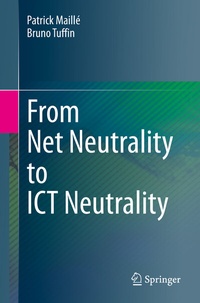
From Net Neutrality to ICT Neutrality
Description

This book discusses the pros and cons of information and communication (ICT) neutrality. It tries to be as objective as possible from arguments of proponents and opponents, this way enabling readers to build their own opinion. It presents the history of the ongoing network neutrality debate, the various concepts it encompasses, and also some mathematical developments illustrating optimal strategies and potential counter-intuitive results, then extends the discussion to connected ICT domains. The book thus touches issues related to history, economics, law, networking, and mathematics.
After an introductory chapter on the history of the topic, chapter 2 surveys and compares the various laws in place worldwide and discusses some implications of heterogeneous rules in several regions. Next, chapter 3 details the arguments put forward by the participants of the net neutrality debate. Chapter 4 then presents how the impact of neutral or non-neutral behaviors can be analyzed mathematically, with sometimes counter-intuitive results, and emphasizes the interest of modeling to avoid bad decisions. Chapter 5 illustrates that content providers may not always be on the pro-neutrality side, as there are situations where they may have an economic advantage with a non-neutral situation, e.g. when they are leaders on a market and create barriers to entry for competitors. Another related issue is covered in chapter 6, which discusses existing ways for ISPs to circumvent the packet-based rules and behave non-neutral without breaking the written law. Chapter 7 gives more insight on the role and possible non-neutral behavior of search engines, leading to another debate called the search neutrality debate. Chapter 8 focuses on e-commerce platforms and social networks, and investigates how they can influence users' actions and opinions. The issue is linked to the debate on the transparency of algorithms which is active in Europe especially. Chapter 9 focuses on enforcing neutrality in practice through measurements: indeed, setting rules requires monitoring the activity of ICT actors in order to sanction non-appropriate behaviors and be proactive against new conducts. The chapter explains why this is challenging and what tools are currently available. Eventually, Chapter 10 briefly concludes the presentation and opens the debate.
Reviews / Votes
"The book covers the current scenario, requirements, techniques in use, and possible mathematical models and regulations required and in use. The authors include the reference notes to encourage healthy debate. The book has ten chapters and lists 184references. It should interest general and/or academic readers interested in Internet neutrality. The book is largely easy to read." (Anoop Malaviya, Computing Reviews, October 25, 2023)More details
Other editions
Additional editions
Persons
Bruno Tuffin received his PhD degree in applied mathematics from the University of Rennes 1 (France) in 1997. Since then, he has been with Inria in Rennes and is the leader of the team called Dionysos since January 2022. He spent eight months as a postdoc at Duke University in 1999. His research interests include developing Monte Carlo and quasi-Monte Carlo simulation techniques for the performance evaluation of telecommunication systems, and developing new Internet-pricing schemes and telecommunication-related economic models. He has published close to two hundred papers on those issues. He has also led or participated into several French and European projects, and co-organized several conferences.
