

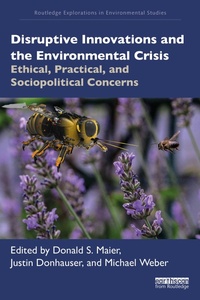
Disruptive Innovations and the Environmental Crisis
Ethical, Practical, and Sociopolitical Concerns
1st Edition
Published on 3. July 2025
214 pages
978-1-040-34784-3 (ISBN)
Description

This book probes the ethical, practical, and sociopolitical implications of leveraging innovative and disruptive means to address the world's various environmental crises.
Packed with keen observations and analyses, the volume brings together research from seasoned scholars and rising stars to cast important new light on urgent issues engendered by humankind's disruption of environments, such as climate change and biodiversity loss. It tackles the question of exactly what has been disrupted in the world-environmentally, economically, socially, and politically. It also examines an assortment of innovative interventions that aim to address disruptions and explores the question of what further disruptions may lurk behind assorted innovative interventions intended to address already existing disruptions. Chapters wrestle with the social, ethical, and ecological implications of disruptions, both pre-existing and those brought about by interventions, connected with deploying artificial gene drives, substituting robotic pollinators for living ones, synthesizing organisms to replace ones lost, installing economic regimes that work well for both citizens and the environment, making science subservient to non-scientific commitments, involving citizens in environmentally consequential decisions, choosing scientific and technological projects that most promise immediate practical payoff, and ensuring that respect for human rights is part and parcel of any technology-infused project. These discussions draw on a rich mix of science, philosophy of science, political theory, economics, sociology, network theory, ethics, and theories of justice and human rights.
This book will be of great interest to students and scholars of environmental science, environmental decision-making, ecology, climate change, environmental philosophy, and the philosophy of science.
Packed with keen observations and analyses, the volume brings together research from seasoned scholars and rising stars to cast important new light on urgent issues engendered by humankind's disruption of environments, such as climate change and biodiversity loss. It tackles the question of exactly what has been disrupted in the world-environmentally, economically, socially, and politically. It also examines an assortment of innovative interventions that aim to address disruptions and explores the question of what further disruptions may lurk behind assorted innovative interventions intended to address already existing disruptions. Chapters wrestle with the social, ethical, and ecological implications of disruptions, both pre-existing and those brought about by interventions, connected with deploying artificial gene drives, substituting robotic pollinators for living ones, synthesizing organisms to replace ones lost, installing economic regimes that work well for both citizens and the environment, making science subservient to non-scientific commitments, involving citizens in environmentally consequential decisions, choosing scientific and technological projects that most promise immediate practical payoff, and ensuring that respect for human rights is part and parcel of any technology-infused project. These discussions draw on a rich mix of science, philosophy of science, political theory, economics, sociology, network theory, ethics, and theories of justice and human rights.
This book will be of great interest to students and scholars of environmental science, environmental decision-making, ecology, climate change, environmental philosophy, and the philosophy of science.
More details
Series
Edition
1. Auflage
Language
English
Place of publication
London
United Kingdom
Publishing group
Taylor & Francis Ltd
Target group
College/higher education
Professional and scholarly
Illustrations
5 Tables, black and white; 4 Line drawings, black and white; 4 Illustrations, black and white
File size
2,48 MB
ISBN-13
978-1-040-34784-3 (9781040347843)
Copyright in bibliographic data and cover images is held by Nielsen Book Services Limited or by the publishers or by their respective licensors: all rights reserved.
Schweitzer Classification
Other editions
Additional editions

Donald S. Maier | Justin Donhauser | Michael Weber
Disruptive Innovations and the Environmental Crisis
Ethical, Practical, and Sociopolitical Concerns
Book
07/2025
1st Edition
Routledge
€206.20
Shipment within 10-20 days
Donald S. Maier | Justin Donhauser | Michael Weber
Disruptive Innovations and the Environmental Crisis
Ethical, Practical, and Sociopolitical Concerns
Book
07/2025
1st Edition
Routledge
€63.10
Shipment within 10-20 days

Disruptive Innovations and the Environmental Crisis
Ethical, Practical, and Sociopolitical Concerns
Book
06/2025
Routledge
Unfortunately, price unknown
Available (delivery time upon request)
Persons
Donald S. Maier is an independent scholar and author of What's So Good About Biodiversity? A Call for Better Reasoning About Nature's Value (2012).
Justin Donhauser was Director of Undergraduate Studies and Associate Teaching Professor in the Department of Philosophy at Bowling Green State University, USA.
Michael Weber is Professor of Philosophy and Chair of the Department of Philosophy at Bowling Green State University, USA. He is the co-editor of Social Trust (Routledge, 2021) and The Future of Work, Technology, and a Basic Income (Routledge, 2020).
Justin Donhauser was Director of Undergraduate Studies and Associate Teaching Professor in the Department of Philosophy at Bowling Green State University, USA.
Michael Weber is Professor of Philosophy and Chair of the Department of Philosophy at Bowling Green State University, USA. He is the co-editor of Social Trust (Routledge, 2021) and The Future of Work, Technology, and a Basic Income (Routledge, 2020).
Content
1. Disruptiveness Beyond Demarcation and Unicity: Gene Drives as a Disruptive Anthropocene Technology? 2. Imagination Exercise in Eco-Engineering: Modeling the Impact of Biomimicking Pollinator Robots on Honey Bee Colonies 3. Ecosocialism, the Shallow, and the Deep: Environmental Philosophy and the New Climate Left 4. Restoring Biodiversity as Compensation for Climate Change 5. Disruption of Science in a Disrupted World 6. Methods of Citizen Participation in Science and Their Concomitant Conceptions of Democratic Legitimacy 7. Funding Priorities and Climate Change: Lessons from Agriculture and Action-Oriented Science 8. Trust and Disruption: Securing Human Rights in a Climate-Changed World
