

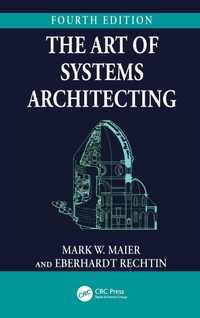
The Art of Systems Architecting
4th Edition
Published on 5. June 2025
519 pages
978-1-040-35174-1 (ISBN)
Description

The Art of Systems Architecting, Fourth Edition, provides structured heuristics to improve the least structured, most art-like elements of systems design. It offers unique techniques to bridge the difference between scientific engineering and qualitative design along with comprehensive methods for combining architectural design with digital engineering. This book illustrates how to go from model-based systems architecture to model-based systems engineering and includes case studies of good and bad architectural decision-making in major systems.
Changes to this edition include materials on architecture processes, architecture description frameworks, and integration with model-based systems engineering (MBSE) and digital engineering. The publication of the ANSI/IEEE 1471 and ISO/IEC 42010 standards on architecture description has provided common vocabulary and organizing methods for documenting architectures. This edition provides a practical application of these standards in architecting and integrating their concepts with a simple process framework. The rise of MBSE and digital engineering tools is in the process of revolutionizing the development of complex systems. The emphasis has been on detailed design descriptions and powerful analysis methods (for example, digital twins). Architects can make effective use of these methods and tools as well, and this new edition provides an integrated set of heuristics and modeling methods to do so. There are many other improvements and additions included to bring this textbook up to date.
This book can be used as a reference book for engineers and managers involved in creating new systems, people responsible for developing mandated architecture descriptions, software architects, system architects, and systems engineers, or as a textbook in graduate engineering courses.
Exercises are interspersed throughout the text, with some designed for self-testing and understanding and others intended to provide opportunities for long-term study and further exploration of the subject.
Changes to this edition include materials on architecture processes, architecture description frameworks, and integration with model-based systems engineering (MBSE) and digital engineering. The publication of the ANSI/IEEE 1471 and ISO/IEC 42010 standards on architecture description has provided common vocabulary and organizing methods for documenting architectures. This edition provides a practical application of these standards in architecting and integrating their concepts with a simple process framework. The rise of MBSE and digital engineering tools is in the process of revolutionizing the development of complex systems. The emphasis has been on detailed design descriptions and powerful analysis methods (for example, digital twins). Architects can make effective use of these methods and tools as well, and this new edition provides an integrated set of heuristics and modeling methods to do so. There are many other improvements and additions included to bring this textbook up to date.
This book can be used as a reference book for engineers and managers involved in creating new systems, people responsible for developing mandated architecture descriptions, software architects, system architects, and systems engineers, or as a textbook in graduate engineering courses.
Exercises are interspersed throughout the text, with some designed for self-testing and understanding and others intended to provide opportunities for long-term study and further exploration of the subject.
More details
Edition
4th edition
Language
English
Place of publication
London
United Kingdom
Publishing group
Taylor & Francis Ltd
Target group
College/higher education
Illustrations
12 Tables, black and white; 51 Line drawings, black and white; 51 Illustrations, black and white
File size
9,57 MB
ISBN-13
978-1-040-35174-1 (9781040351741)
Copyright in bibliographic data and cover images is held by Nielsen Book Services Limited or by the publishers or by their respective licensors: all rights reserved.
Schweitzer Classification
Other editions
Additional editions
Mark W. Maier | Eberhardt Rechtin
The Art of Systems Architecting
Book
06/2025
4th Edition
CRC Press
€134.40
Shipment within 10-20 days

Eberhardt Rechtin
The Art of Systems Architecting
Book
05/2025
CRC Press
Unfortunately, price unknown
Available (delivery time upon request)
Persons
Dr. Mark W. Maier is a technical fellow at The Aerospace Corporation, Electronics and Sensors Division, an architect-engineering firm specializing in space systems for the United States Government. His specialty is systems architecture. He teaches and consults in that subject for The Aerospace Corporation, its clients, and corporations throughout the United States and Europe. He has done pioneering work in the field, especially in collaborative systems, socio-technical systems, and modeling, as well as significant research in advanced sensors. He is a senior member of the IEEE and one of the lead authors of ANSI/IEEE 1471 Recommended Practice for Architecture Description, which has become the basis for further international standardization. Dr. Maier received his B.S. degree in Engineering and Applied Science and an M.S. in Electrical Engineering from Caltech in 1983 and 1984, respectively. He joined the Hughes Aircraft Company in El Segundo, CA, upon graduating from Caltech in 1983. At Hughes, he was a section head responsible for signal processing algorithm design and systems engineering. While at Hughes, he was awarded a Howard Hughes Doctoral Fellowship, on which he completed a Ph.D. in Electrical Engineering, specializing in radar signal processing, at USC. At USC, he began his collaboration with Dr. Eberhardt Rechtin, who started the first systems architecture academic program. In 1992, he joined the faculty of the University of Alabama in Huntsville in the Electrical and Computer Engineering Department. As an associate professor at UAH, he carried out research in system architecture, stereo image compression, and radar signal processing. He has published several dozen journal articles and conference papers in these fields.
Dr. Eberhardt Rechtin received his B.S. and Ph.D. degrees from the California Institute of Technology (Caltech) in 1946 and 1950, respectively. He joined Caltech's Jet Propulsion Laboratory (JPL) in 1948 as an engineer, leaving it in 1967 as assistant director. At JPL, he was the chief architect and director of the NASA/JPL Deep Space Network. In 1967, he joined the Office of the Secretary of Defense as the director of the Advanced Research Projects Agency (ARPA) and later as assistant secretary of defense for Telecommunications. He left the Department of Defense in 1973 to become chief engineer of Hewlett-Packard. He was elected as the president and CEO of The Aerospace Corporation in 1977, retiring in 1987. After retirement from Aerospace, he joined the faculty of the University of Southern California (USC) as a professor with joint appointments in Electrical Engineering-ystems, Industrial & Systems Engineering, and Aerospace Engineering. During his time at USC, he founded their graduate program in Systems Architecting. Dr. Rechtin was extensively honored for his engineering accomplishments. He was a member of the National Academy of Engineering; a fellow of the IEEE, AIAA, and the AAAS; and an Academician of the International Academy of Astronautics. He was further honored by the IEEE with its Alexander Graham Bell Award, by the Department of Defense with the Distinguished Public Service Award, by NASA with its Medal for Exceptional Scientific Achievement, by the AIAA with its von Karman Lectureship, by Caltech with its Distinguished Alumni award, and by NEC with its C&C Prize. His published works include Systems Architecting: Creating and Building Complex Systems, Prentice Hall, 1991; The Art of Systems Architecting with Mark W. Maier; and Why Eagles Can't Swim: The Systems Architecting of Organizations. Dr. Rechtin passed away in 2006.
Dr. Eberhardt Rechtin received his B.S. and Ph.D. degrees from the California Institute of Technology (Caltech) in 1946 and 1950, respectively. He joined Caltech's Jet Propulsion Laboratory (JPL) in 1948 as an engineer, leaving it in 1967 as assistant director. At JPL, he was the chief architect and director of the NASA/JPL Deep Space Network. In 1967, he joined the Office of the Secretary of Defense as the director of the Advanced Research Projects Agency (ARPA) and later as assistant secretary of defense for Telecommunications. He left the Department of Defense in 1973 to become chief engineer of Hewlett-Packard. He was elected as the president and CEO of The Aerospace Corporation in 1977, retiring in 1987. After retirement from Aerospace, he joined the faculty of the University of Southern California (USC) as a professor with joint appointments in Electrical Engineering-ystems, Industrial & Systems Engineering, and Aerospace Engineering. During his time at USC, he founded their graduate program in Systems Architecting. Dr. Rechtin was extensively honored for his engineering accomplishments. He was a member of the National Academy of Engineering; a fellow of the IEEE, AIAA, and the AAAS; and an Academician of the International Academy of Astronautics. He was further honored by the IEEE with its Alexander Graham Bell Award, by the Department of Defense with the Distinguished Public Service Award, by NASA with its Medal for Exceptional Scientific Achievement, by the AIAA with its von Karman Lectureship, by Caltech with its Distinguished Alumni award, and by NEC with its C&C Prize. His published works include Systems Architecting: Creating and Building Complex Systems, Prentice Hall, 1991; The Art of Systems Architecting with Mark W. Maier; and Why Eagles Can't Swim: The Systems Architecting of Organizations. Dr. Rechtin passed away in 2006.
Content
Part I: Introduction. 0.1. Case Study 1: The DARPA Grand Challenge. 1. Extending the Architecting Paradigm. 2. Heuristics as Tools. Part II: Introduction: New Domains, New Insights. 0.2. Case Study 2: The DC-3. 3. Builder-Architected Systems. 0.3. Case Study 3: Mass and Lean Production. 4. Manufacturing Systems. 0.4. Case Study 4: Intelligent Transportation Systems. 5. Social Systems. 0.5. Case Study 5: MedInfo and Layered Systems. 6. Software and Information Technology Architecture. 0.6. Case Study 6: The Global Positioning System. 7. Collaborative Systems. Part III: Introduction: Processes and Models. 0.7. Case Study 7: SAR Drone. 8. Architecting Models and Processes Concepts. 9. A General Architecting Process. 10. Architecting with Digital Engineering. 11. Frameworks and Standards. Part IV: Introduction: The Systems Architecting Profession. 12. Architecting in Business and Government. 13. The Political Process and Systems Architecting. 14. The Professionalization of Systems Architecting. Appendix A. Appendix B. Appendix C. Glossary.
