

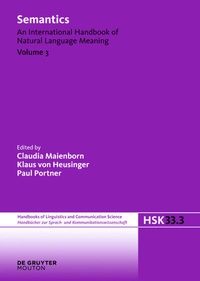
Semantics
1st Edition
Published on 19. December 2012
X, 934 pages
978-3-11-025338-2 (ISBN)
Description

No detailed description available for "SEMANTICS (MAIENBORN ET AL.) BD. 33.3 HSK E-BOOK".
More details
Series
Language
English
Place of publication
Berlin/Boston
Germany
Publishing group
de Gruyter Mouton
Target group
Professional and scholarly
US School Grade: College Graduate Student
File size
9,19 MB
ISBN-13
978-3-11-025338-2 (9783110253382)
DOI
http://www.degruyter.com/isbn/9783110253382
Schweitzer Classification
Other editions
Additional editions
Claudia Maienborn | Klaus von Heusinger | Paul Portner
Semantics
Book
01/2013
1st Edition
De Gruyter Mouton
€489.00
Article exhausted; check different version
Claudia Maienborn | Klaus von Heusinger | Paul Portner
Semantics
Book
12/2012
1st Edition
De Gruyter Mouton
€490.00
Shipment within 7-9 days
Persons
Content
1 - XVI. The interface of semantics with phonology and morphology [Seite 11]
1.1 - 77. Semantics of intonation [Seite 11]
1.2 - 78. Semantics of inflection [Seite 42]
1.3 - 79. Semantics of derivational morphology [Seite 70]
1.4 - 80. Semantics of compounds [Seite 92]
1.5 - 81. Semantics in Distributed Morphology [Seite 123]
2 - XVII. The syntax-semantics interface [Seite 145]
2.1 - 82. Syntax and semantics: An overview [Seite 145]
2.2 - 83. Argument structure (omitted) [Seite 195]
2.3 - 84. Operations on argument structure [Seite 196]
2.4 - 85. Type shifting [Seite 231]
2.5 - 86. Constructional meaning and compositionality [Seite 243]
2.6 - 87. Scalar implicature as a grammatical phenomenon [Seite 269]
3 - XVIII. The semantics-pragmatics interface [Seite 305]
3.1 - 88. Semantics/pragmatics boundary disputes [Seite 305]
3.2 - 89. Context dependence [Seite 332]
3.3 - 90. Deixis and demonstratives [Seite 379]
3.4 - 91. Presupposition [Seite 404]
3.5 - 92. Implicature [Seite 432]
3.6 - 93. Game theory in semantics and pragmatics [Seite 459]
3.7 - 94. Conventional implicature and expressive content [Seite 488]
4 - XIX. Typology and crosslinguistic semantics [Seite 509]
4.1 - 95. Semantic types across languages [Seite 509]
4.2 - 96. Count/mass distinctions across languages [Seite 531]
4.3 - 97. Tense and aspect: Time across languages [Seite 553]
4.4 - 98. The expression of space across languages [Seite 580]
5 - XX. Diachronic semantics [Seite 597]
5.1 - 99. Theories of meaning change: An overview [Seite 597]
5.2 - 100. Cognitive approaches to diachronic semantics [Seite 624]
5.3 - 101. Grammaticalization and semantic reanalysis [Seite 647]
6 - XXI. Processing and learning meaning [Seite 675]
6.1 - 102. Meaning in psycholinguistics [Seite 675]
6.2 - 103. Meaning in first language acquisition [Seite 696]
6.3 - 104. Meaning in second language acquisition [Seite 725]
6.4 - 105. Meaning in neurolinguistics (omitted) [Seite 747]
6.5 - 106. Conceptual knowledge, categorization, and meaning [Seite 747]
6.6 - 107. Space in semantics and cognition [Seite 777]
7 - XXII. Semantics and computer science [Seite 797]
7.1 - 108. Semantic research in computational linguistics [Seite 797]
7.2 - 109. Semantics in corpus linguistics [Seite 831]
7.3 - 110. Semantics in computational lexicons [Seite 859]
7.4 - 111. Web semantics [Seite 889]
7.5 - 112. Semantic issues in machine translation [Seite 903]
8 - Index [Seite 933]
1.1 - 77. Semantics of intonation [Seite 11]
1.2 - 78. Semantics of inflection [Seite 42]
1.3 - 79. Semantics of derivational morphology [Seite 70]
1.4 - 80. Semantics of compounds [Seite 92]
1.5 - 81. Semantics in Distributed Morphology [Seite 123]
2 - XVII. The syntax-semantics interface [Seite 145]
2.1 - 82. Syntax and semantics: An overview [Seite 145]
2.2 - 83. Argument structure (omitted) [Seite 195]
2.3 - 84. Operations on argument structure [Seite 196]
2.4 - 85. Type shifting [Seite 231]
2.5 - 86. Constructional meaning and compositionality [Seite 243]
2.6 - 87. Scalar implicature as a grammatical phenomenon [Seite 269]
3 - XVIII. The semantics-pragmatics interface [Seite 305]
3.1 - 88. Semantics/pragmatics boundary disputes [Seite 305]
3.2 - 89. Context dependence [Seite 332]
3.3 - 90. Deixis and demonstratives [Seite 379]
3.4 - 91. Presupposition [Seite 404]
3.5 - 92. Implicature [Seite 432]
3.6 - 93. Game theory in semantics and pragmatics [Seite 459]
3.7 - 94. Conventional implicature and expressive content [Seite 488]
4 - XIX. Typology and crosslinguistic semantics [Seite 509]
4.1 - 95. Semantic types across languages [Seite 509]
4.2 - 96. Count/mass distinctions across languages [Seite 531]
4.3 - 97. Tense and aspect: Time across languages [Seite 553]
4.4 - 98. The expression of space across languages [Seite 580]
5 - XX. Diachronic semantics [Seite 597]
5.1 - 99. Theories of meaning change: An overview [Seite 597]
5.2 - 100. Cognitive approaches to diachronic semantics [Seite 624]
5.3 - 101. Grammaticalization and semantic reanalysis [Seite 647]
6 - XXI. Processing and learning meaning [Seite 675]
6.1 - 102. Meaning in psycholinguistics [Seite 675]
6.2 - 103. Meaning in first language acquisition [Seite 696]
6.3 - 104. Meaning in second language acquisition [Seite 725]
6.4 - 105. Meaning in neurolinguistics (omitted) [Seite 747]
6.5 - 106. Conceptual knowledge, categorization, and meaning [Seite 747]
6.6 - 107. Space in semantics and cognition [Seite 777]
7 - XXII. Semantics and computer science [Seite 797]
7.1 - 108. Semantic research in computational linguistics [Seite 797]
7.2 - 109. Semantics in corpus linguistics [Seite 831]
7.3 - 110. Semantics in computational lexicons [Seite 859]
7.4 - 111. Web semantics [Seite 889]
7.5 - 112. Semantic issues in machine translation [Seite 903]
8 - Index [Seite 933]
