

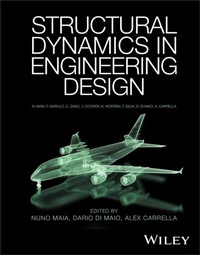
Structural Dynamics in Engineering Design
Description

Structural Dynamics in Engineering Design covers the fundamentals of structural dynamics and its application to the engineering design process, providing all of the necessary information to implement an optimal design process. Each of its seven chapters is written by an expert in the field and provides the reader with the structural dynamic theoretical background and its more practical aspects for the implementation of an advanced design capability.
The first three chapters are dedicated to the underlying theory of the three main processes: the fundamentals of vibration theory, the basis of experimental dynamics and the main numerical analysis tools (including reference to the finite element method). Having laid the foundation of the design philosophy, the following three chapters present the reader with the three disciplines of identification, nonlinear analysis and validation/updating. The final chapter presents some applications of the approach to real and complex engineering cases.
Key features:
* Takes a multi-disciplinary approach and contains critical information on theory, testing and numerical analysis for structural dynamics.
* Includes a chapter on industrial applications (including aircraft design and ground vibration testing), which illustrates the design process and explains how structural dynamics is applied at different stages.
The book is a must-have for researchers and practitioners in mechanical and aerospace engineering (in particular test engineers, CAE analysts and structural dynamicists), as well as graduate students in mechanical and aerospace engineering departments.
More details
Other editions
Additional editions
Persons
Edited by:
Nuno Maia
Nuno M. M. Maia is Professor of Mechanical Engineering at Instituto Superior T?cnico (IST), University of Lisbon. He has an MSc. in Mechanical Engineering from IST (1985), a Ph.D in Mechanical Vibrations from Imperial College London (1989) and Habilitation from IST (2001). He has authored around 230 publications, including two textbooks. He has organized 10 international conferences on Structural Dynamics, supervised 10 Ph.D students and coordinated national and international research projects.
Dario Di Maio
Dario Di Maio is Associate Professor of Mechanical Engineering at the Engineering Technology Faculty of University of Twente, The Netherlands. He has an MSc. in Mechanical Engineering from University Politecnica delle Marche, Italy (2001), and a Ph.D. in Mechanical Vibrations from Imperial College London (2007). He had a long collaboration with Rolls-Royce plc. through the Vibration and Composite University Technology Centre at Imperial College London and University of Bristol in the research areas of structural dynamics and composite fatigue failure. He authored around 100 publications. He was a leading figure of the Society of Experimental Mechanics (SEM) in the International Modal Analysis Conference (IMAC). He supervised 10 PhD students and more than 50 MSc. Students.
Alessandro 'Alex' Carrella
Alessandro 'Alex' Carrella has a degree in Aerospace Engineering from the University of Naples (Italy) and was awarded a PhD in Structural Dynamics at the ISVR (University of Southampton, UK). He was a lecturer in Structural Dynamics at the Dept of Aerospace Engineering at the University of Bristol when he left academia to join LMS (now Siemens) as Product Manager for Dynamic Environmental Test solutions first and then as manager of Aerospace & Defense Business development. Today he runs his own vibration and acoustic consultancy firm as well as directing the international operations at MSI-DFAT. Alex is an active member of the international space testing community and serves on technical and managing boards of major conferences.
Content
Preface xix
List of Authors xxi
Chapter 1 Theoretical Background 1
Chapter 2 Vibration Testing and Analysis 81
Chapter 3 Numerical Methods 131
Chapter 4 Linear System Identification 211
Chapter 5 Nonlinearity in Engineering Dynamics 295
Chapter 6 Updating of Numerical Models 387
Chapter 7 Industrial Case Studies 457
Appendices 519
Appendix A 519
Appendix B 537
Appendix C 539
Index 543
Acronyms
A ADC Analog to Digital Conversion AR Autoregressive ARMA Autoregressive Moving Average ARMAX Autoregressive Moving Average with eXhogneous inputs ASMAC Alternated Search Modal Assurance Criterion C CB Craig-Bampton method CDF Cumulative Distribution Function CMIF Complex Mode Indicator Function CMS Component Mode Synthesis CMU Computational Model Updating CoV Coefficient of Variation COMAC Coordinate Modal Assurance Criterion CSAC Cross Signature Assurance Criterion CSC Cross Signature Correlation CSD Cross Power Spectral Density CSF Cross Signature Scale Factor D DAC Digital to Analog Conversion DIC Digital Image Correlation DIRS Dynamic Improved Reduction System DOF Degree of Freedom E eCDF empirical Cumulative Distribution Function EFDD Enhanced Frequency Domain Decomposition EI Effective Independence method EJ Engineering Judgement EMA Experimental Modal Analysis ERA Eigensystem Realisation Algorithm ERA/DC Eigensystem Realisation Algorithm using Data Correlations F FAAC Frequency Amplitude Assurance Criterion FDAC Frequency Domain Assurance Criterion FDD Frequency Domain Decomposition FE Finite Element FEA Finite Element Analysis FEM Finite Element Method FFT Fast Fourier Transform FI Fisher Information matrix FMFEM Fine Mesh Finite Element Method FRAC Frequency Response Assurance Criterion FRF Frequency Response Function FRSF Frequency Response Scale Factor FS-SLDV Fast Scan Scanning Laser Doppler Velocimeter G GAC Global Amplitude Criterion GFEM Global Finite Element Model GSC Global Shape Criterion GVT Ground Vibration Test I IIRS Iterated Dynamic Improved Reduction System IRF Impulse Response Function IRS Improved Reduction System K KMO Kaiser-Meyer-Olkin criterion KS-test Kolmogorov-Smirnov goodness-of-fit test L LAC Local Amplitude Criterion LDV Laser Doppler Velocimeter LHS Latin Hypercube Sampling LSCE Least-Squares Complex Exponential LSFD Least Squares Frequency Domain M MAC Modal Assurance Criterion MBA Modal-Based Assembly MCMC Markov Chain Monte-Carlo MCS Monte-Carlo Simulations MDOF Multiple Degree of Freedom MEMS Micro-Electro-Mechanical Systems MIMO Multiple Input Multiple Output MISO Multiple Input Single Output MMIF Multivariate Mode Indicator Function ModMMIF Modified Multivariate Mode Indicator Function MPC Modal Phase Collinearity index MSF Modal Scale Factor N NMPF Normal Mode Purity Function O ODS Operational Deflection Shape OMA Operational Modal Analysis P PA Horn's Parallel Analysis PCA Principal Component Analysis PDF Probability Density Function PID Proportional Integral Derivative PSD Power Spectral Density Q QTH Quasi-Steady Three-Dimensional Histogram R RFM Response Function Method RK Runge-Kutta RK4 Runge-Kutta of 4th order RMS Root Mean Square RSS Root Sum of Squares RVAC Response Vector Assurance Criterion S svs Singular Values SDE Stochastic Differential Equation SDOF Single Degree of Freedom SEREP System Equivalent Reduction Expansion Process SHM Structural Health Monitoring SLDV Scanning Laser Doppler Velocimeter SLE Simultaneous Linear Equations SIMO Single Input Multiple Output SISO Single Input Single Output SNR Signal-to-Noise-Ratio SPL Sound Pressure...
