

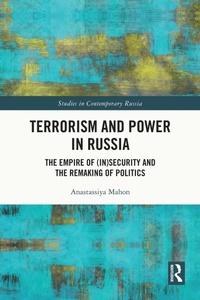
Terrorism and Power in Russia
The Empire of (In)security and the Remaking of Politics
1st Edition
Published on 2. March 2026
222 pages
978-1-040-63304-5 (ISBN)
Description

Why is it that in Russia, crises so often become framed as terrorism-and what does this tell us about power, politics, and state control? This book examines how the Kremlin has used the language of terrorism to shape Russia's domestic, regional, and international politics, from the Chechen wars to Syria and the 2022 invasion of Ukraine.
Combining securitisation theory with a three-level analysis, it traces how securitising actors and speech acts reframed terrorism as an existential threat, enabling exceptional measures at home, influence across Russia's near abroad, and claims to counterterrorism leadership internationally. Using securitisation theory, the book follows the rhetoric through laws, presidential addresses, media narratives, and policy outcomes, showing how terrorism securitisation patterns forged in Chechnya travelled into Syria and Ukraine. It offers a clear, system-based analysis of Moscow's securitisation of the terrorism threat, drawing on verified official documents and original Russian sources to explain how security talk becomes state practice.
This book will interest scholars, students, and practitioners of Russian politics, security studies, and international relations, as well as readers in media and communication, area studies, and contemporary history. It is suitable for advanced undergraduate and postgraduate courses on foreign policy, terrorism and counterterrorism, and propaganda, and will be useful to policymakers, analysts, and journalists seeking a rigorous guide to Russia's securitisation of terrorism.
Combining securitisation theory with a three-level analysis, it traces how securitising actors and speech acts reframed terrorism as an existential threat, enabling exceptional measures at home, influence across Russia's near abroad, and claims to counterterrorism leadership internationally. Using securitisation theory, the book follows the rhetoric through laws, presidential addresses, media narratives, and policy outcomes, showing how terrorism securitisation patterns forged in Chechnya travelled into Syria and Ukraine. It offers a clear, system-based analysis of Moscow's securitisation of the terrorism threat, drawing on verified official documents and original Russian sources to explain how security talk becomes state practice.
This book will interest scholars, students, and practitioners of Russian politics, security studies, and international relations, as well as readers in media and communication, area studies, and contemporary history. It is suitable for advanced undergraduate and postgraduate courses on foreign policy, terrorism and counterterrorism, and propaganda, and will be useful to policymakers, analysts, and journalists seeking a rigorous guide to Russia's securitisation of terrorism.
Reviews / Votes
"Terrorism and Power in Russia is essential reading for anyone who wants to understand Putin's Russia and how it is positioning itself in the world. Drawing on extensive original research, Anastasia Mahon reveals that the campaign against terrorism has become a core part of Russia's identity, both at home and abroad."- Dr Jenny Mathers, Department of International Politics, Aberystwyth University
"In this insightful and theoretically rigorous book, Anastassiya Mahon confronts an important and timely topic: Russia's use of terrorism as a critical frame for action. Securitization is often a slippery slope and this book richly demonstrates how Russia's securitization of terrorism has evolved from its narrow application in the context of Chechnya to an ubiquitous use domestically, regionally, and internationally that has major implications not only for Ukraine but Europe and the wider world."
- Dr Nicholas Ross Smith, Senior Research Fellow and Lead academic of the EUIP Jean Monnet Network, National Centre for Research on Europe, University of Canterbury
More details
Series
Edition
1. Auflage
Language
English
Place of publication
London
United Kingdom
Publishing group
Taylor & Francis Ltd
Target group
College/higher education
Product notice
Reflowable
File size
0,81 MB
ISBN-13
978-1-040-63304-5 (9781040633045)
Copyright in bibliographic data and cover images is held by Nielsen Book Services Limited or by the publishers or by their respective licensors: all rights reserved.
Schweitzer Classification
Other editions
Additional editions
Anastassiya Mahon
Terrorism and Power in Russia
The Empire of (In)security and the Remaking of Politics
Book
approx. 03/2026
1st Edition
Routledge
€210.80
Not yet published
Person
Anastassiya Mahon is a political scientist of security and authoritarian politics whose work examines how (in)security narratives consolidate power, police dissent, and justify intervention. Her research spans Russia, Eurasia, and the Middle East, with interests in digital repression, memory politics, and the strategic use of humanitarian language in conflict and foreign policy. She has published in Critical Studies on Security, International Studies Perspectives, the Journal of Illiberalism Studies, and the Conversation. Based in the UK, she teaches international relations, security studies and Russian politics.
Content
Acknowledgements
Chapter 1 Introduction
Chapter 2 Domestic Securitization: The Emergence and Development of the Chechen Terrorist Threat in Russia
Chapter 3 Regional Securitization: The Terrorist Threat across Eurasia
Chapter 4 Securitization of the Terrorist Threat on the International Level: The Counterterrorism Campaign in Syria.
Chapter 5 Securitization of the Terrorist Threat on the International Level: The case of Ukraine
Chapter 6 Conclusion.
Chapter 1 Introduction
Chapter 2 Domestic Securitization: The Emergence and Development of the Chechen Terrorist Threat in Russia
Chapter 3 Regional Securitization: The Terrorist Threat across Eurasia
Chapter 4 Securitization of the Terrorist Threat on the International Level: The Counterterrorism Campaign in Syria.
Chapter 5 Securitization of the Terrorist Threat on the International Level: The case of Ukraine
Chapter 6 Conclusion.
