

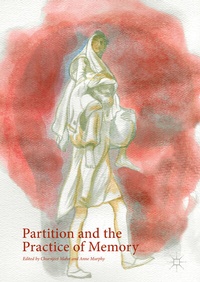
Partition and the Practice of Memory
Description

More details
Other editions
Additional editions
Persons
Churnjeet Mahn
is a Chancellor's Fellow and Senior Lecturer in English Literature at the University of Strathclyde, UK. She is the author of
British Women's Travel to Greece, 1840-1914
(2012) She has edited special journal editions, serves on editorial boards, and has published in journals including
Victorian Studies
and
Annals of Tourism Research
.
Anne Murphy is Associate Professor in the Department of Asian Studies at the University of British Columbia, Canada. She is author of The Materiality of the Past: History and Representation in Sikh Tradition (2012) and edited Time, History and the Religious Imaginary in South Asia (2011). She has published articles in History and Theory, Studies in Canadian Literature, South Asian History and Culture, the Journal of the American Academy of Religion , and other journals.
Content
Chapter 1: Introduction; Churnjeet Mahn and Anne Murphy (editors).- Section 1: Commemoration in the Everyday.- Chapter 2: Music and its Many Memories: Complicating 1947 for the Punjab; Radha Kapuria (King's College London, PhD Candidate).- Chapter 3: From Udero lal in Sindh to Ulhasnagar in Maharashtra: Partition and memories across borders in the tradition of Jhulelal; Michel Boivin (Director of Research at National Centre for Scientific Research (CNRS) & Member, Centre for South Asian Studies (CEIAS)) & Bhavna Rajpal (University of Westminster, PhD Candidate).- Chapter 4: Between Mini-India and Sonar Bangla: Memorialisation and Place-Making Practices of East Bengal Hindu Refugees in the Andaman Islands; Philipp Zehmisch (Center for Advanced Studies, Munich, Research Fellow).- Section 2: The Archive and the Literary.- Chapter 5: The Story of Partition at the Intersection of the Official and the Alternate Archives; Pallavi Chakravarty (Assistant Professor, Ambedkar University Delhi).- Chapter 6: Narrating Trauma, Constructing Binaries, Affirming Agency: Partition in Muslim Women's Autobiographical Writing; Siobhan Lambert-Hurley (University of Sheffield, Reader in International History).- Chapter 7: Relocating the Memory of the Partition in Bapsi Sidhwa's Defend Yourself Against Me; Daniela Vitolo (University "L'Orientale" - Naples, PhD Candidate) .- Chapter 8: Poetics of Pain: Writing Women's Memory of Partition; Anne Castaing (CNRS, Paris, Research Fellow).- Section 3: Specters of Partition within the Lived Present.- Chapter 9: The Gulbarg Memorial and the Problem of Memory; Heba Ahmed (Jawaharlal Nehru University, New Delhi, PhD Candidate).- Chapter 10: The Shahbag protest and imagining an "ideal" Bangladesh; Sanchari De (Jadavpur University, Kolkata/ Lund University, Sweden PhD Candidate/EMINTE Scholar).- Chapter 11: Remembering a lost presence: The specter of Partition in the stories of Lahore-based Punjabi-language author Zubair Ahmed; Anne Murphy (University of British Columbia, Canada, Associate Professor).- Chapter 12: Memory in Ruins: 'Past Presents' in the Aam Khas Bagh; Churnjeet Mahn (University of Strathclyde, Senior Lecturer).
