

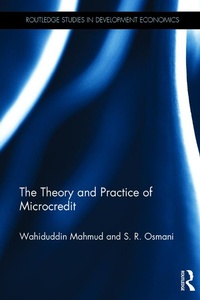
The Theory and Practice of Microcredit
Published on 4. October 2016
286 pages
978-1-315-41316-7 (ISBN)
Description

The remarkable speed at which microcredit has expanded around the world in the last three decades has piqued the curiosity of practitioners and theorists alike. By developing innovative ways of making credit available to the poor, the idea of microcredit has challenged many traditional assumptions about both poverty reduction strategies and financial markets. While this has encouraged new theorising about how microcredit works, the practice of microcredit has itself evolved, often in unpredictable ways, outpacing the development of theory.
The Theory and Practice of Microcredit aims to remedy this imbalance, arguing that a proper understanding of the evolution of practice is essential both for developing theories that are relevant for the real world and for adopting policies that can better realize the full potential of microcredit. By drawing upon their first-hand knowledge of the nature of this evolution in Bangladesh, the birthplace of microcredit, the authors have pushed the frontiers of current knowledge through a rich blend of theoretical and empirical analysis. The book breaks new grounds on a wide range of topics including: the habit-forming nature of credit repayment; the institutional strength and community-based role of microfinance institutions; the relationships between microcredit and informal credit markets; the pattern of long-term participation in microcredit programmes and the variety of loan use; the scaling up of microenterprises beyond subsistence; the "missing middle" in the credit market; and the prospects of linking micro-entrepreneurship with economic development.
The book will be of interest to researchers, development practitioners and university students of Development Economics, Rural Development, or Rural Finance, as well as to public intellectuals.
The Theory and Practice of Microcredit aims to remedy this imbalance, arguing that a proper understanding of the evolution of practice is essential both for developing theories that are relevant for the real world and for adopting policies that can better realize the full potential of microcredit. By drawing upon their first-hand knowledge of the nature of this evolution in Bangladesh, the birthplace of microcredit, the authors have pushed the frontiers of current knowledge through a rich blend of theoretical and empirical analysis. The book breaks new grounds on a wide range of topics including: the habit-forming nature of credit repayment; the institutional strength and community-based role of microfinance institutions; the relationships between microcredit and informal credit markets; the pattern of long-term participation in microcredit programmes and the variety of loan use; the scaling up of microenterprises beyond subsistence; the "missing middle" in the credit market; and the prospects of linking micro-entrepreneurship with economic development.
The book will be of interest to researchers, development practitioners and university students of Development Economics, Rural Development, or Rural Finance, as well as to public intellectuals.
Reviews / Votes
'Microcredit turns out to be a much more interesting (and controversial) proposition than first imagined. Mahmud and Osmani have had front row seats to the unfolding history of microcredit in Bangladesh - and they have played key roles in that history. Their inside perspective yields a clear-eyed view of the way that microcredit has played out in practice and where it is going. Their analysis, in turn, provokes us to revisit fundamental ideas about microcredit - and about finance in general.' - Jonathan Morduch, co-author of The Economics of Microfinance and Professor at the New York University Wagner Graduate School of Public Service, USA.'The field of microcredit has been characterized by extremely polarized views which frequently end up shedding more heat than light. So we are fortunate to have a serious and balanced analysis by two leading development economists from Bangladesh where microcredit has a long history. By offering a close reading of the evolving history of microfinance institutions in the country, by shifting the analytical focus from a narrow concern with enterprise to a broader focus on livelihoods and by factoring in an assessment of spill-over effects on the local economy, the authors offer a persuasive account of the strengths and limitations of microcredit.' - Naila Kabeer, co-author of Money with a Mission: Microfinance and Poverty Reduction and Professor of Gender and Development at the London School of Economics, UK.
'This valuable book addresses both the conceptual foundations of microcredit and its reality, with special reference to Bangladesh-in many ways the home of the modern microcredit movement. The authors show deep knowledge of the ground level institutional landscape, a facility with analytical approaches, and an appreciation of the interactions between the two. The book will be useful for students as an introduction to the topic, and as a refresher for practitioners to dip into.' - Ravi Kanbur, T.H. Lee Professor of World Affairs, International Professor of Applied Economics and Management and Professor of Economics, Cornell University, USA.
More details
Series
Language
English
Place of publication
London
United Kingdom
Publishing group
Taylor & Francis Ltd
Target group
College/higher education
Illustrations
22 Tables, black and white; 9 Line drawings, black and white; 9 Illustrations, black and white
File size
1,90 MB
ISBN-13
978-1-315-41316-7 (9781315413167)
Copyright in bibliographic data and cover images is held by Nielsen Book Services Limited or by the publishers or by their respective licensors: all rights reserved.
Schweitzer Classification
Other editions
Additional editions
Wahiduddin Mahmud | S. R. Osmani
The Theory and Practice of Microcredit
Book
12/2019
1st Edition
Routledge
€65.60
Shipment within 15-20 days
Wahiduddin Mahmud | S. R. Osmani
The Theory and Practice of Microcredit
Book
10/2016
1st Edition
Routledge
€208.00
Shipment within 15-20 days
Persons
Wahiduddin Mahmud was, until recently, Professor of Economics at the University of Dhaka and is currently Chairman, Economic Research Group, Dhaka, Bangladesh. He is a founder and former chairman of Palli-Karma Sahayak Foundation (PKSF), the apex wholesale microcredit lending institution in Bangladesh. He is also a Senior Country Advisor of International Growth Centre, the Chairman of the South Asia Network of Economic Research Institutes, and is on the Governing Board of the Global Development Network. He served as a member of the UN Committee for Development Policy and has held visiting positions at the World Bank, UN Development Programme (UNDP), International Food Policy Research Institute (IFPRI) and Institute of Development Studies (IDS) at Sussex University.
S. R. Osmani is Professor of Development Economics at Ulster University, UK. He obtained a PhD in economics from the London School of Economics and worked at the Bangladesh Institute of Development Studies, Dhaka, and at the World Institute for Development Economics Research, Helsinki, before joining Ulster University. He has published widely on issues related to employment and poverty, inequality, hunger, famine, nutrition, rights-based approaches to development, and development problems in general.
S. R. Osmani is Professor of Development Economics at Ulster University, UK. He obtained a PhD in economics from the London School of Economics and worked at the Bangladesh Institute of Development Studies, Dhaka, and at the World Institute for Development Economics Research, Helsinki, before joining Ulster University. He has published widely on issues related to employment and poverty, inequality, hunger, famine, nutrition, rights-based approaches to development, and development problems in general.
Content
List of figures
List of tables
Preface
1 Introduction
2 Microcredit in Bangladesh: how the credit markets work
3 Microcredit in Bangladesh: how the microcredit model works
4 Theories of microcredit: group lending and moral hazard
5 Theories of microcredit: adverse selection and repayment enforcement
6 When theory meets reality: testing the theories of microcredit
7 Economic impact of microcredit: the experience of Bangladesh
8 The patterns of loan use
9 The economics of microenterprise
10 Micro-entrepreneurship and economic development
References
Index
List of tables
Preface
1 Introduction
2 Microcredit in Bangladesh: how the credit markets work
3 Microcredit in Bangladesh: how the microcredit model works
4 Theories of microcredit: group lending and moral hazard
5 Theories of microcredit: adverse selection and repayment enforcement
6 When theory meets reality: testing the theories of microcredit
7 Economic impact of microcredit: the experience of Bangladesh
8 The patterns of loan use
9 The economics of microenterprise
10 Micro-entrepreneurship and economic development
References
Index
