

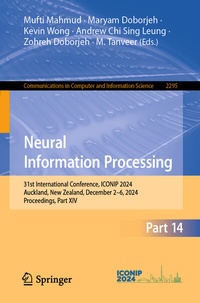
Neural Information Processing
Description

The sixteen-volume set, CCIS 2282-2297, constitutes the refereed proceedings of the 31st International Conference on Neural Information Processing, ICONIP 2024, held in Auckland, New Zealand, in December 2024.
The 472 regular papers presented in this proceedings set were carefully reviewed and selected from 1301 submissions. These papers primarily focus on the following areas: Theory and algorithms; Cognitive neurosciences; Human-centered computing; and Applications.
More details
Other editions
Additional editions

Content
Evaluating Large Language Models for Depression Detection in Text: A Comparative Analysis.- A Self-Sampling Data Augmentation Method for Low-Resource Neural Machine Translation.- RLKGE: Trustworthiness Measurement for Knowledge Graph Triples based on Reinforcement Learning.- Improving Empathetic Dialogue Generation via Response Attention Guidance.- Advanced Stock Market Forecasting Using Synergic of Sentiment Analysis and Association Rule Mining.- Exploit the Emotional Dynamics for Better Conversational Emotion Recognition.- Knowledge Enhanced Sentence-Level Fine-grained Relation Extraction via Multi-Agent Collaborative Generation.- Multi-view Adaptive Fusion Model for Multimodal Fake News Detection.- A Hybrid Prompt Method for Few-shot Named Entity Recognition.- GDBT: A Joint Model for Overlapping Relational Triple Extraction Based Global Detection and Bidirectional Tagging.- Retrieval-Enhanced Method Using Siamese Networks and Graph Kernel Functions for Code Summarization.- Enhancing Prompt Tuning for Smaller Pretrained Models via Knowledge Distillation.- AcademicMT: Boosting Performance of Large Language Models in Academic Translation.- Improving Neural Machine Translation by Multi-Step Teacher-Assisant Knowledge Distillation.- Enhancing Robustness in Large Language Models Prompting for Mitigating the Impact of Irrelevant Information.- TUMS: Enhancing Tool-use Abilities of LLMs with Multi-structure Handlers.- A Legal Case Matching Model Using Dual LLMs, BGE, and Mamba-2.- Fine-grained Controllable Generation of Latent Language Diffusion Models 252.- Can Dynamic Prompt Help Sentiment Style Transfer?.- Label-template based Few-Shot Text Classification with Contrastive Learning.- Curriculum Learning with Difficulty Division for Metaphor Detection.- Open-Source Large Language Models Excel in Named Entity Recognition.- Precision Where It Matters: A Novel Spike Aware Mixed-Precision
Quantization Strategy for LLaMA-based Language Models.- Hypergraph Contrastive Learning for Evidence-Aware Fake News Detection.- SmartPL: An Integrated Approach for Platoons Driving on
Mixed-Traffic Freeways.- Optimizing Training Speed with Novel Adaptive Exploration Technique
in Simulation and Real-World Robotics for Visual Path Following.- Modeling and Adaptive Sliding Mode Control of Autonomous Underwater Vehicles.- Causality-Aware Transformer Networks for Robotic Navigation.
