

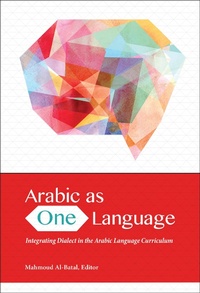
Arabic as One Language
Description

For decades, students learning the Arabic language have begun with Modern Standard Arabic (MSA) and then transitioned to learning spoken Arabic. While the MSA-first approach neither reflects the sociolinguistic reality of the language nor gives students the communicative skills required to fully function in Arabic, the field continues to debate the widespread adoption of this approach. Little research or evidence has been presented about the effectiveness of integrating dialect in the curriculum. With the recent publication of textbooks that integrate dialect in the Arabic curriculum, however, a more systematic analysis of such integration is clearly becoming necessary.
In this seminal volume, Mahmoud Al-Batal gathers key scholars who have implemented integration to present data and research on the method's success. The studies address curricular models, students' outcomes, and attitudes of students and teachers using integration in their curricula. This volume is an essential resource for all teachers of Arabic language and those working in Teaching Arabic as a Foreign Language (TAFL).
More details
Other editions
Additional editions
Person
Mahmoud Al-Batal is professor of Arabic at the American University of Beirut and former director of the University of Texas, Austin Arabic Flagship program and the Center for Arabic Study Abroad (CASA). He has published many articles and books on TAFL and is one of the authors of the Al-Kitaab Arabic Language Program.
Content
Preface
Acknowledgments
Part 1: Dialect Integration: A New Frontier for Arabic
1. Dialect Integration in the Arabic Foreign Language Curriculum: Vision, Rationale, and Models
Mahmoud Al-Batal
2. To Separate or to Integrate, That Is the Question: The Cornell Arabic Program Model
Munther Younes
3. Lessons Learned and Empirical Data from Twenty-Five Years of Using an Integrated Approach
R. Kirk Belnap
4. Preparing Arabic Teachers for Integration: The Edinburgh Model
Jonathan Featherstone
5. Preparing Students for the Future: Integrating Dialect and Standard into the Arabic Foreign Language Classroom
Elizabeth Huntley
Part 2: Curricular Models and Approaches to Integration
6. A Digitally Assisted Model of Integration of Standard and Colloquial Arabic Based on the Common European Framework
Manuela E. B. Giolfo and Federico Salvaggio
7. Developing a Genre-Based Curriculum to Teach Arabic Diglossia
Emma Trentman
8. An Integrated Moroccan and Modern Standard Arabic Curriculum for First-Year Learners
Mike Turner
9. Arabic Diglossic Speaking without Mixing: Practices and Outcomes from a Beginning Level
Sonia Shiri and Charles Joukhadar
Part 3: Integration and Skill Development
10. Integrating Colloquial Arabic into the Arabic L2 Curriculum: An Analysis of Learner Speech
Lama Nassif
11. Diverse Speaker Output in the Integrated Classroom: Trends and Interpretation
Thomas Leddy-Cecere
12. Effects of Integrated Arabic on Written Language Skills at West Point: A Longitudinal Study
Gregory R. Ebner and Jeff Watson
Part 4: Learners' and Teachers' Voices and Perspectives
13. Integrating Colloquial Arabic in the Classroom: A Study of Students' and Teachers' Attitudes and Effects
Martin Isleem
14. Dialect Integration: Students' Perspectives within an Integrated Program
Mahmoud Al-Batal and Christian Glakas
15. Integration and Students' Perspectives in a Multidialect Environment
Mai Zaki and Jeremy Palmer
16. Teachers' Voices: Analysis of Teachers' Speech and Teachers' Perspectives in Integrated Arabic Classrooms
Caroline Najour
List of Contributors
Index
