

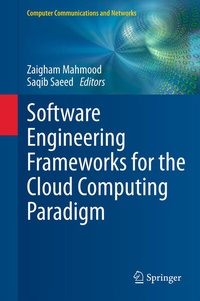
Software Engineering Frameworks for the Cloud Computing Paradigm
Description

Reviews / Votes
From the reviews:
"This book focuses on one of the hottest areas in computer science today. . It begins by addressing the impact of the cloud platform on the software development life cycle process, including designing and testing. . the book is very informative and helpful in introducing software engineering students as well as traditional application developers to cloud computing. Summing Up: Recommended. Upper-division undergraduates through professionals/practitioners." (F. H. Wild III, Choice, Vol. 51 (4), December, 2013)More details
Other editions
Additional editions
Persons
Dr. Zaigham Mahmood is a researcher in the School of Computing at the University of Derby, UK, and a Senior Technology Consultant at Debesis Education. His other publications include the successful Springer book Cloud Computing for Enterprise Architectures .
Dr. Saqib Saeed is an Assistant Professor in the Computer Science Department at Bahria University, Islamabad, Pakistan.
Content
Part I: Impact of the Cloud Paradigm on Software Engineering.- Impact of the Semantic Web and Cloud Computing Platforms on Software Engineering.- Envisioning Cloud-Induced Transformations in the Software Engineering Discipline.- Limitations and Challenges in Cloud-Based Applications Development.- Part II: Software Development Life Cycles for Cloud Platforms.- Impact of Cloud Services on Software Development Life Cycles.- Cloud-Based Development Using Classic Life Cycle Models.- Business Requirements Engineering for Developing Cloud Computing Services.- Testing Perspectives for Cloud-Based Applications.- Testing in the Cloud.- Part III: Software Design Strategies for Cloud Adoption.- Feature-Driven Design of SaaS Architectures.- Impact of Cloud Adoption on Agile Software Development.- Technical Strategies and Architectural Patterns for Migrating Legacy Systems to the Cloud.- Cloud-Aided Software Engineering.- Development of Cloud Applications in Hybrid Clouds with Support for Multi-Scheduling.- Part IV: Performance of Cloud-Based Software Applications.- Efficient Practices and Frameworks for Cloud-Based Applications Development.- A Methodology for Identifying the Relationships Between Performance Factors for Cloud Computing Applications.
