

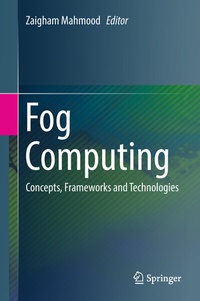
Fog Computing
Description

This authoritative text/reference describes the state of the art of fog computing, presenting insights from an international selection of renowned experts. A particular focus is provided on development approaches, architectural mechanisms, and measurement metrics for building smart adaptable environments. The coverage also includes important related topics such as device connectivity, security and interoperability, and communication methods.
Topics and features: introduces the core concepts and principles of fog computing, and reviews the latest research and best practice relating to fog/edge environments; discusses the vision for an Internet of Things (IoT) in terms of fog computing and other related distributed computing paradigms, such as cloud computing; presents a survey of the key issues and broader aspects of the fog paradigm, as well as the factors that affect adoption of fog computing; examines frameworks and methodologies for fog-based architecture design, improving performance, and measuring quality of experience; proposes tools and methodologies for analyzing large amounts of sensor data from smart city initiatives; describes approaches for designing robust services, management of data-intensive applications, context-aware data analysis, and vehicular networking; identifies potential future research directions and technological innovations in relation to distributed computing environments such as the IoT. This enlightening volume offers essential perspectives for researchers of distributed computing and computer networking, as well as for advanced undergraduate and graduate students pursuing interests in this area. Professional engineers seeking to enhance security and connectivity in their IoT systems will also find this work to be a valuable reference.More details
Other editions
Additional editions
Person
Prof. Dr. Zaigham Mahmood is a Senior Technology Consultant at Debesis Education UK and a Professor at the Shijiazhuang Tiedao University in Hebei, China. He also holds positions as Foreign Professor at NUST and IIU in Islamabad, Pakistan. He has previously served as a Reader (Associate Professor) at the University of Derby, UK, and Professor Extraordinaire at the North West University Potchefstroom, South Africa. Among his many publications are the Springer titles Smart Cities , Connected Environments for the Internet of Things , Software Project Management for Distributed Computing , Requirements Engineering for Service and Cloud Computing , Connectivity Frameworks for Smart Devices , Data Science and Big Data Computing , Cloud Computing: Challenges, Limitations and R&D Solutions , Continued Rise of the Cloud , Cloud Computing: Methods and Practical Approaches , Software Engineering Frameworks for the Cloud Computing Paradigm , and Cloud Computing for Enterprise Architectures .
